About British Ahwazi Friendship Society

The British Ahwazi Friendship Society was set up to promote solidarity and understanding between Europe and the Ahwazi Arab people.
Working with civil society organisations, the BAFS lobbies the British parliament, the European Union and the United Nations to bring attention to the plight of the Ahwazis. We work in partnership with democratic secularist Ahwazi groups, including the Ahwaz Studies Centre, the Ahwaz Human Rights Group and the Democratic Solidarity Party of Al-Ahwaz.
We also aim to bring education and skills to the Ahwazi diaspora, particularly in the UK, which is home to 3,000 Ahwazi Arabs. Our main focus is promoting an independent Ahwazi media by channelling grants to the Al-Ahwaz satellite television station and training Ahwazis in broadcast and print journalism.
We do not support separatism and oppose any invasion of Iran by foreign forces.
We condemn all forms of terrorism and have no links to any armed group.
We believe that through national non-violent civil disobedience supported by global solidarity, the people of Ahwaz and the rest of Iran can build a democratic and tolerant Iran where no-one is subject to persecution, racism or oppression on the grounds of race, religion, language or gender.
We uphold the notion of Iran as a multi-ethnic and multi-cultural country and believe that decentralisation, federalism and regional autonomy is essential to democracy in Iran.
About Al-Ahwaz
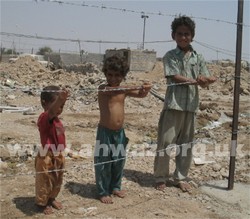
Over 4.5 million indigenous Ahwazi Arab people live in the territory known as al-Ahwaz or Khuzestan in present-day Islamic Republic of Iran. Prior to its annexation by Iran in 1925, al-Ahwaz was an autonomous, and at times, independent territory, with the majority of the population comprising indigenous Ahwazi Arab tribes.
For some 500 years, the region was called Arabistan by Persian rulers (signifying the territory's Arab character). The central government changed the territory's name to Khuzestan in 1936. Currently, Al-Ahwaz or Khuzestan is an area of 69,000 sq kilometres, which lies between South western Iran, bordering also Iraq, Kuwait and the Gulf.
Since 1925, indigenous Ahwazis have been brutalized and deliberately kept backward by the successive regimes of Iran. While their land accounts for over 80% of Iranian oil production, they benefit no revenue in return with half of Ahwazi people in absolute poverty and 80% of Ahwazi children suffering from malnutrition.
The Ahwazis believe that their right of self-determination would provide them with a suitable means of conflict resolution for the ongoing conflict with the Iranian government. The prospect of the full enjoyment of this right could provide the basis for negotiations and dialogue.
The overwhelming majority number of Ahwazis believe in non-violent means to establish a civil society based on the rule of law to foster democratic principles and values. However, frustration of the poor and the frustrations of the desperate Ahwazi youth is being viewed as the cause of the current violence in Khuzestan, including the destruction of oil installations. Iran, on the other hand, refuses to release thousands of Ahwazi political prisoners, many of whom have been incarcerated for more than 20 years, and continues its land confiscation programme.
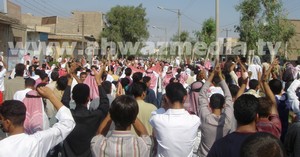
The Ahwazis have been subjected to the eradication of their national identity, culture, language, and customs; and are faced with forced assimilation and imposition of Persian language and culture. The Ahwazi children are being deprived of the use and study of their language. Ahwazis cannot wear their national and ethnic dresses and costumes in official centres. Therefore, a dominant Persian minority influences in every respect of life, political, social, cultural and economical of the Ahwazis. As such the legitimate demands of self determination of the Ahwazi people are often labelled as "separatist", "secessionist" or called "stooges of foreign countries" or "danger to security and territorial integrity".
The people of al-Ahwaz believe that the future of Iran as a modern and a progressive state, and a responsible member of the International community, could be guaranteed only through a voluntary association of all national groups constituting Iran; where they will have the legitimate opportunity to develop their respective cultures, languages, histories, economies, under an appropriate manifestation of self-determination and a system of good governance. The Ahwazis have often stated their desire to live in coexistence with all groups in present-day Iran and have advocated the realisation of a genuine democratic reform process to guarantee a form of the right of self-determination that ensures democracy, human rights and the rule of law.
British Ahwazi Friendship Society
P.O Box 2397
London, W8 4ZS
United Kingdom
Tel:
Email: Contact us for more information