




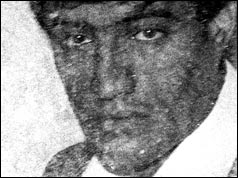
 A parole board is to rule on the release of the only surviving hostage taker involved in the 1980 Iranian Embassy Siege, Fowzi Badavi Nejad, in January.
An Ahwazi Arab and former member of the Democratic Revolutionary Movement for the Liberation of Arabistan, he was just 23 when he took part in the siege. The other hostage-takers were killed when the SAS stormed the building to release the hostages. Nejad was sentenced to life imprisonment (25 years) for conspiracy to murder in 1981. Two hostages were killed in the incident, but Nejad was never accused of murder. Some hostages testified that Nejad had prevented further killings towards the end of the siege.
Nejad's prison tariff was reduced from 25 to 22 years in 2004 by the Court of Appeal, with the backing of the Lord Chief Justice Lord Woolf. However, he remained in prison under the orders of the then Home Secretary David Blunkett, whose anti-terrorist legislation was recently ruled illegal by the courts.
Now aged 49, he is said to be a reformed character and his group has disbanded, which indicates that he is no longer a threat to the UK - the group had never targetted Britain or its interests. Ahmad Dadgar, one of the hostages, has campaigned for his release, claiming that Nejad has been adequately punished for his actions and calling on the British government to give him political asylum. Dadgar, a leading Iranian diplomat at the time, was shot during the siege.
His view is shared by Robin Horsfall, one of the SAS officers involved in freeing the hostages, who told the Guardian newspaper in February 2005: "I'd have no problem with him staying in this country. We should say, 'Well, you've paid your debt to society,' and we should let him get on with the rest of his life."
Prisoner officers have told the media that Nejad plans to campaign to prevent British Muslims from joining terrorist organisations. A prison officer told one newspaper that "Nejad has grown into a model inmate. He has educated himself, shown remorse and is eager to give something back to the country he once terrorised."
A parole board ruling for Nejad's release will cause problems for the British government's relations with Iran. He cannot be returned to Iran as he will be executed. In September, Iran's Foreign Ministry spokesman Mohammad Ali Hosseini accused the British government of hypocrisy for planning a "premature amnesty" for Nejad, who he claimed was a terrorist. At the same time, he also accused London's Metropolitan Police of supporting terrorism by allowed the British Ahwazi Friendship Society (BAFS) to demonstrate outside the House of Commons ( click here for further details ).
Tehran has already accused the UK of sponsoring Ahwazi separatism in Khuzestan. Iran claims that British and Americans are inflaming ethnic tension in the province. Demonstrations in April, which led to the killing of more than 160 unarmed Ahwazis by Iranian security services, were followed by a string of bomb attacks in Ahwaz City on 12 June. Ahwazi groups point out that the unrest is rooted in the Iranian government's campaign of ethnic cleansing and the impoverishment of Ahwazi Arabs, but Tehran is eager to blame the US and UK. The government is alleging foreign involvement in Khuzestan to back up its claim that the UK and US are preparing for an invasion of Iran and to justified continuing repression of Ahwazi Arabs.
BAFS spokesman Nasser Bani Assad said: "Nejad was a naive young man who was recruited into a terrorist organisation that was manipulated by Iraq during the Iran-Iraq War. At the time, Iraq was attempting to use long-standing grievances among Ahwazi Arabs to bolster its invasion of Iran. But the conflict between Iran and Iraq is over, Saddam Hussein is now a convicted criminal and Fowzi Nejad is a reformed individual.
"We condemn his past actions, but hope that the British people will understand that he does not pose a threat to them. In fact, his desire to campaign against terrorism will be invaluable in the campaign to stop young British Muslims making the same mistake as he did.
"We hope that in the event of any asylum application, the Home Office will ignore the rhetoric from Tehran and understand that if he is deported to Iran he will face torture and will be executed."
Labels: UK
permalink
keywords: ahvaz ahwaz ahwazi arabistan khuzestan khuzistan khuzestani arab arabistan iran iranian human rights security oil news ahmadinejad ethnic cleansing
.......................................................................................
