





The British Ahwazi Friendship Society (BAFS) website celebrates its first anniversary this week.
BAFS was created in December 2004 to lobby on behalf of Ahwazi Arabs and attract international attention to their cause, which has never received the coverage it deserves. The Ahwazis endure ethnic persecution, high levels of poverty, forced displacement and state terrorism, despite being indigenous to one of the world's most oil-rich regions.
BAFS's position has been to support Ahwazi groups that are committed to non-violent means to foster change and promote human rights, equality ande democracy in Iran. It works in collaboration with the Democratic Solidarity Party of Ahwaz (DSPA), the Ahwaz Human Rights Organisation (AHRO), the Ahwaz Studies Centre, the Ahwaz Education and Human Rights Foundation and the Unrepresented Nations and Peoples Organisation (UNPO).
The organisation's website was launched in March 2005 during the 61st session of the UN Commission on Human Rights, where Mansour Silawi-Ahwazi of the DSPA and Sanjukta Ghosh representing the Ahwaz Human Rights Organisation - both officers of the BAFS - met with UN officials to highlight issues affecting Ahwazis ( click here for article ).
The Ahwazis hit the headlines the following month when an intifada in Al-Ahwaz (Khuzestan) was brutally put down by security forces, leading to more than 160 deaths. The unrest was sparked by the leak of a letter written by former Vice President Mohamed Ali Abtahi calling for the "ethnic restructuring" of Khuzestan to reduce the Arab population from 70 per cent to 30 per cent of the province's total ( click here for article ). BAFS was the first website to report the uprising and to publish the translation of the letter.
In July, UNHCR's Special Rapporteur for Adequate Housing Miloon Kothari spoke of his outrage over the forced displacement of Ahwazi Arabs. Kothari's findings and BAFS's lobbying efforts prompted MEPs such as Paulo Casaca to include the condemnation of the forced migration of Ahwazi Arabs in a motion on Iran in October. The motion was sponsored by all the European Parliament's political groups and represented a major breakthrough for the Ahwazi lobbying campaign.
BAFS's coverage of the Ahwazi struggle against persecution and poverty has attracted plaudits from leading journalists, politicians, human rights groups and lobbyists. Many would not have known about the plight of the Ahwazis without BAFS's reputation as the only source of news and information on Ahwaz in the English language. Within just one year and with few resources, BAFS has helped transform the Ahwazi struggle from an unknown local dispute into an issue with important regional and international importance. Just this month, BAFS's work was acknowledged in feature articles in the Washington Times and Shaarq magazine, the UK's only English language publication the British Arab community.
BAFS Chairman Daniel Brett said: "The coming year will be crucial for the Ahwazi cause, which risks being drowned out by the arguments over Iran's nuclear programme. In the year ahead, we will be holding meetings at the House of Commons in London and the European Parliament and Commission in Brussels and will continue to build on our success in raising the profile of Ahwazis among NGOs, the United Nations and the media. We believe that the Ahwazis can only win freedom, peace and justice with international solidarity, not with bullets and guns."
Highlights of the past year:
Click on headline to view article
March 2005:
Ahwazi Women's Rights at the UN
Ahwazis with UNPO at Geneva
April 2005:
A tragic week in the history of Ahwaz
Ahwazi unity in EU appeal
May 2005:
HRW condemns Iran's violence in Khuzestan
Ahwaz hunger strike
Former Iranian MP in Ahwazi appeal
June 2005:
Ahwaz Arab voice at the UN in Geneva
Bodies of tortured Ahwazis found in Karoon River
Bomb blasts in Ahwaz City, Iran
UNPO Votes in Support of Indigenous Ahwazi Arabs in Iran
Ahwazi Arab Political Prisoner Released in Iran
July 2005:
Britain's Costain Group Condemned Over Iran Investment
Iran's Execution of Gays Part of Ethnic Repression
Anti-Government Demonstrations Erupt in Ahwaz
August 2005:
Iran: UN steps up criticism of minority discrimination
Iranian parliament rejects oil revenue to help poor
September 2005
Oil wells sabotaged in Ahwazi Arab homeland
Iran's mass arrest of Ahwazi tribal leaders and intellectuals
Basra Insurgency and Iran's Militarisation of Ahwaz
October 2005
Iran's Militarisation of the Shatt Al-Arab
Ahmadinejad reveals his policy in Ahwaz
Ahwaz link to Iran-backed insurgency in Iraq's Basra province
European Parliament Condemns Iran's Persecution of Arabs
Ahwaz bomb attack
Iran-UK Relations Threatened as New Bomb is "Discovered"
Abadan Refinery "Bomb Plot"
Iran uses Ahwazi Homeland as Terrorist Smuggling Route
November 2005
Amnesty Concern Over Bawi Brothers Death Sentence
UNHCR Highlights Plight of Ahwazi Refugees in Iraq
Details Emerge of Iran's Eid Crack-Down in Ahwaz
December 2005
Iran to build nuclear facility in Ahwazi Arab homeland
Iranian minorities parties meet with EU authorities
Majlis members protest at Karoon River diversion in Ahwaz
January 2006
Freed Ahwazi Arab prisoner speaks of treatment
Iran security forces attack Ahwazi anti-government protest
Iran's crack-down as Ahwaz Eid protests continue
Iran authorities arrest hundreds and shoot demonstrators in Ahwaz
Iran is ethnic cleansing Ahwazis claims senior European politician
Ahwaz bombings come after weeks of unrest
Joint Ahwazi statement against Ahwaz bomb attacks
Iran regime fails evidence test on Ahwaz bombings
Photos of two Ahwazis martyred by Iran
Khuzestan MPs threaten mass resignation over river diversion
February 2006
Ahwazi children in Iran's custody at risk of torture: Amnesty
Iran increases repression in Ahwaz
Iran sentences seven over Ahwaz bombings
Amnesty condemns Iran's treatment of ethnic minorities
Ahwaz tribal leader in appeal to Iran president
Bomb explodes in Ahwaz, no casualties Iran floods Ahwaz Arabs out of their homes
Ethnic Cleansing in full force in Iran
Al-Ahwaz witnesses three explosions
March 2006:
Regime executes Ahwazis, abuses pregnant woman and child
Executed: Young Ahwazi Men Hung
Bomb in Ahwaz City hours after executions
Mayor among the latest Ahwazis arrested by Iran regime
Iran's oil exports in danger due to rising Ahwaz unrest
Iran imprisons pregnant Ahwazi women and children - new details
Pictures: Ahwazi demonstration against Iranian fascism in London
Iran Slammed for 'Barbarian' Treatment of Ahwazi Arabs
Iran Criticised over Ahwaz Crisis at UNCHR
Teacher faces execution for bombings
Second attack on Ahwaz-Abadan pipeline?
Amnesty appeal for release of Ahwazi women and children
Labels: activism
permalink
keywords: ahvaz ahwaz ahwazi arabistan khuzestan khuzistan khuzestani arab arabistan iran iranian human rights security oil news ahmadinejad ethnic cleansing
.......................................................................................
 Amnesty International has launched an appeal for the release of Ahwazi children and pregnant women from Iranian custody.
The detention without trial of three women - Masoumeh Kaabi (28), Sakina Naisi (40) and Soghra Khudayrawi - and two four-year-old boys - Masoumeh's son Aimad and Soghra's son Zeidan - was first reported by the British Ahwazi Friendship Society (BAFS) earlier this month.
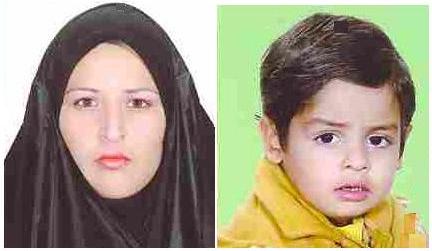 Masoumeh (pictured left with her son Aimad) is the wife of political activist Habib Nabgan, who has fled the country. He has received threats that his family will be tortured or killed if he does not return to Iran. Soghra's husband, Khalaf Derhab Khudayrawi, is also wanted by the authorities in connection with his political activities.
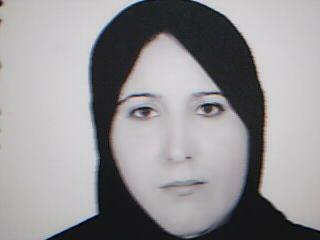 Sakina (right)was three months at the time of her arrest on 27 February and there are concerns for her health. She is the wife of Ahmad Naisi, a prominent political activist wanted by the authorities. Following her arrest, the authorities destroyed her husband's family home in the Sho'aybiyeh district of Ahwaz with bulldozers.
In its urgent action appeal on behalf of the women and children, Amnesty International said it "believes all five are very likely to be prisoners of conscience held solely in order to force their husbands and fathers to give themselves up to the Iranian authorities. As such they should be released immediately and unconditionally."
On 11 March, Ahwazis demonstrated outside the European Commission's offices in London, calling for their release ( click here for pictures ). The European Commission and European Parliament were given details on the treatment of Ahwazi women and children in Iranian custody, but the Commission and the European Parliament's delegation for Iran have refused to condemn the government's use of kidnap as a weapon against opponents.
BAFS spokesman Nasser Bani Assad said: "The EU and UN should send investigators to Al-Ahwaz immediately to assess the situation there. We believe that the UNCHR should refer Iran to the UN Security Council over the gross human rights violations and ethnic cleansing suffered by the Ahwazi Arabs. It is a situation that cannot be allowed to continue and the UN Convention on Human Rights must be upheld."
Labels: Amnesty , women
permalink
keywords: ahvaz ahwaz ahwazi arabistan khuzestan khuzistan khuzestani arab arabistan iran iranian human rights security oil news ahmadinejad ethnic cleansing
.......................................................................................
20 March, 2006
 The pipeline between Ahwaz City and Abadan, site of one of the world's largest oil refineries, was damaged and set on fire on Sunday.
This is the second time the pipeline has been damaged this month. On the night of 7-8 March, firefighters took at least 10 hours to put out a fire that an oil company official blamed on sabotage.
The latest blazed occurred near Om Alghizlan. Officials did not rule out sabotage.
The Abadan refinery has a capacity of 450,000 barrels per day, around 30 per cent of Iran's total refining capacity. Al-Ahwaz produces around 80-90 per cent of Iran's total crude output, representing at least 10 per cent of OPEC's output.
Pipelines in Al-Ahwaz (Khuzestan) were previously bombed in September 2005, temporarily disrupting supplies ( click here for story ). The regime also claimed in October that it had foiled an attempt to bomb Abadan refinery following major bomb attacks on Ahwaz City ( click for story ).
Al-Ahwaz (Khuzestan) has witnessed rising anger and despair among Ahwazi Arabs, who are being subjected to a large-scale land confiscation programme accompanied by violent repression, which many regard as a campaign of ethnic cleansing.
Ahwazi tribal leaders, journalists, businessmen, opposition activists, imams, teachers and even a mayor are among those being rounded up and imprisoned and executions have increased dramatically as the regime attempts to stamp out dissent. This has led to a climate of confrontation between the Ahwazis and the regime, with anti-government demonstrations and rioting regularly breaking out in Arab districts and city slums.
Ahwazi Arab tribes have in the past been co-opted by the government and armed to protect oil installations. However, the climate of unrest may have led some members of these tribes to attack the facilities they are employed to protect, using their in-depth knowledge of the pipeline infrastructure.
Nasser Bani Assad, spokesman for the British Ahwazi Friendship Society, said: "In their desperation, the Ahwazi Arabs are beginning to realise that regime could to be brought to its knees if oil supplies are disrupted by a relentless Ahwazi intifada, but the rest of the world will also feel the heat. The question is, will the international community intervene to stabilise the situation in Al-Ahwaz or will it wait until the problems have a direct impact on world oil supply?"
Labels: intifada
permalink
keywords: ahvaz ahwaz ahwazi arabistan khuzestan khuzistan khuzestani arab arabistan iran iranian human rights security oil news ahmadinejad ethnic cleansing
.......................................................................................
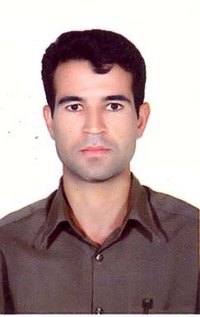 Teacher Risan Hassan Sawari, 30, is facing imminent execution, according to his relatives.
He was one of several men "confessing" on the state-owned Khuzestan TV to carrying out bomb attacks in October 2005. He is completely innocent of the charges levelled at him by the Iranian regime as he has been held in custody since September 2005 on unspecified charges.
Risan is among several men shown on Khuzestan TV in early March confessing to the attacks. Two have already been publically executed in Ahwaz City ( click here for report ).
Amnesty International has released an urgent action on behalf of Risan and eight other men, including Dr Awdeh Afrawi, a respected psychologist at Ahwaz's Shahid Chamran hospital ( click here for report ). Dr Afrawi's son was one of the two executed on 2 March. His daughter has since been murdered by security officials.
Risan's family fear that he will be executed in prison. Most executions in Ahwaz have been carried out in prison, without relatives being informed. Rioting followed the public executions carried out earlier this month and further hangings are likely to inflame the situation in Ahwaz.
Below is a picture of Risan (far left) with his pupils

Labels: death penalty
permalink
keywords: ahvaz ahwaz ahwazi arabistan khuzestan khuzistan khuzestani arab arabistan iran iranian human rights security oil news ahmadinejad ethnic cleansing
.......................................................................................
13 March, 2006
A group with ECOSOC status has brought the UNCHR's attention to the killings and torture of Ahwazi Arabs by the Iranian regime.
The International Federation for the Protection of the Rights of Ethnic, Religious, Linguistic and Other Minorities (IFPRERLOM) has drawn attention to the discrimination and marginalisation of more than four million Ahwazi Arabs. In a report submitted to the 62nd session of the Commission on Human Rights in Geneva, IFPRERLOM highlighted the killings of at least 61 Ahwazis by Iranian security forces during an Arab intifada in April 2005.
The organisation also mentioned reports published by human rights organisations such as Amnesty International and Human Rights Watch over the torture, ill-treatment, and incommunicado detention and incidents of arbitrary arrest and detention of Ahwazi Arabs, including children. The arrests came after Basiji militias attacked a crowd of Arab Shia worshippers during Eid-ul-Adha on 11 January. They had gathered peacefully to demand an end to the persecution of Arabs, poverty and unemployment among Arabs, and the release of political prisoners arrested since April 2005 following unrest in Khuzestan province.
The organisation's written statement "notes with concern the tension that has mounted among the Arab population since April 2005, after it was alleged that the government planned to disperse the country's Arab population or to force them to relinquish their Arab identity. As the cycle of violence in the Khuzestan province threatens to intensify, IFPRERLOM appeals to the Commission on Human Rights
> to call upon Iran to investigate incidents of arbitrary arrest and detention, reports of torture and ill-treatment;
> to call, as a matter of urgency, for a follow-up to the initial request by UN Special Rapporteur on extrajudicial, summary or arbitrary executions, to the government of Iran to arrange a visit; and
> to urge authorities in Iran to implement measures to promote and protect the rights of minorities, including the indigenous Ahwazi Arabs, Balochis and other minority groups in Iran."
Ahwazi groups have repeatedly called for Iran to be referred to the UN Security Council over its appalling human rights record, not just in relation to Ahwazis but other ethnic minorities, religious groups, women, the political opposition and trade unionists.
Labels: UN
permalink
keywords: ahvaz ahwaz ahwazi arabistan khuzestan khuzistan khuzestani arab arabistan iran iranian human rights security oil news ahmadinejad ethnic cleansing
.......................................................................................
The world's leading human rights organisation, Amnesty International, has lodged an appeal on behalf of nine Ahwazi Arabs sentenced to death.
The men have reportedly been convicted of carrying out bomb attacks in Ahwaz in October 2005, although Amnesty says the exact charges are unclear. There is confusion over the convictions as the trials are held in secret religious courts that are not usually open to the public. Government officials have also given conflicting statements on whether the nine men have been convicted in relation to the bombings. The Ministry of Justice claims that 45 people have been arrested in connection with the bombings, but statements by other officials suggest that the number could be higher.
Seven of the men have already been shown "confessing" on Khuzestan TV and have been convicted of "waging war on God, corruption on the earth and murder", according to some government officials, These crimes carry the death penalty, either by hanging or crucifixion.
Earlier this month, two Ahwazi Arabs - Mehdi Nawaseri and Muhammad-Ali Afrawi - were executed in a street in Ahwaz City after their "confessions" were read out on Khuzestan TV. Muhammad-Ali Afrawi's father, Dr Awdeh Afrawi, 52, is among those listed in Amnesty's appeal. He is a respected psychologist at Ahwaz's Shahid Chamran hospital, although the Iranian regime insists that he is a terrorist working on behalf of the British government. He was arrested shortly after the October 2005 bombings. Muhammad-Ali's sister was murdered by the security services during demonstrations that followed the executions.
Amnesty is concerned that Aliredha Salman Delfi, Ali Manbouhi, Jaafar Sawari, Ali Helfi, Nazem Burehi and Risan Sawari could also face execution in relation to the October 2005 bombings. However, Ali Manbouhi, Ali Helfi and Nazem Bureihi have been in custody since 2000, when they were arrested on charges of "insurgency" and each sentenced to 35 years' imprisonment. They were featured in the "confessions" footage on Khuzestan TV. Risan Sawari was previously arrested in April 2005, but then released and re-arrested in September 2005 - a month before the bombings. Jaafar Sawari and Aliredha Salman Delfi were also reportedly arrested in September 2005. Moslem al-Ha'i was mentioned during the "confessions" as a participant in the bombings, but it is not known when he was arrested, according to Amnesty.
The latest urgent action is the tenth issued by Amnesty on behalf of Ahwazi Arabs since last April's Arab intifada in Ahwaz.
Links:
Latest Amnesty International report on Ahwazis facing execution
Executed: Young Ahwazi Men Hung by Iranian Tyrants - British Ahwazi Friendship Society, 2 March 2006
Iran Slammed for 'Barbarian' Treatment of Ahwazi Arabs - British Ahwazi Friendship Society, 13 March 2006
Labels: Amnesty , death penalty
permalink
keywords: ahvaz ahwaz ahwazi arabistan khuzestan khuzistan khuzestani arab arabistan iran iranian human rights security oil news ahmadinejad ethnic cleansing
.......................................................................................
12 March, 2006
 Portuguese Socialist MEP Paulo Casaca, the head of the European Parliament's delegation to NATO, has slammed the Iranian regime's "show trials" of Ahwazi Arabs.
He has also raised the possibility that the regime itself is responsible for terrorist attacks in Ahwaz in order to blame them on the Ahwazis, who hard-liners have accused of "waging war on God".
Mr Casaca has previously called Iran's treatment of its Ahwazi Arab population "ethnic cleansing", referring to the regime's mass expulsions of the indigenous Arab population of Khuzestan.
Following the latest wave of executions, he told the British Ahwazi Friendship Society that "the Iranian show trials seem to be heading still further than its Stalinist predecessors: people are convicted for putting bombs in the city in spite the fact that they were in custody while the bombings take place. It might be a particularly cynical way to confess that the State planted the bombs in the first place.
"The totalitarian theocracy that is oppressing Iranians and exporting its fanatic model elsewhere in the Middle East is nowhere so bararian as with its own citizens of Arab descent. How can the Arab World go on ignoring this?"
The Henry Jackson Society (HJS), a British think tank on foreign policy, has also brought attention to the persecution of Ahwazi Arabs following the executions. In an article on the HJS website, the society's Greater Middle East Section Director Martyn Frampton says: "Determined to secure access to energy resources and to use Khuzestan as a launch-pad for interfering in Iraq (which it borders), Ahmadinejad's regime has stepped up pre-existing repression of the province's Ahwazi Arab population. Falsely accused of 'disloyalty' to the state, the Ahwazis have been exposed to abuses ranging from cultural repression to whole-scale 'ethnic cleansing.'"
Mr Frampton also states that Iranian accusations of British responsibility for the Ahwaz bomb attacks, however unfounded, "mean that the UK, whether it wants to be or not, is involved." He criticises the West's fixation on the nuclear issue, while ignoring the problem of human rights abuse in Iran.
On Saturday, Ahwazi Arabs staged a demonstration outside the European Commission's offices in London calling on the European Union to stop being silent on the Iranian regime's imprisonment of pregnant Ahwazi women and children. They called on the EU to help protect the Ahwazis from Iran's violent ethnic cleansing project.
Links
"While the West Fiddles, Iran's People ..." , Martyn Framption, Henry Jackson Society
Iran is ethnic cleansing Ahwazis claims senior European politician , British Ahwazi Friendship Society, 19 January 2006
Labels: activism , human rights
permalink
keywords: ahvaz ahwaz ahwazi arabistan khuzestan khuzistan khuzestani arab arabistan iran iranian human rights security oil news ahmadinejad ethnic cleansing
.......................................................................................
11 March, 2006
On Saturday, members of London's Ahwazi Arab community and human rights activists staged a protest against the Iranian regime's abuse of women outside the European Commission offices in Westminster.
Click here for more details on the imprisonment and oppression of Ahwazi women and children.
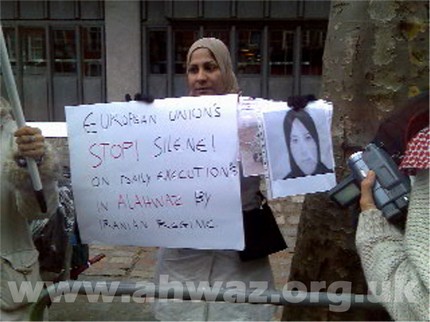
A protestor holds a placard saying "European Union Stop Silence on Daily Executions in Al-Ahwaz by Iranian Regime"
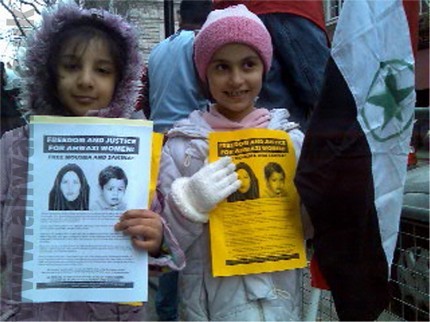
Girls protest against the imprisonment of Ahwazi children in Iran
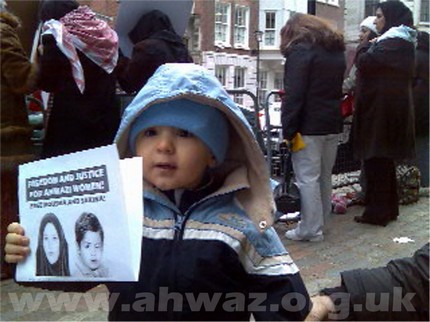
A baby boy carries a picture of four-year-old Aimad and his mother Masouma who are being held in Sepidar prison, where Ahwazis are known to have been tortured by the Iranian regime
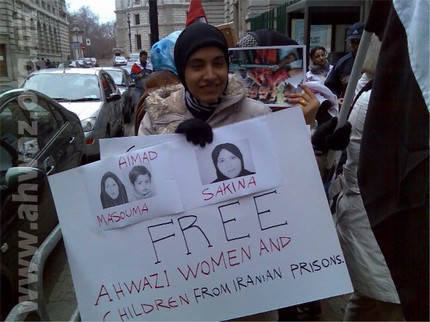
A protestor holds up the pictures of two Ahwazi women currently in prison, with a placard saying: "Free Ahwazi Women and Children from Iranian Prisons"
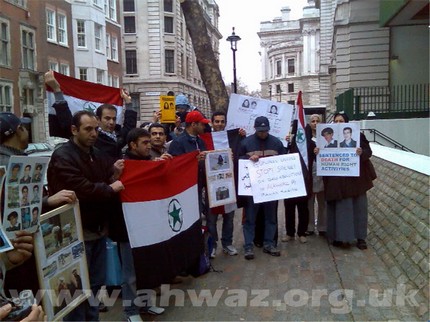
Ahwazis gather in front of the European Commission's offices with pictures of the many Ahwazis who have been sentenced to death for peacefully campaigning for human rights
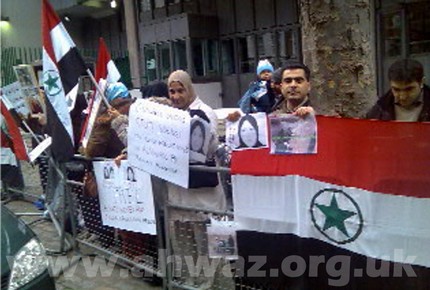
Protestors carrying Ahwazi flags and pictures of Ahwazi victims of the Iranian regime
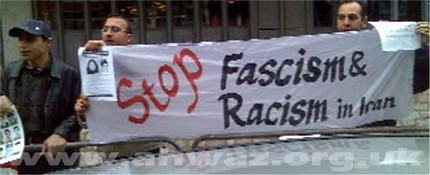
Protestors hold up a banner saying: "Stop Fascism and Racism in Iran"
Labels: activism
permalink
keywords: ahvaz ahwaz ahwazi arabistan khuzestan khuzistan khuzestani arab arabistan iran iranian human rights security oil news ahmadinejad ethnic cleansing
.......................................................................................
Ahwazi Arab women suffer a double persecution by the Iranian regime due to their ethnicity and their gender. The Ahwazi Arab homeland has more oil than the United Arab Emirates and more poverty than Palestine, due to the Iranian regime's policy of forced displacement, land confiscation, "ethnic restructuring" and Persianisation.
Groups representing Ahwazis are highlighting the plight of Ahwazi women currently imprisoned by the regime: Masouma Kaabi, Sakina Niassi, Fahima Ismail Badawi and Soghra Khdhirawi.
Fahimah, a teacher from the Kot Abdoudalla district, is another pregnant woman being held in prison. She is four months pregnant and is extremely ill with many fearing she could suffer a miscarriage. She is the wife of detainee Ali Madouri-Zadeh.
Meanwhile, 40-year-old Sakina (pictured), an imprisoned pregnant Ahwazi woman also being held in Sepidar prison, appears to have suffered a miscarriage as a result of her treatment in prison. Her life is at risk as she is reportedly receiving little or no medical treatment.
Soghra is being held with her four-year-old son Zeydan. She is in prison after her husband Khalaf Dehrab was murdered by the Iranian regime.
Masouma, 28, is being held in the notorious Sepidar prison with her four-year-old son Aimad (both pictured). The woman and baby have been imprisoned to punish Ahwazi political activist Habib Nabgani, Masouma's husband and Aimad's father, but Aimad is reported to have fallen ill due to poor prison conditions.
None of the women have been charged with any crime. The imprisonment of women and children is a tactic used by the regime to silence opposition among Ahwazi Arabs, who have staged a number of large anti-government demonstrations since last April's Ahwazi intifada when the regime lost control over parts of Al-Ahwaz in south-western Iran.
We demand that Ahwazi women and children be freed by the Iranian regime!
We demand that the European Union acts to protect Ahwazi women from oppression!
WE DEMAND AN END TO THE FASCIST ABUSE OF AHWAZI WOMEN!
WE DEMAND AN END TO THE EUROPEAN UNION'S SILENCE!
Ahwazi groups are staging a demonstration outside the European Commission's offices in Storey's Gate, London, on Saturday, 1pm-3pm
Click here to download a leaflet
Labels: human rights , women
permalink
keywords: ahvaz ahwaz ahwazi arabistan khuzestan khuzistan khuzestani arab arabistan iran iranian human rights security oil news ahmadinejad ethnic cleansing
.......................................................................................
10 March, 2006
Ahwazi activists will be holding a demonstration on Saturday outside the European Commission's offices in London to bring attention to the oppression of Ahwazi women under the Iranian regime. The demonstration will begin at 1pm at 8 Storey's Gate ( ).
Ahwazi women suffer persecution on the basis of their ethnicity as well as their gender. Al-Ahwaz (Khuzestan), the Ahwazi Arab homeland, has more oil than the United Arab Emirates and more poverty than Palestine.
Groups representing Ahwazis are seeking to bring attention to the plight of two Ahwazi women currently imprisoned by the regime: Masouma Kaabi and Sakina Niassi. Masouma, 28, is being held in custody with her four-year-old son Aimad (both pictured above) and her mother-in-law. The women and baby have been imprisoned to punish Ahwazi political activist Habib Nabgani, Masouma's husband and Aimad's father, but Aimad is reported to have fallen ill due to poor prison conditions.
Meanwhile, 40-year-old Sakina Niasi, an imprisoned pregnant Ahwazi woman, appears to have suffered a miscarriage as a result of her treatment in prison. Her life is at risk as she is reportedly receiving little or no medical treatment.
The imprisonment of women and children is a tactic used by the regime to silence opposition among Ahwazi Arabs, who have staged a number of large anti-government demonstrations since last April's intifada when the regime lost control over parts of Khuzestan province.
Click here to download a leaflet calling for Masouma and Sakina's freedom
permalink
keywords: ahvaz ahwaz ahwazi arabistan khuzestan khuzistan khuzestani arab arabistan iran iranian human rights security oil news ahmadinejad ethnic cleansing
.......................................................................................
09 March, 2006
The Iranian regime says it has arrested more than 50 Ahwazi Arabs in a clamp-down on anti-government protests in Al-Ahwaz (Khuzestan).
Officials claim the arrests are related to a series of bomb attacks, but the charges against those in custody are not known. The government claims that the latest people seized following massive protests against the persecution of Ahwazi Arabs are insurgents being directed by the British government.
Several figures in Iran, including former reformist presidential candidate Mustafa Moin, have suggested that the bombings are probably the work of the pro-regime Basij militias seeking to strengthen the power of hard-liners within the government.
There have been six executions of Ahwazi Arabs in the past week with three more likely within the next month ( click here for report ).
Labels: intifada
permalink
keywords: ahvaz ahwaz ahwazi arabistan khuzestan khuzistan khuzestani arab arabistan iran iranian human rights security oil news ahmadinejad ethnic cleansing
.......................................................................................
Iran is continuing its ritual executions in Al-Ahwaz (Khuzestan) with three men facing the death penalty for recent bombings - despite the fact that they were in prison at the time of the attacks.
Ali Manbouhi, Ali Helfi and Nazem Bereihi have been serving sentences of 35 years imprisonment since their arrests for insurgency in 2000. They were among those made to confess to recent attacks on Khuzestan TV last week. Reports suggest they are likely to face a retrial on charges of "waging war on God" and murder soon, with the regime seeking to make them scapegoats for unrest in Al-Ahwaz. The punishments for these crimes include hanging, crucifixion and amputation.
Nasser Bani Assad, spokesman for the British Ahwazi Friendship Society, said: "We know for certain that these men could not be responsible for the bomb attacks in Al-Ahwaz because they are being held in a high security prison. The retrial and execution of these men is illegal even by Iranian law. It is an act of vengeance and intimidation against the Ahwazi people and is part of the government's campaign to portray all Arabs as enemies of the state.
"President Mahmoud Ahmadinejad believes that once the Ahwazi Arabs are scared into silence, the ethnic cleansing programme in Al-Ahwaz can be stepped up to secure oil supplies and to tighten Iranian control over neighbouring areas of Iraq. But state violence is only inflaming the situation. Recent developments indicate that Ahwazi Arabs are now seeking to cripple the national economy by attacking oil installations."
Labels: death penalty
permalink
keywords: ahvaz ahwaz ahwazi arabistan khuzestan khuzistan khuzestani arab arabistan iran iranian human rights security oil news ahmadinejad ethnic cleansing
.......................................................................................
08 March, 2006
Oil pipelines supplying Abadan with crude caught fire on Tuesday night in what some believe was an act of sabotage coinciding with weeks of unrest among Ahwazi Arabs.
Abdolreza Asadi, head of the state-owned Karoun oil company, said that the fires near Ahwaz City were possibly the result of sabotage, although the fire service later reported that they were caused by a leak. The Abadan refinery has a capacity of 450,000 barrels per day, around 30 per cent of Iran's total refining capacity. Al-Ahwaz produces around 80-90 per cent of Iran's total crude output, representing at least 10 per cent of OPEC's output.
Pipelines in Al-Ahwaz (Khuzestan) were previously bombed in September 2005, temporarily disrupting supplies ( click here for story ). The regime also claimed in October that it had foiled an attempt to bomb Abadan refinery following major bomb attacks on Ahwaz City ( click for story ).
Al-Ahwaz has witnessed rising anger and despair among Ahwazi Arabs, who are being subjected to a large-scale land confiscation programme accompanied by violent repression, which many regard as a campaign of ethnic cleansing. Ahwazi tribal leaders, journalists, businessmen, opposition activists, imams, teachers and even a mayor are among those being rounded up and imprisoned and executions have increased dramatically as the regime attempts to stamp out dissent. This has led to a climate of confrontation between the Ahwazis and the regime, with anti-government demonstrations and rioting regularly breaking out in Arab districts and city slums.
Nasser Bani Assad, spokesman for the British Ahwazi Friendship Society, said: "We know that certain Ahwazi Arab tribal leaders have been politically co-opted and armed by the regime to help guard oil installations. Consequently, they have an in-depth knowledge of the pipeline infrastructure. If the current ethnic repression continues, it is possible that some members of these tribes will attack the installations they were meant to be guarding.
"Disruptions to oil supply in Ahwaz on a scale seen in the Niger Delta will have global economic and political implications. Any major attack on Abadan refinery, which represents over a quarter of Iran's refining capacity, or export pipelines from Al-Ahwaz's massive oilfields will hit the country's oil exports as well as its own fuel supplies. Oil prices will shoot through the roof if the Ahwazi intifada begins to strike at Iran's oil industry.
"In their desperation, the Ahwazi Arabs are beginning to realise that regime could to be brought to its knees if oil supplies are disrupted by a relentless Ahwazi intifada, but the rest of the world will also feel the heat. The question is, will the international community intervene to stabilise the situation in Al-Ahwaz or will it wait until the problems have a direct impact on world oil supply?"
Labels: intifada
permalink
keywords: ahvaz ahwaz ahwazi arabistan khuzestan khuzistan khuzestani arab arabistan iran iranian human rights security oil news ahmadinejad ethnic cleansing
.......................................................................................
A man identified as "Iraj D" was hanged in public on Monday in Shooshtar, Al-Ahwaz (Khuzestan). The man was charged with murder but no detail of his trial was released. This is the sixth execution in Al-Ahwaz within the space of a week. The Iranian regime does not publicise all the executions it carries out, with most carried out inside prison. The number of state killings is likely to be higher than reported.
Link: Executed: Young Men Hung by Iranian Tyrants
Labels: death penalty
permalink
keywords: ahvaz ahwaz ahwazi arabistan khuzestan khuzistan khuzestani arab arabistan iran iranian human rights security oil news ahmadinejad ethnic cleansing
.......................................................................................
07 March, 2006
Saeed Ehmidan, the mayor of Khalafiyeh (Khalafabad), is among the latest wave of arrests by the Iranian regime in Al-Ahwaz (Khuzestan). Khalafiyeh is a own of 30,000 inhabitants lying 58 miles south-east of Ahwaz City.
Others residents of Khalafiyeh arrested by the regime include:
Aref Ghali Hidari
Ahmed Karim Hidari
Mousa Karim Hidari
Hossien Saeed Moramadhi
Ahmed Saeed Moramazi
Yousef Saeed Moramazi
Hadi Badily (Madori)
Prominent Ahwazi Arabs are being rounded up in a wave of repression designed to stop the anti-government demonstrations in the province. Mass arrests and executions follow pressure on President Mahmoud Ahmadinejad from his hard-line supporters who have called for a tougher line on the political opposition. In February, Hamid Zangeneh, a non-Arab Majlis member for Khuzestan aligned with the former Revolutionary Guards commander Mohsen Rezaei, called for Arabs to be taught a lesson with high profile executions, martial law and a crack-down by security forces. In an interview with the Mehr News Agency, Zangeneh accused the regime of not doing enough, despite the killings and mass arrests of Arabs. President Ahmadinejad is under pressure from the religious establishment to prove his hard-line credentials by killing Arabs.
Labels: intifada
permalink
keywords: ahvaz ahwaz ahwazi arabistan khuzestan khuzistan khuzestani arab arabistan iran iranian human rights security oil news ahmadinejad ethnic cleansing
.......................................................................................
06 March, 2006
The Al-Ahwaz Democratic Popular Front (ADPF) has denied any involvement in bomb attacks in Ahwaz after being implicated in forced television "confessions" by two Ahwazis before they were executed last week.
The two men in their early 20s had read out scripts written by the regime that claimed they had contacted Ahwazi groups based in the UK and Canada, including the ADPF.
In response, the ADPF's spokesman Abu Sharif issued a statement claiming that the men had been tortured into confessing responsibility for the explosions in October 2005, which killed six people. He accused the Iranian government of carrying out the attacks to provide an excuse to impose martial law.
Despite its pro-independence line, which is at odds with many other Iranian minority parties who advocate decentralisation within a united Iran, the ADPF is not one of the groups that has claimed responsibility for attacks in Ahwaz. The Iranian government has failed to produce evidence linking any Ahwazi group or foreign governments to the attacks, beyond the "confessions" issued by the accused on Khuzestan TV.
Link: Iran regime shows forced confessions on television
Labels: intifada
permalink
keywords: ahvaz ahwaz ahwazi arabistan khuzestan khuzistan khuzestani arab arabistan iran iranian human rights security oil news ahmadinejad ethnic cleansing
.......................................................................................
Ahwazi activists are continuing to press for the release of 28-year-old Masouma Kaabi, her four-year-old son Aimad and her mother-in-law from prison. The women and baby have been imprisoned to punish Ahwazi political activist Habib Nabgani, Masouma's husband and Aimad's father, but Aimad is reported to have fallen ill due to poor prison conditions.
Human rights activists are also concerned about the well-being of 40-year-old Sakina Naisi, an imprisoned pregnant Ahwazi woman who appears to have suffered a miscarriage as a result of her treatment in prison. Her life is at risk as she is reportedly receiving little or no medical treatment.
 There have been a number of other reports of children under 16 as well as women being held in prison by the regime. The imprisonment of women and children is a tactic used by the regime to silence opposition among Ahwazi Arabs, who have staged a number of large anti-government demonstrations since last April's intifada when the regime lost control over parts of Khuzestan province.
Executions of Ahwazis have also risen, accompanied by forced confessions broadcast on the provincial television channel. Last week, two Ahwazi Arabs - Mehdi Nawaseri and Muhammad-Ali Afrawi - were publically hung in Ahwaz City accused of being responsible for bomb attacks in Ahwaz ( click here for further information ). The regime claimed they were Sunni extremists working for the British. Basiji militants loyal to the ruling mullahs chanted "Death to Israel! Death to America!" while watching the executions. The executions were followed by a bomb attack in the Kianpars district of Ahwaz City and rioting in the Hay Althwra (Shilangabad), Hay Zerghan, Zowyeh, Malasheyah and Koot Abdoula districts. Three other Ahwazis were executed in Karoon Prison two days previously.
The hangings were condemned by a number of human rights organisations, including the Arab Commission for Human Rights. Non-governmental organisations also criticised the men's trials, which they say failed to meet minimum international standards. Amnesty International, which opposes the death penalty, had led a campaign to prevent the men's execution.
The British Ahwazi Friendship Society (BAFS) has obtained exclusive pictures of Masouma and Aimad (above) and is distributing them to the United Nations, European Commission and British parliament to attract international attention to human rights abuses against Ahwazi Arabs.
BAFS spokesman Nasser Bani Assad said: "The EU and UN should send investigators to Al-Ahwaz immediately to assess the situation there. We believe that the UNCHR should refer Iran to the UN Security Council over the gross human rights violations and ethnic cleansing suffered by the Ahwazi Arabs. It is a situation that cannot be allowed to continue and the UN Convention on Human Rights must be upheld."
Labels: human rights , women
permalink
keywords: ahvaz ahwaz ahwazi arabistan khuzestan khuzistan khuzestani arab arabistan iran iranian human rights security oil news ahmadinejad ethnic cleansing
.......................................................................................
03 March, 2006
The British Ahwazi Friendship Society (BAFS) has received reports that throughout Friday demonstrators clashed with police in Hay Althwra (Shilangabad), Hay Zerghan, Zowyeh, Malasheyah and Koot Abdoula. There are reports of three deaths, including two women, at the hands of security forces. Four children are also reported to have been injured.
The protests came a day after two Ahwazi Arab men were hung in Ahwaz City. Khadija Afrawi, known as Foziya, the sister of Ali Afrawi, one of the men who was executed, was killed by the Iranian intelligence services. Her crime was to complain about her brother's execution. The hangings were followed hours later with a percussion bomb attack in the Kianpars area of Ahwaz City.
BAFS had warned that the execution of Ahwazi Arab political prisoners would result in an upsurge in anti-government protests. It also believes that the government will use any violence in Ahwaz as a pretext of vigilantism by Basiji forces, an intensification of its ethnic cleansing programme and a real danger of genocide against Ahwazi Arabs.
Ahwazi activists have called on the international community to seek ways of preventing further state violence and human rights abuses. However, they stress that the Ahwazi cause should not be used to justify military intervention in Iran. Ahwazis say they need a voice at an international level and do not want a return to the dark days of the Iran-Iraq War when their homeland attacked with chemical and biological weapons by the warring Iraqi and Iranian forces.
Labels: death penalty , intifada
permalink
keywords: ahvaz ahwaz ahwazi arabistan khuzestan khuzistan khuzestani arab arabistan iran iranian human rights security oil news ahmadinejad ethnic cleansing
.......................................................................................
A percussion bomb exploded in the Kianpars area of Ahwaz City just hours after two young Ahwazi Arab men were executed in Naderi Street.
No deaths or injuries were reported, although the windows of nearby buildings were smashed by the blast.
Meanwhile, the government's Islamic Republic News Agency has reported that the two men the regime had executed in Ahwaz City were responsible for the bomb attacks of 24 January ( click here for report ). However, reports from human rights organisations, including Amnesty International, indicate that they were arrested immediately following bomb attacks in October 2005 and had remained in custody.
On Wednesday evening, a Khuzestan TV programme broadcast "confessions" for recent bombings by a number of Ahwazis in custody, including Ali Monbohi, who has been in custody since 2000. The "confessions", which were read out by the accused, did not implicate any foreign government in the attacks.
Nasser Bani Assad, spokesman for the British Ahwazi Friendship Society, said: "The regime's inconsistency casts serious doubt on the veracity of its accusations against the Ahwazis currently in custody as well as its claims that the British were responsible - claims that have not been substantiated with any evidence. Despite arresting hundreds and killing scores of Ahwazi Arabs accused of terrorist acts, including pregnant women and children, the frequency of bomb attacks in Ahwaz is rising.
"If the international community ignores the plight of the Ahwazis, then many angry and impoverished Ahwazi Arabs are bound to look for solutions that are not peaceful. We have always stressed the need for non-violent resistance and international solidarity, but we fear that as state terrorism increase in Al-Ahwaz, more and more disillusioned and angry Ahwazi Arabs will seek methods that are not peaceful. For the sake of stability and peace in the Middle East, multi-lateral bodies must start addressing the Ahwazi issue or the situation will escalate further."
Labels: death penalty , intifada
permalink
keywords: ahvaz ahwaz ahwazi arabistan khuzestan khuzistan khuzestani arab arabistan iran iranian human rights security oil news ahmadinejad ethnic cleansing
.......................................................................................
02 March, 2006

Two young men - Mehdi Nawaseri and Muhammad-Ali Afrawi - were hung in Ahwaz today by the Iranian regime.
Mehdi and Muhammad-Ali, who the regime claims are Salafist extremists working on behalf of the British forces in Iraq, were met with taunts and jeers by Basijis shouting "Death to Israel!" Witnesses say they were gradually hoisted into the air, causing them to die slowly of strangulation. They were convicted of carrying out bomb attacks in Ahwaz on 15 October 2005 by a secret religious court. Their death sentences were approved by the Supreme Court. They died after months of torture and forced confessions by the regime. But they were not alone as Ahwazis in Al-Ahwaz and across the world held all-night vigils for the two young men.
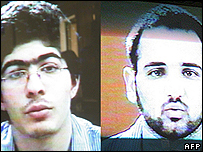 The night before, the two young men in their early 20s were shown on Khuzestan TV, frightened and barely able to speak as they were forced to confess to crimes many believe they did not commit (
right click here and save to download "confessions"
). Their executions follow the hanging of three Ahwazi Arabs in Karoon Prison on Tuesday morning.
The night before, the two young men in their early 20s were shown on Khuzestan TV, frightened and barely able to speak as they were forced to confess to crimes many believe they did not commit (
right click here and save to download "confessions"
). Their executions follow the hanging of three Ahwazi Arabs in Karoon Prison on Tuesday morning.
Amnesty International, Unrepresented Nations and Peoples Organisation (UNPO) Ahwaz Human Rights Organisation (AHRO) and the British Ahwazi Friendship Society (BAFS) sent out appeals to governments, UNHCR and Members of the European Parliament to intervene to stop the executions. However, the appeals were ignored as the international community tried to appease the Iranian regime to forge a deal on the nuclear issue. Human rights in Iran have been kept off the international agenda, despite reports of an upsurge in abuses and executions.
 President Ahmadinejad has cancelled public visits to Khuzestan on three occasions due to anti-government unrest among Ahwazi Arabs. He has been embarrassed and humiliated and now he is attempting to prove his hard-line credentials by taking violent revenge on Ahwazi Arabs. The unrest is the result of the government's ethnic cleansing of Khuzestan, which involves land confiscation, forced migration and enticements to non-Arabs from outside the province to settle in plush new residential areas. The regime is clearing out the Arabs to secure its control of local resources and to extend its political influence over Iraq.
BAFS spokesman Nasser Bani-Assad said: "This is yet another tragic day for the Ahwazi Arabs. We thank Amnesty, UNPO, AHRO and countless sympathetic individuals for trying their best to stop this latest wave of executions. The regime thinks that public hangings will weaken the resolve of Ahwazi Arabs to fight for their rights. They could not be more wrong. Every abuse strengthens the will to overcome oppression. Every bullet fired, every punch and kick of a prison guard, every man and woman that dies at the hands of the tyrants of Tehran will only help unite the Ahwazis.
"The Ahwazi Arab homeland is the most oil-rich region on the planet, but the Ahwazi Arabs are among the world's poorest people. They hold the destiny of Iran, the Middle East and the world in their hands. The more they are oppressed and impoverished, the stronger they will rise up and change the course of history. The international community will not be able to ignore the Ahwazi Arabs for long."
Labels: death penalty
permalink
keywords: ahvaz ahwaz ahwazi arabistan khuzestan khuzistan khuzestani arab arabistan iran iranian human rights security oil news ahmadinejad ethnic cleansing
.......................................................................................
The British Ahwazi Friendship Society (BAFS) has received footage from the Iranian government-owned Khuzestan TV showing the "confessions" of those accused of carrying out bomb attacks in Ahwaz, who were due to be publically executed in Ahwaz City on Thursday morning (download: http://www.tv.ahwazmedia.com/video/documentary/khuzestantv.rm - right click and save).
Those shown in the clip include two young men in their early 20s, Mehdi Nawaseri and Muhammad-Ali Afrawi, whose cases have been publicised by BAFS, the Ahwaz Human Rights Organisation and Amnesty International. Ali Monbohi, who was detained in 2000, is also featured. This indicates that he could also be facing execution, although he was in prison during the time of the recent bomb attacks in Ahwaz. There is no mention by the accused of British involvement in the attacks, despite the allegations made by Iranian officials that the bombers were British agents. Both Mehdi and Muhammad-Ali appear to be reading out their "confessions" and seem to be hesitating as they speak. It is widely believed that the men have been tortured, a common practice by Iranian interrogators.
BAFS has also received video phone clips of protests by Ahwazi Arabs against state terrorism and executions:
http://www.tv.ahwazmedia.com/video/Inside/film1.3gp
Labels: death penalty
permalink
keywords: ahvaz ahwaz ahwazi arabistan khuzestan khuzistan khuzestani arab arabistan iran iranian human rights security oil news ahmadinejad ethnic cleansing
.......................................................................................
01 March, 2006
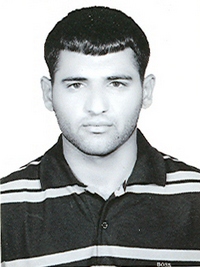 Reports from Iran claim that three Ahwazi Arabs were executed on the morning of 28 February and two are set to be publically executed on 2 March. Meanwhile, a critically ill pregnant woman and a four year old in ill health along with his mother and grand-mother are among those Ahwazis suffering Iran's over-crowded prisons, where the regime extracts confessions through torture.
Atef Nour Mosawi, Anwar Nour Mosawi and Jalal Nasser Al-Nasser were executed in Karoon Prison. The two awaiting execution are Mehdi Nawaseri (pictured) and Muhammad-Ali Afrawi, whose cases have been publicised by the British Ahwazi Friendship Society (BAFS). They are accused of carrying out the 15 October bombings in Ahwaz City and have been convicted of "waging war on God". Khuzestan province's deputy governor Mohsen Farokh-Nejad claims that they are "individuals with Wahabi and Salafist tendencies", an accusation that normally infers Saudi involvement. He has previously claimed that those responsible for the bombings were British agents, although the regime has not published any proof to support its allegations.
Amnesty International and the Unrepresented Nations and Peoples Organisation (UNPO) have both sent appealed for executions in Ahwaz to be halted. According to reports from Iran, the two men will be hung in Naderi Street in Ahwaz City. Five others - Aouda Afrawi (a medical doctor), Aliredha Salman Delfi, Ali Manbouhi, Raisan Sawari and Jafar Sawari - are also set for long prison sentences.
The regime claims they are the culprits for bomb attacks in Ahwaz, although human rights groups, former prisoners and relatives of prisoners claim that they have suffered torture. The regime has instructed the local television station to broadcast confessions made by the men during their incarceration.
Abuse of Ahwazi women and children - shame on the mullahs
Ahwazi activists are highlighting the cases of two female Ahwazi political prisoners: Sakina Naisi and Mousma Kaabi. Sakina is 40 years old and pregnant and reportedly bleeding, which suggests that she is in danger of a miscarriage and possible death due to her prison conditions.
Masouma is 28 years old and is the wife of Habib Nabgani, an Ahwazi political activist. She is in prison with her four year-old son Aimad, who is reportedly ill due to poor conditions, and her mother-in-law.
BAFS spokesman Nasser Bani Assad said: "The Iranian regime is depraved. It treats Ahwazi Arab women as less than dogs. Anyone in the regime with any sense of decency should release Sakina, Mousma, Aimad and Mousma's mother-in-law immediately and see that they receive adequate medical treatment. It must stop executions and torture and release all Ahwazi political prisoners immediately. The UNCHR and the European Commission must send fact-finding teams to Al-Ahwaz to assess the human rights situation there.
"The world is obsessed with Iran's nuclear programme, but is ignoring the human rights of the people of Iran and ignoring the brutal ethnic cleansing of Ahwazi Arabs. What options are the Ahwazis left with when their appeals go unheeded and their women are brutalised by the Iranian regime's policy of state terrorism and ethnic cleansing?"
Labels: death penalty , women
permalink
keywords: ahvaz ahwaz ahwazi arabistan khuzestan khuzistan khuzestani arab arabistan iran iranian human rights security oil news ahmadinejad ethnic cleansing
.......................................................................................
