




 Iran's leading prisoners rights activist,
Emad Baghi
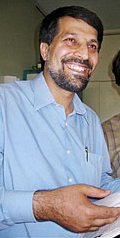
(pictured), has revealed that 26 year old Abdolamir Farjolah Kaab was on hunger strike when he was executed in Karoun Prison on Tuesday (24 January) along with three other Ahwazi Arab political prisoners.
Iran's leading prisoners rights activist,
Emad Baghi
(pictured), has revealed that 26 year old Abdolamir Farjolah Kaab was on hunger strike when he was executed in Karoun Prison on Tuesday (24 January) along with three other Ahwazi Arab political prisoners.
Baghi told Radio Farda that he had staged a hunger strike to protest at being held in solitary confinement for nearly a year. He claimed that all four were held in solitary confinement from the time of their arrest in March 2006 until they were executed.
Baghi also accused the Iranian government of breaking Islamic rules which forbid executions during the month of Moharam.
The names of executed are:
1. Mohammad Lazem Kaab Pour, 28, married with one child, student at Shushtar University
2. Abdolamir Farjolah Kaab, 26, married, student at Shushtar University
3. Alireza Asakereh, 24, single from Maashur (Mahshahr)
4. Khalaf Dohrab Khanafereh (Khazirawi), 34, married with one child from Falahieh
They were among 10 men, all members of Iran's Arab minority, who were reportedly convicted of being mohareb (at enmity with God). On 10 January 2007, three leading UN human rights experts - Philip Alston, UN Special Rapporteur on extrajudicial, summary or arbitrary executions; Leandro Despouy, UN Special Rapporteur on the independence of judges and lawyers, and Manfred Nowak, UN Special Rapporteur on torture - jointly called on the government of Iran to "stop the imminent execution of seven men belonging to the Ahwazi Arab minority and grant them a fair and public hearing." These UN experts stated: "We are fully aware that these men are accused of serious crimes. However, this cannot justify their conviction and execution after trials that made a mockery of due process requirements."
Labels: death penalty
permalink
keywords: ahvaz ahwaz ahwazi arabistan khuzestan khuzistan khuzestani arab arabistan iran iranian human rights security oil news ahmadinejad ethnic cleansing
.......................................................................................
24 January, 2007
 The following is a report published by Amnesty International following
today's execution of four Ahwazi Arabs
.
The following is a report published by Amnesty International following
today's execution of four Ahwazi Arabs
.
Click here to download the full report :
Amnesty International deplores the executions earlier today of four Iranian Arab men and fears for the lives of other prisoners who are reported to have been sentenced to death recently following unfair trials.
Amnesty International is calling on the Iranian authorities to halt executions and to ensure that all persons in detention are protected from torture or other ill-treatment.
Executions in Iran continue at an alarming rate. Amnesty International recorded at least 177 executions in 2006 but fears that the true figure may have been much higher. At least four of those executed were under the age of 18 at the time of their alleged offences, including one who was still under 18 at the time of his execution. In 2006, Iran and Pakistan were the only countries in the world to continue to execute child offenders (although Pakistan enacted in 2000 the Juvenile Justice System Law which abolished the death penalty for people under 18 at the time of the crime in most parts of the country). To date in 2007, Amnesty International has recorded 19 further executions in Iran, including the four today.
Those executed today are believed to be Khalaf Derhab Khudayrawi, Alireza Asakreh, Mohammad Jaab Pour and Abdulamir Farjallah Jaab. They were among 10 men, all members of Iran's Arab minority, who were reportedly convicted of being mohareb (at enmity with God) on account of their alleged involvement in bomb attacks in October 2005 which caused the deaths of at least six people and wounded more than a hundred others, in Ahvaz city, Khuzestan province. According to reports, the four men were denied access to their lawyers in the two weeks prior to their execution.
On 9 November 2006, the head of the Khuzestan Prosecutor's Office, Abbas Ja'afari Dowlat Abadi, reportedly announced that the Supreme Court had upheld the death sentences against 10 of some 19 people allegedly responsible for bomb explosions in Khuzestan and that they would be publicly hanged.
On 13 November 2006, an Iranian local television station, Khuzestan TV, broadcast a documentary film which included the "confessions" of nine of these men, In the programme, the 10 people, said to be members of a group named Al-e Naser, (a little-known Iranian Arab militant group that is not known to have been active since the time of the Iran-Iraq war in the 1980s) "confessed" to their involvement in the bomb explosions.
On 19 December 2006 three of them, Abdullah Suleymani (initially named as Alireza Asakreh), Malek Banitamim and Ali Matouri Zadeh were reportedly executed in prison in Khuzestan province.
The bodies of the executed men were reportedly not handed to their families for burial, and there were fears that they would be buried in an unmarked, mass grave site called La'natabad (Place of the damned). The security forces reportedly prevented people from visiting the families to offer condolences.
According to information received by Amnesty International, on or around 2 March 2006 and prior to his arrest, Khalaf Derhab Khudayrawi was reportedly shot by the security forces before being taken away. His family believed he had died in the shooting, but a few days later received a phone call from the authorities informing them that he had been transferred to the Sepidar detention centre. His wife, Soghra Khudayrawi, and four-year-old son Zeidan were detained in Ahvaz on 7 March 2006 and both remain in detention. (See UA 65/06, MDE 13/028/2006, 23 March 2006) and Iran: Appeal Case: Four Ahwazi Arab women and two children: Prisoners of conscience, AI Index: MDE 13/059/2006, 17 May 2006, http://web.amnesty.org/library/Index/ENGMDE130592006?open&of;=ENG-IRN). Mohammad Jaab Pour and Abdulamir Farjallah Jaab were also reportedly arrested on 7 March 2006.
At the beginning of June 2006, seven lawyers who appeared before Branch 3 of the Revolutionary Court representing the defendants, including some of the 10 who were sentenced to death, reportedly wrote formally to the court's president complaining about irregularities in the trial. They said they were notified of their clients' trial date only one to two days in advance, instead of the minimum of five days stipulated in Article 64 of the Civil Procedure Code, and could not study their clients' files fully; that they were not allowed to meet in private with their clients although they had requested this and despite the head of the judiciary's stated assurance on 20 May 2006 that "nobody has the right to issue an order in contravention of the law and to deprive the accused of the right of visits by their family and lawyer. They must know quite clearly that they may request private meetings with their lawyers." The lawyers also complained that trial sessions have been held without other defendants or their lawyers being present.
Following this letter, in October 2006 at least five of the lawyers were summoned to appear before Branch 7 of the Revolutionary Court in Ahwaz for allegedly endangering national security by complaining about the legal proceedings and publishing their protest on Ahwazi websites abroad. They were reportedly released upon payment of bail.
On 10 January 2007, three leading UN human rights experts - Philip Alston, UN Special Rapporteur on extrajudicial, summary or arbitrary executions; Leandro Despouy, UN Special Rapporteur on the independence of judges and lawyers, and Manfred Nowak, UN Special Rapporteur on torture - jointly called on the government of Iran to "stop the imminent execution of seven men belonging to the Ahwazi Arab minority and grant them a fair and public hearing." The seven individuals concerned were reported to be Abdulreza Sanawati Zergani, Qasem Salamat, Mohammad Jaab Pour, Abdulamir Farjallah Jaab, Alireza Asakreh, Majed Alboghubaish Khalaf and Derhab Khudayrawi. These UN experts stated: "We are fully aware that these men are accused of serious crimes⦠However, this cannot justify their conviction and execution after trials that made a mockery of due process requirements."
Labels: death penalty
permalink
keywords: ahvaz ahwaz ahwazi arabistan khuzestan khuzistan khuzestani arab arabistan iran iranian human rights security oil news ahmadinejad ethnic cleansing
.......................................................................................
 The Iranian regime has hung four more Ahwazis, according to official news agencies.
The four were among up to 20 men recently sentenced to death for undermining national security and "waging war on God" following trials that were condemned as flawed by UN officials , human rights organisations , the British government , the European Commission and the European Parliament . The executions, which reportedly took place last night and this morning in Karoun prison in Ahwaz City, bring the total number of Ahwazis recently killed by the regime to seven; three were executed in December .
The Iranian government has not announced the names of those it has executed. The British Ahwazi Friendship Society (BAFS) has received the name of one of those executed, Mohammad Ka'ab Pour, and unconfirmed reports on the names of the other three.
The executions are related to the Iranian regime's attempts to suppress dissent through state terrorism and the execution of opposition and human rights activists. Ahwazi Arabs endure African levels of poverty, although their homeland produces 80-90 per cent of Iran's oil.
Labels: death penalty
permalink
keywords: ahvaz ahwaz ahwazi arabistan khuzestan khuzistan khuzestani arab arabistan iran iranian human rights security oil news ahmadinejad ethnic cleansing
.......................................................................................
19 January, 2007
The European Commission and the British government have condemned Iran's persecution of Ahwazi Arabs and the imminent execution of opposition activists in recent letters to British Green MEP Dr Caroline Lucas.
Commissioner Benita Ferrero-Waldner , who has responsibility for external affairs, said that the European Union is examining intervening in the cases of men recently condemned to death for their alleged role in bomb attacks in Ahwaz. The planned executions were last week condemned by UN experts , which described their trials as making "a mockery of due process requirements." Amnesty International, Human Rights Watch and Iranian human rights activists such as Emad Baghi have also criticised the trial process of the men accused of "waging war on god."
Ferrero-Waldner added that the EU and its diplomatic missions in Tehran were "monitoring as closely as possible the situation in the Khuzestan province" and acknowledged that Ahwazi Arabs "do indeed suffer from discrimination."
Kim Howells , the British foreign minister with responsibility for the Middle East, said that the British government was "deeply concerned about the situation of religious and ethnic minorities in Iran, who continue to face discrimination and intimidation." He stated that the British government was "closely following" the cases of Ahwazi political prisoners sentenced to death. He added that "we have concerns about the conduct of their trial including whether it was held secretly behind closed doors, whether a jury was present, and whether defendants had adequate access to lawyers before the trial."
Labels: death penalty , EU , human rights , UK
permalink
keywords: ahvaz ahwaz ahwazi arabistan khuzestan khuzistan khuzestani arab arabistan iran iranian human rights security oil news ahmadinejad ethnic cleansing
.......................................................................................
18 January, 2007
Journalist Wayne Madsen has withdrawn his allegation that the British Ahwazi Friendship Society (BAFS) is a front for British intelligence following an email exchange with BAFS Chairman Daniel Brett.
On 12 January, the Wayne Madsen Report (WMR) published an article that alleged that three explosions near Mohammara/Khorramshahr were attacks by members of the Ahwazi Arab ethnic group sponsored by British intelligence. It quoted unnamed intelligence sources in support of its claims. Mr Brett emailed the website, pointing out that the explosions were related to landmine clearance operations, as confirmed in the Iranian media and by Iranian officials . He also stated that while the Iranians have blamed British intelligence for ethnic unrest and bomb attacks by Ahwazi Arabs, the Iranian government has failed to provide any proof to support its allegations.
WMR subsequently published Mr Brett's letter, along with a rebuttal in defence of its claims. The website stated that BAFS was an "obvious British intelligence operation." It also referred to Mr Brett's previous involvement in the Fabian Society, which was described as "the vanguard for the neo-imperialistic 'New Labor' policies of Tony Blair." Additionally, it called into question the source of BAFS funding, claiming that the organisation was a tool of "neocon grand conspirators."
Following a subsequent exchange of correspondence between Mr Madsen and Mr Brett, the WMR website stated that it was "satisfied that the Ahwazi exile movement is not in total collusion with U.S. and British intelligence in fomenting attacks in Khuzestan province in southwestern Iran."
Mr Brett gave Mr Madsen assurances that BAFS had not had contact with a research company associated with the US Marines Corps, that it is not in contact with the Mujahideen-e Khalq Organisation (MKO), that it is not in contact with any military intelligence organisation of any country and that it rejects violence as a means to advancing the minority rights agenda in Iran. BAFS said that it relies only on donations from private individuals from within the Ahwazi diaspora and receives no funds from non-governmental organisations or governments.
In his email, Mr Brett said that "we oppose any invasion of Iran," adding that "we do not believe that democracy can be imposed by force from outside Iran." He stressed that "our campaigns to stop the execution of Ahwazi opposition activists have attracted support from across the political spectrum in the UK, including the backing of senior members of the progressive left."
Following the WMR's retraction of its allegations against Mr Brett and against BAFS, Mr Brett said: "We are grateful that Mr Madsen has looked at the evidence and has the courage to make a public statement that his initial assessment of our organisation was wrong. While he may still have suspicions about US and British policies in the Middle East, he acknowledges that BAFS is independent of these governments' foreign policy agenda. BAFS hopes that Mr Madsen will speak directly to members of the Ahwazi opposition in exile to increase his knowledge of the region's political climate."
permalink
keywords: ahvaz ahwaz ahwazi arabistan khuzestan khuzistan khuzestani arab arabistan iran iranian human rights security oil news ahmadinejad ethnic cleansing
.......................................................................................
10 January, 2007
 The Unrepresented Nations and Peoples Organisation (UNPO) has reiterated
calls by the Ahwaz Human Rights Organisation (AHRO) for an end to mass executions of Ahwazi Arabs
(
click here for UNPO's press release
).
The Unrepresented Nations and Peoples Organisation (UNPO) has reiterated
calls by the Ahwaz Human Rights Organisation (AHRO) for an end to mass executions of Ahwazi Arabs
(
click here for UNPO's press release
).
The international lobbying organisation, which supports self-determination for ethnic groups across the world, said that it "remains deeply concerned by the routine execution of Iran's dissidents, strongly condemns the use of public hangings, and has repeatedly called for international action to address the deteriorating human rights situation faced by the Ahwazi Arab population of Iran."
It has written an appeal to Dr. Javier Solana, the Secretary-General/High Representative of the Council of the European Union, Pierre de Boissieu, the Deputy Secretary-General of the Council of the European Union, and Mr. Robert Cooper, Director-General of External Economic Relations and Politico-Military Affairs at the Council of the European Union, to:
- urge Iran to immediately halt the executions of the latest seven Ahwazi Arab activists sentenced to death;
- urge Iran to afford all Ahwazi Arab activists presently detained; free, fair, and open trails, in a manner consistent with international standards of justice;
- call upon the Iranian Government to cease in its use of public executions as a weapon of free and oppression.
Labels: death penalty , EU
permalink
keywords: ahvaz ahwaz ahwazi arabistan khuzestan khuzistan khuzestani arab arabistan iran iranian human rights security oil news ahmadinejad ethnic cleansing
.......................................................................................
 The following is a press release published by the United Nations High Commissioner for Human Rights in relation to Iran's planned execution of seven Ahwazi Arabs:
Philip Alston, the Special Rapporteur on extrajudicial, summary or arbitrary executions, Leandro Despouy, the Special Rapporteur on the independence of judges and lawyers, and Manfred Nowak, the Special Rapporteur on torture, issued the following statement today. They are independent experts appointed by the United Nations Human Rights Council.
The UN Human Rights Council's experts on extrajudicial executions, independence of judges and lawyers and torture today urged the Iranian Government to "stop the imminent execution of seven men belonging to the Ahwazi Arab minority and grant them a fair and public hearing".
Philip Alston, Leandro Despouy and Manfred Nowak, the UN independent experts, called the attention of the international community to the case of ten men who were sentenced to death after a secret trial before a court in the Western Iranian province of Khuzestan. Their lawyers were not allowed to see the defendants prior to their trial, and were given access to the prosecution case only hours before the start of the trial. The lawyers were also intimidated by charges of "threatening national security" being brought against them. The convictions were reportedly based on confessions extorted under torture. "The only element of the cases of these men not shrouded in secrecy was the broadcast on public television of their so-called confessions", Mr. Nowak said.
The three experts indicated that in August and November 2006 they had sent two letters to the Government of Iran, bringing the allegations of unfair trial and torture to their attention and seeking clarification from the Government. No reply to these letters was ever received. Instead, three of the ten men were executed in mid-December with no regard for the strong concerns expressed on behalf of the UN Human Rights Council. On Monday, January 8th, 2007, the authorities in Ahwaz, the capital of Khuzestan province, informed the families of the remaining seven men that they would be executed within the next few days.
"We are fully aware that these men are accused of serious crimes, including having tried to overthrow the Government after having received military training by US and UK forces", the UN experts said. "However, this cannot justify their conviction and execution after trials that made a mockery of due process requirements."
Background
The three men executed in mid-December (named Malek Banitamim, Abdullah Solymani and Ali Matorizadeh) and the seven reportedly at imminent risk of execution are part of a larger group of Ahwazi Arab activists arrested in June 2006 on charges of having received training in Iraq by officials of the United States of America, the United Kingdom and Israel, and of having returned to Iran with the intent to destabilize the country, to sabotage oil installations and to overthrow the Government. In the course of the year 2006, the Special Rapporteur on summary executions has raised his concerns regarding unfair trials on capital charges also with regard to ten other Ahwazi Arabs, as well as other Iranians accused of violently opposing the Government. The Government of Iran systematically refuses to provide information and engage in a dialogue on these matters with the independent experts, violating its obligations under the procedures of the Human Rights Council.
Iran is a party to the International Covenant on Civil and Political Rights and has a legal obligation to respect its provisions. While the Covenant allows it to retain the death penalty, it prescribes that capital punishment can only be imposed after a trial satisfying the strictest fair trial guarantees. These include the right to a fair and public hearing, the right not to be compelled to confess guilt, and the right to "adequate time and facilities for the preparation of ones defence" with the assistance of a lawyer of ones own choosing.
In their correspondence with the Government of Iran, the UN independent experts also expressed their concerns about the charges of "mohareb", which according to the reports published in the Iranian media triggered the application of the death penalty in these cases. "Mohareb" can be translated as "being at war with God" and is a charge typically waged by the Iranian prosecutors against political dissidents, critics of the Government and persons accused of espionage. This charge carries with it the risk of being too vague to satisfy the very strict standards of legality set by international human rights law for the imposition and execution of the death penalty.
The names of the seven men at imminent risk of execution are reported as Ghasem Salami, Mohammad Lazem Kaabpour, Abdolamir Farjolah Kaab, Alireza Asakereh, Majad Albughbish, Abdolreza Sanawati, and Khalaf Dohrab Khanafereh.
UNHCR press release
Labels: death penalty , UN
permalink
keywords: ahvaz ahwaz ahwazi arabistan khuzestan khuzistan khuzestani arab arabistan iran iranian human rights security oil news ahmadinejad ethnic cleansing
.......................................................................................
09 January, 2007
 The following article by Daniel Brett was
published by Media Star World
, India's leading Urdu language news features agency
The following article by Daniel Brett was
published by Media Star World
, India's leading Urdu language news features agency
President Mahmoud Ahmadinejad's four-day visit to Khuzestan last week was billed as a chance to listen to the province's largely Arab population. Instead, it turned out to be a long lecture on foreign policy with little attempt to address the causes of ethnic unrest in the province.
Ahmadinejad's series of rallies were more notable for what he did not say rather than what he did say. There was the usual litany of anti-Western slogans, the defiance of the UN Security Council's censure of Iran over its nuclear programme, the promise of Israel's demise and the Nazi Holocaust denial that has become the hallmark of the Ahmadinejad administration. Yet Arabs in the audience - who are a minority in Iran but a majority in Khuzestan - did not hear a single word on the civil unrest that has gripped the province since April 2005, when riots broke out after a letter detailing an "ethnic restructuring" plan for Khuzestan was publicised on Al-Jazeera.
 There were signs that the audience wanted to hear more about more fundamental issues. Hand-written placards were held up indicating that a massive presence of Bassij paramilitaries had not completely suppressed dissent. One read "Inflation, unemployment, insecurity, drug addiction have desiccated the tree of the revolution" and another said "Oil and gas are our rights. Eliminate youth unemployment."
For most Ahwazis, industrial development has not led to a significant increase in living standards.
Situated in south-western Iran and bordering Iraq, Khuzestan is the motor of the Iranian economy providing 80-90 per cent of its oil output. However, the province's indigenous Ahwazi Arabs are among the poorest people in Iran, with Arab districts enduring African levels of child malnutrition, the highest illiteracy rates in the Middle East and low life expectancy. Poverty has fuelled social problems, such as drug addiction which has led to a dramatic rise in HIV/AIDS. Added to these economic problems are the lingering effects of Iraq's invasion of Khuzestan, which most Ahwazi Arabs opposed and died in their thousands resisting. Saddam promise of sovereignty for Ahwazi Arabs was never realised, but he left in his wake wrecked cities, poisoned soil and the world's largest minefields which continue to claim lives - although the sacrifices of the Arabs who bore the brunt of Iraqi aggression is rarely recognised and little has been done to clear up the devastation of one of history's most bloody wars. The lack of progress in human development reveals that the promises of the Islamic Revolution - which the local Arab population had embraced in 1979 - have never been fulfilled, despite the province's immense resources.
Economic inequality is underpinned by racial discrimination and state terrorism. In its first assessment of the Ahmadinejad administration's human rights record, Amnesty International pointed out that Arabs have been "denied state employment under the gozinesh criteria." The report adds that "hundreds of Arabs have been arrested since President Ahmadinejad's election and many are feared to have been tortured or ill-treated. The prisons in Khuzestan province, and particularly the capital Ahvaz, are reported to be extremely overcrowded as a result of the large numbers of arrests ... Children as young as 12 are reported to have been detained with adult prisoners. Some of those detained are believed to have been sentenced to imprisonment or death after grossly unfair trials before Revolutionary Courts."
One of the main issues is land expropriation, which Amnesty says is "so widespread that it appears to amount to a policy aimed at dispossessing Arabs of their traditional lands. This is apparently part of a strategy aimed at the forcible relocation of Arabs to other areas while facilitating the transfer of non-Arabs into Khuzestan and is linked to economic policies such as zero interest loans which are not available to local Arabs." Members of the European Parliament have described it as ethnic cleansing on a par with Serbia's purges on Kosovar Albanians.
The problem of land confiscation predates Ahmadinejad's appointment as president. The UN Special Rapporteur on the Right to Adequate Housing Miloon Kothari appeared to be incredulous at the treatment of Ahwazi Arabs. In an interview following his visit to Iran in July 2005: "...when you visit Ahwaz ... there are thousands of people living with open sewers, no sanitation, no regular access to water, electricity and no gas connections ... why is that? Why have certain groups not benefited? ... Again in Khuzestan, ... we drove outside the city about 20 km and we visited the areas where large development projects are coming up - sugar cane plantations and other projects along the river - and the estimate we received is that between 200,000-250,000 Arab people are being displaced from their villages because of these projects. And the question that comes up in my mind is, why is it that these projects are placed directly on the lands that have been homes for these people for generations?"
The Ahwazi Arabs are looking over the waters to their brothers in the rich oil emirates and wondering what life would be like if they had sovereignty over their homeland, which contains oil reserves of over 100 billion barrels - more than the combined total of Kuwait and the UAE. They are also looking back to the time when Khuzestan was known as Arabistan, a large part of which was ruled from Mohammara, now Khorammshahr. The British guaranteed protection for the local Arab ruler Sheikh Khazal Khan in return for an agreement for exclusive oil rights for the Anglo-Persian Oil Company (now British Petroleum), which discovered oil there in 1909. Khazal's rule was ended in 1925 when Reza Pahlavi's forces overran Arabistan, deposed him and imposed direct control. By then, the British had decided that a powerful central government led by a Persian monarch was essential to halt the tide of Bolshevism and ditched their support for the Mohammara sheikhdom.
The Ahwazi Arabs are well aware of what might have been had Pahlavi not imposed central government control over their homeland. Most regard the resurrection of Arabistan as a pipedream. Separatism is unpopular not because Iran's Arab population is overcome by mindless patriotism. The Ahwazis are predominantly Shia, which makes them unworthy of solidarity in the minds of the Sunni dominated Arab League. This may change due to geopolitics and an intensive campaign of international lobbying by Ahwazi groups in recent years. In an article in the British Arab magazine Sharq, Arab Media Watch chairman Sharif Hikmat Nashashibi wrote that "Iran's indigenous Arabs are one of our best-kept secrets, so well kept that many, if not most of us, do not know they exist. Just try finding any information about them on the Arab League website. Nonetheless, due to current internal and external factors, we may be hearing a lot more about them in the near future."
The Iranian intelligentsia is already warning that failure to deal with the crisis in Khuzestan threatens to turn it from a provincial problem into a regional geopolitical issue. In a recent letter to the Chief of the Judiciary Ayatollah Hashemi Shahroudi appealing for clemency for a number of Ahwazis sentenced to death, writer and human rights advocate Emad Baghi wrote that "this kind of ethnic issue is rooted in the poverty, socio-economic deprivation and accumulated repressed complexes abused and exploited by foreign forces. It is only through the pursuit and implementation of justice that ethnic concerns can be addressed and external manipulation neutralized." He urged Shahroudi to end the mass execution of Ahwazis "to avoid costly mistakes not only in relation to the taking of precious human lives but also because of the real potential for heightening and injuring ethnic sensibilities." Yet the regime does not appear to be listening to Baghi's words of wisdom. Instead, Baghi has been repeatedly detained for criticising government policy.
There is little evidence to support Tehran's claims that foreign governments are involved in ethnic unrest. Senior Ahwazi leaders are mindful of the dangers of aligning too closely with the interests of foreign powers, following Saddam Hussein's attempts to rouse Arab nationalism in the province during the Iran-Iraq War (1980-88). However, their attempts to organise constitutional means to advance the Arab rights agenda have been violently suppressed by the government. The Lejnat Al-Wefaq (Reconciliation Committee), which formed in 1999 and won a seat in the Majlis and control of Ahwaz City Council, was recently outlawed and founding members were executed. In doing so, the government undermined the Ahwazis' rights to equality, as outlined in Article 15 of the Iranian Constitution.
Meanwhile, an underclass of disenfranchised and enraged young men is seeking out new ideologies to oppose the regime and neighbouring Iraq has become a breeding ground for armed radicalism. There are ominous signs that Khuzestan is becoming a new front in Iraq's nascent civil war, with videos of armed men purportedly from a resurrected Ahwazi Arab nationalist militant group, the Mohieldain Al-Naser Martyrs Brigade, speaking of revenge against the Iranian regime with Iraqi accents. And the moderate Ahwazis are being sidelined due to the growing confrontation between the government and the ethnic Arabs. The rhetoric of militant groups has given unhappy young men a sense of hope that Ahmadinejad's lectures on Israel and nuclear weapons have failed to provide.
The regime would be wise to study the story of Prophet Daniel, who was buried in Khuzestan. He warned the Babylonian Nebuchadnezzar that regardless of his kingdom's wealth, it had feet of clay that could be broken with just a small stone. Iran's feet of clay - its oil reserves - are in Khuzestan and if the level of despair compels Ahwazi youth to seek martyrdom, the province's Arabs could strike a blow that could topple the Islamic Republic.
Labels: features
permalink
keywords: ahvaz ahwaz ahwazi arabistan khuzestan khuzistan khuzestani arab arabistan iran iranian human rights security oil news ahmadinejad ethnic cleansing
.......................................................................................
The Iranian government is continuing to defy a UN General Assembly resolution passed in Novemeber that condemned "increasing discrimination and other human rights violations against ethnic and religious minorities" by announcing that a further seven Ahwazi Arab opposition activists will be executed in coming days.
Three Ahwazis were executed in Karoun Prison on 19 December, despite a worldwide campaign backed by the European Parliament which called for a halt to the execution of Arab rights activists ( click here for more information ). Iranian prisoners' rights activist Emadeddin Baghi has also called for a stop to the hangings, claiming that the charges against the men are dubious, the trial process is flawed and the executions are fuelling instability in the Ahwaz region ( click here for his appeal to the Chief of the Judiciary ).
A further three Ahwazis were sentenced to death on 1 January . According to the Tehran-based Ahwazi journalist Youssef Azizi Bani Torouf, 20 Ahwazi Arabs have been sentenced to death in the past year with many more waiting trial for political crimes that carry the death penalty ( click here to read his article in Arabic ).
The Ahwaz Human Rights Organisation (AHRO) has published the names of seven Ahwazis facing imminent execution:
1. Ghasem Salami, 41, married with 6 children
2. Mohammad Lazem Kaabpour, 28, married with one child, student at Shushtar University
3. Abdolamir Farjolah Kaab, 26, married, student at Shushtar University
4. Alireza Asakereh, 24, single from Maashur (Mahshahr)
5. Majad Albughbish, 30, single from Maashur (Mahshahr)
6. Abdolreza Sanawati, 34, married from Ahwaz City
7. Khalaf Dohrab Khanafereh, 34, married with one child from Falahieh
The families of these men were informed yesterday by Iranian authorities in Ahwaz that they will be executed within the next few days.
On November 13, 2006, the Iranian regime broadcast videos of forced confessions of 11 Ahwazi Arabs on Khuzestan TV but due to international outrage including unanimous condemnation by the European Parliament in a resolution on November 16, 2006, as well as a resolution by 48 British MPs and similar actions by other EU parliaments, the execution of the these men was delayed.
There is a great deal of confusion over the number of Ahwazis who are facing execution
On 9 November, Abbas Jaafari Dowlatabadi, head of Iran's Judiciary in the southern province of Khuzistan, told the Islamic Republic News Agency that Iran's Supreme Court had confirmed the execution sentence of at least 19 of the 35 Iranian Arabs sentenced to death by Ahwaz Revolutionary Court.
These men have been found guilty of allegedly bombing oil installations at Southwestern Iranian province of Khuzesatn (al-Ahwaz), homeland to 5 million Ahwazi-Arabs. All men are members of the persecuted Ahwazi community. The trials were deeply flawed, according to Amnesty International, Human Rights Watch and other international and Iranian human rights organizations. All the evidence points to their innocence.
All these men were tortured into making false confessions. Their lawyers were not allowed to see them prior to their trial and they were given the prosecution case only hours before the start of the trial, which was held in secret. The lawyers for the condemned men - all but one of whom are Ahwazi Arabs - have been arrested for complaining about the illegal and unjust nature of the men's trials. They have been charged with threatening national security.
Although Ahwazi-Arab homeland in Iran's Khuzestan province is one of the most oil-rich regions in the world and represents up to 90 per cent of Iran's oil production. Yet this community endures extreme levels of poverty, unemployment and illiteracy. Ahwazis are subjected to repression, racial discrimination and faced with land confiscation, forced displacement and forced assimilation.
The convictions are evidently arbitrary and are intended to collectively punish Ahwazi Arabs for opposing the system of apartheid that they are subjected to.
Peaceful opposition among Ahwazi Arabs to the Iranian regime's racist policies of ethnic cleansing has been brutally suppressed. Since April 15, 2005 the beginning of the Ahwazi Intifada (Uprising), over 25,000 Ahwazis were arrested, at least 131 were killed and over 150 were disappeared (believed to have been tortured and killed by Iranian security forces). Iranian authorities level accusations against the USA, Great Britain and Israel as the cause of Ahwazi demands for democracy, social and economic justice. Ethnic cleansing against Iranian-Arabs in Khuzestan has intensified since the mid-1990s, particularly following the election of Mahmoud Ahmadinejad in 2005.
Labels: death penalty
permalink
keywords: ahvaz ahwaz ahwazi arabistan khuzestan khuzistan khuzestani arab arabistan iran iranian human rights security oil news ahmadinejad ethnic cleansing
.......................................................................................
08 January, 2007
The Director of the Ahwaz Chamber of Commerce has condemned central government policy for hindering industrial development in the Arab-majority Khuzestan province.
According to the Mehr News Agency , the trade official accused state-owned companies of seriously damaging the local economy and the environment. He added that Iranian industries in the province were unable to compete with countries like Turkey on the neighbouring Iraqi market due to excessive government interference, which was undermining the quality of industrial products.
The official's attacks on government policy come just days after a four-day tour of the province by President Mahmoud Ahmadinejad, who claimed that he had endorsed a number of projects for industrial development. The vote of no confidence indicates that few industrialists have faith in the Ahmadinejad administration's economic policies.
Ahwazi Arabs have also accused the government of economic mismanagement and racial discrimination, which have created African levels of poverty in one of the world's most oil-rich regions.
Labels: poverty
permalink
keywords: ahvaz ahwaz ahwazi arabistan khuzestan khuzistan khuzestani arab arabistan iran iranian human rights security oil news ahmadinejad ethnic cleansing
.......................................................................................
 Intelligence reports relating to Iranian support for terrorism in Iraq have confirmed information issued by the British Ahwazi Friendship Society (BAFS) almost two years ago (
click for article
).
Intelligence reports relating to Iranian support for terrorism in Iraq have confirmed information issued by the British Ahwazi Friendship Society (BAFS) almost two years ago (
click for article
).
Strategic Policy Consulting in Washington has stated that the Al-Qods Force, which is run by Iran's quasi-military Islamic Revolutionary Guards, is "stepping up terrorism and encouraging sectarian violence in Iraq," using the Fajr Garrison (pictured) in the Arab populated city of Ahwaz, southwestern Iran, as a base of operations. The Al-Qods Force trains militants in manufacturing improved explosive devices and finances and organises pro-Iranian militias in Iraq. According to SPC, the Iraq network is under the command of Jamal Jaafar Mohammad Ali Ebrahimi, who is also known as Mehdi Mohandes. He is alleged to have been responsible for planning the bombing of the US and the UK embassies in Kuwait in the 1980s and has been on Interpol's wanted list since 1984.
BAFS has also received credible information relating to the Iranian regime's attempts to recruit Ahwazi Arabs to fight in Iraq as well as money laundering through offshore accounts to fund terrorist operations.
Related articles:
Ahwaz used as a terrorist base - March 2005
Basra Insurgency and Iran's Militarisation of Ahwaz - September 2005
Iran's Militarisation of the Shatt Al-Arab - October 2005
Safeguarding the Ahwazi Arabs is essential for achieving a stable and democratic Middle East - December 2005
Labels: terrorism
permalink
keywords: ahvaz ahwaz ahwazi arabistan khuzestan khuzistan khuzestani arab arabistan iran iranian human rights security oil news ahmadinejad ethnic cleansing
.......................................................................................
02 January, 2007
By Abu Mousa Zafrani, British Ahwazi Friendship Society
President Mahmoud Ahmadinejad's tour of the Arab majority province of Khuzestan was portrayed by the official media as an opportunity to listen to local people's concerns and problems. But he used his speech to a crowd of Bassij loyalists in the restive Ahwaz City as an opportunity to grandstand Iran's foreign policies amid the country's growing international isolation.
During Ahmadinejad's speech in Ahwaz, one brave demonstrator held up a placard which read: " Inflation, unemployment, insecurity, drug addiction have desiccated the tree of the revolution ." The protestor was reminding the President that the monarchist regime was overthrown on the issue of social justice, suggesting that his conflict with the UN Security Council has little relationship with the desire of the population to rid itself of poverty.
Ahmadinejad's Ahwaz lecture on Tuesday showed that the Iranian regime believes that it can convince the masses to forget their suffering and rally in to its defence in the face of supposed Western aggression. His strategy is to use the nuclear issue as a bargaining chip in international affairs while instilling fear in the Iranian population of foreign aggression to quash internal dissent.
Ahmadinejad told his followers: " The Iranian nation is wise and will stick to its nuclear work and is ready to defend it completely ." Whether or not the nuclear programme is for peaceful purposes, the Ahwazi Arabs are convinced that they will be denied any benefits of the nuclear programme, just as the regime denies them a share in the revenues generated by the oil extracted from land that was confiscated from them.
No Ahwazi is prepared to defend the nuclear programme, which is not going to provide them with any material benefits. Many see the construction of nuclear plants on their land as just another industry that excludes them from employment. Some fear that the government's reckless attitude towards safety - Khuzestan's oil pipelines are notoriously unsafe while industrial pollution in the province is causing birth defects and contributing to low life expectancy - puts them at immediate risk of a Chernobyl-style disaster.
The nuclear programme involves the construction of Russian-designed nuclear power plants on their homeland - a region that experiences frequent earthquakes, with tremours measuring 3.7 on the Richter scale reported just days ago .
Most Ahwazis question the need for expensive nuclear power stations when their homeland's oil resources are more than enough to cater for power needs. Rather than spend oil revenue on social development in Khuzestan, the Iranian regime is sinking it into an unnecessary nuclear programme that is leading to international isolation that benefits no-one.
Ahmadinejad's speech made no reference to growing unrest among local Ahwazi Arabs who face an aggressive campaign of land confiscation that many human rights observers have termed "ethnic cleansing". Nor did it address endemic poverty among Arabs, whose homeland contains more oil reserves than Kuwait and the UAE combined - over 100 billion barrels. The response of the Ahmadinejad administration to those who have highlighted the suffering of Ahwazi Arabs is to ignore, silence, intimidate, arrest, torture and execute them.
In his Ahwaz lecture, Ahmadinejad insists that his priority is the humiliation of the West and that the British and Americans are responsible for all of humanity's problems . Are the British responsible for the 80 per cent child malnutrition rate in Khuzestan's Arab populated district of Dasht-e-Azadegan? Are the British driving Ahwazi Arabs off their farms into city slums and a life of unemployment and poverty and drug addiction? Are the British diverting Khuzestan's rivers, causing ecological devastation in the marshlands along the Shatt Al-Arab? Are the British jailing the young children of Ahwazi Arab opposition leaders to pressure them into confessing to crimes they did not commit? The suffering of the Ahwazi Arabs and other minorities in Iran has nothing to do with the British - it is the responsibility of the regime itself.
The subtext of Ahmadinejad's Ahwaz speech was a demand that Ahwazi Arabs abandon all opposition activism for the sake of the nuclear programme. Or they will face serious consequences. It is no coincidence that three Ahwazi activists were sentenced to death on the eve of the President's visit to the provincial capital . He was sending a message - put up and shut up, or you and your families will suffer.
The Lejnat Al-Wefaq - a reformist Arab group that sought constitutional means to advance Arab minority rights - was banned after its candidates won all but one seat on Ahwaz City Council in 2003. Its members were rounded up and imprisoned and last month a leading founding member, Ali Matouri Zadeh, was executed in Karoun Prison - just a day after pro-Ahmadinejad candidates faced a severe drubbing in the local elections. His wife Fahima and baby daughter Salma, who was born in prison in March 2006, remain in prison. A further three Ahwazis were sentenced to death on Monday as a prelude to Ahmadinejad's visit.
Ahmadinejad has not even listened to calls from Khuzestan's elected representatives. The conservative-dominated Majlis (parliament) has voted down on three occasions proposals by Khuzestan's MPs for a modest 1.5 per cent of oil revenues to be redirected to assist poverty alleviation and employment generation in the province.
Ahmadinejad portrays Iran as a model for the Muslim world, but Ahwazi Arabs are comparing themselves to the lifestyles enjoyed by their Arab brothers on the other side of the Gulf. And they are thinking to themselves, is the loss of their dignity a price worth paying for Tehran's confrontation with the international community?
In his speech, Ahmadinejad said without any sense of irony that " rulers who stand against their nation ... will face similar fate " as Saddam Hussein. Last month, students staged demonstrations at Amir Kabir University of Technology while Ahmadinejad was lecturing to them. They chanted their verdict on his rule: " ." And the whole of Iran was behind them, delivering an astounding defeat for Ahmadinejad at the recent elections to the Assembly of Experts. If Ahmadinejad continues down the path of international isolation, economic austerity and political authoritarianism, he will indeed meet the same fate as Saddam Hussein.
Labels: features , human rights , nuclear
permalink
keywords: ahvaz ahwaz ahwazi arabistan khuzestan khuzistan khuzestani arab arabistan iran iranian human rights security oil news ahmadinejad ethnic cleansing
.......................................................................................
 President Mahmoud Ahmadinejad is planning to visit Ahwaz on Tuesday, the day after three Ahwazi Arabs were sentenced to death for opposing his regime.
According to the President's press department Ahmadinejad is scheduled to tour a number of Arab towns, including Ahwaz, Mohammara (Khorramshahr) and Abadan. He will be accompanied by members of his cabinet, supposedly to meet with the people and discuss their problems.
However, Arabs who have attempted to demonstrate peacefully against Iran's land confiscation and Persianisation programmes have faced arrest, summary execution and torture.
On Monday, three Ahwazi Arabs were sentenced to death by Mashahr Revolutionary Court on charges of "waging war against God" and acting against national security, according to the Iranian Labour News Agency (ILNA) . The Iranian media has referred to the three men only by their initials: H A, A M and H H. They were tortured into giving confessions, but are contesting the verdicts and the cases will be referred to Iran's Supreme Court.
Three Ahwazis were executed in Karoun Prison on 19 December, despite a worldwide campaign backed by the European Parliament which called for a halt to the execution of Arab rights activists ( click here for more information ). Iranian prisoners' rights activist Emadeddin Baghi has also called for a stop to the hangings, claiming that the charges against the men are dubious, the trial process is flawed and the executions are fuelling instability in the Ahwaz region ( click here for his appeal to the Chief of the Judiciary ).
According to the Tehran-based Ahwazi journalist Youssef Azizi Bani Torouf, 20 Ahwazi Arabs have been sentenced to death in the past year with many more waiting trial for political crimes that carry the death penalty ( click here to read his article in Arabic ).
Nasser Bani Assad, spokesman for the British Ahwazi Friendship Society (BAFS), said: "Ahmadinejad claim that he is listening to the poor and dispossessed is belied by the brutal methods meted out to any Ahwazi Arab campaigning for minority rights. Arab groups seeking constitutional means of advancing the rights agenda have been banned and their leaders imprisoned or executed.
"Ahmadinejad has no interest in the poor of Ahwaz and the Ahwazi Arabs despise his government, as shown in the recent muncipal elections. Pro-Ahmadinejad candidates failed to achieve any significant support despite a successful boycott campaign by his opponents which saw turn-out fall to around 40 per cent. His visit to Ahwaz is not welcomed by the local population."
Labels: death penalty
permalink
keywords: ahvaz ahwaz ahwazi arabistan khuzestan khuzistan khuzestani arab arabistan iran iranian human rights security oil news ahmadinejad ethnic cleansing
.......................................................................................
