





 Iran's Department of the Environment is examining the environmental crisis that has hit the Ahwazi Arab homeland, following years of campaigning by Ahwazi activists.
Scientists are to assess the impact of pollutants from both the oil and non-oil industries on the marine environment in the Arab-majority province of Khuzestan as well as Hormozgan and Bushehr on the Gulf coast, said the deputy head of marine environment at the Department of the Environment, Mohammad Baqer Nabavi, in an interview with the Iranian Students News Agency (ISNA).
"Pollution from oil, gas and petrochemical industries and other factories located in the south will be assessed," he said, adding the plan will start next month. Nabavi said Mahshahr, Asalouyeh and Bandar Abbas are the three main environmental crisis areas. Special environmental teams and experts will measure the level of pollution of oil and non-oil wastes such as chemical agents.
 The British Ahwazi Friendship Society (BAFS) has placed the environment at the centre of its campaign against the economic marginalisation of indigenous Ahwazi Arabs. Many Ahwazis traditionally depend on fishing for their livelihoods and have complained that pollution from oil and petrochemicals industries is poisoning the fish and reducing fish stocks.
In March, two of Iran's leading ecologists claimed that the Bandar Imam petrochemical complex is causing environmental devastation. Research by Dr Abbas Ismail Sari and Dr Bahram Kiaee found that a large area of Khuzestan is seriously affected by pollution from mercury and other dangerous chemicals used in petrochemicals manufacturing ( click here for article ).
In December, a conference Azad University in Ahwaz City heard that the Iranian regime's industrial policies are causing environmental chaos in Khuzestan. At the conference, Dr Hormoz Mahmmodi Rad, the head of Khuzestan's environmental organisation, described situation affecting the province's natural environment as "worrying" and "chaotic" with serious consequences for human health. He emphasised the need for planned industrial development with action to stop the industrial pollutants from pouring into the Karoun River. The Karoun is an essential water source for agriculture as well as fishing, which together provide the largest source of income for indigenous Ahwazi Arabs. Dr Mahmmodi Rad warned that the province's natural environment was in a perillous state, with biodiversity in the marshlands severely threatened and some animal species could face extinction as a result of industrial pollution ( click here for more details on the conference ).
Earlier in 2006, controversy erupted over pollution from the Bandar Imam Petrochemical Company, a subsidiary of the state-owned National Petrochemical Company, following the death of thousands of fish off the Mahshahr (Mashour) coast. Some Gulf states banned seafood imports from Iran due to radioactive contamination, indicating that marine pollution is a long-term industrial disaster ( click for further information ).
Labels: environment
permalink
keywords: ahvaz ahwaz ahwazi arabistan khuzestan khuzistan khuzestani arab arabistan iran iranian human rights security oil news ahmadinejad ethnic cleansing
.......................................................................................
25 June, 2007
Iran's Minister Parviz Fatah has rejected the United Nation Environment Plan's (UNEP) concerns over the environmental impact of the government's Karoun River diversion project, despite concerns that it will create an environmental disaster on the scale of the Aral Sea in Central Asia.
According to local media reports , Fatah said that the government would instead step up its river diversion programme, claiming that it "will not damage any part of the country and will not reduce the quota of water of any province." He said that Khuzestan would benefit from hydroelectric power stations that form part of the river diversion project.
UNEP has officially warned the Iranian Environment Association that the southwest of Iran, which is the homeland of the Ahwazi Arabs, and south of Iraq are facing a situation similar to the environmental catastrophes that have affected the Aral Sea in Central Asia and the Amazon jungle. The region contains extensive marshes and rivers that support endangered species of fish as well as migratory birds. Ahwazi farmers and fishermen also depend on the waters for their livelihoods.
According to the UNEP, the Hor al-Azeem marsh has transformed from one of the biggest marshes in the Middle East to a barren wasteland with soil that is too salty to sustain any plants. The marsh lies at the mouth of the Karkeh River on the Iran-Iraq border and also receives water from the Tigris and Euphrates rivers. Dam projects in Turkey and Iraq as well as river diversion projects such as Iraq's Saddam Canal have decimated the marshland, reducing it to a tenth of its original size.
Iran's current project of transferring the waters of the Karoun River to Rafsanjan, Isfahan and other desertified Iranian provinces will have major consequences for the marshland, according to environmental activists. They point to the impact of river diversion on the Aral Sea, which has seen thousands of people lose their jobs in the fishing industry, a lack of drinking water, high rates of infant mortality, still births and deformities, high cancer rates, respiratory illnesses and skin problems. Ahwazi Arabs in Khuzestan already suffer from poor health, low life expectancy, high rates of unemployment and pollution from the oil and petrochemicals industries. The diversion of the Karoun would spell disaster for their livelihoods and well-being.
In January 2006, local members of parliament threatened to resign their seats in protest at the diversion of the Karoun. They claimed that it would seriously undermine water security and the livelihoods of many farmers in the Arab-majority province. In December 2005, the MPs launched a petition to impeach Fattah over the project.
Water quality is a major problem for residents of Khuzestan
. In most of the province's towns and cities, water is polluted with industrial wastes and open sewers run through the middle of the streets. In Khafjieh, in the western part of the province, the situation has become so bad that schools are failing to provide safe drinking water to children and have closed. Meanwhile, the river diversion project along with the construction of dams is already making the situation worse. The Karoon River is also an important source of water supply for farmers. The diversion project will hit the province's Arab majority hard, exacerbating endemic poverty in the region by reducing water availability.
Ahwazi Arab representatives have long been campaigning against river diversion, but the Iranian government has continued to press ahead with the scheme. At a session of the United Nations Sub-Commission on the Promotion and Protection of Human Rights in May-June 2005, Karim Abdian, Director of Ahwaz Education and Human Rights Foundation, drew attention to the diversion of water from Karkhe River, which passes through an entirely indigenous Ahwazi Arab area of Howizeh and Boustan, to Kuwait and the diversion of the Karoon's water to central Iranian provinces.
Labels: environment
permalink
keywords: ahvaz ahwaz ahwazi arabistan khuzestan khuzistan khuzestani arab arabistan iran iranian human rights security oil news ahmadinejad ethnic cleansing
.......................................................................................
24 May, 2007
 By Redha Amini and Ali Bani Torfi
The Arab-majority province of Khuzestan is suffering from long-term political negligence and economic deprivation, despite being rich of oil and gas and serving as a hub for industrial and exoports, according to the Farsi language Karoon newspaper.
In an article entitled "Khuzestan is the richest province, but ..." published on 6 May, the newspaper states that out of a population of 4.35 million, 1.46 million live in the countryside where there are problems of under-employment while official unemployment in the province is up to 20 per cent. Despite the province's fertility and potential in agriculture, farms are suffering from a lack of investment and are under-performing, leading to rural poverty.
Dr Nasser Soudani, the parliamentary representative for Ahwaz City, was forced to concede the problems with unemployment in the region. He also highlighted the problem of drinking water, which is contaminated and regularly cut off despite the region's large rivers and reservoirs. He laid the blame on the demand for water from sugar cane plantations, which were established after the government confiscated thousands of hectares of land from Ahwazi Arab farmers.
Ahwazi NGOs believe that poverty is far worse than the government is prepared to admit, with unemployment estimated at up to 50 per cent in Arab-populated cities such as Abadan and Mohammerah (Khorramshahr). Iranian politicians are also unwilling to address the root cause of water shortages: the diversion of water to Isfahan and Rafsanjan.
Soudani identified three main problems in Khuzestan: "first there is insufficient development spending, second there is no developed and comprehensive plan and third there is no effective management ... The region's level of educational attainment is lower than other regions and the Education Ministry and the Ministry of Science, Research and the Environment should pay special attention to this region to tackle these problems."
He also talked of an outbreak of untreatable skin and blood illnesses which he said were getting out of control.
Labels: environment , poverty
permalink
keywords: ahvaz ahwaz ahwazi arabistan khuzestan khuzistan khuzestani arab arabistan iran iranian human rights security oil news ahmadinejad ethnic cleansing
.......................................................................................
20 March, 2007
By Pooran Saki
Arab people in Khuzestan are suffering immensely from unnecessary deaths and subsequent bereavement as a result of the non-availability of basic health facilities. People in Khuzestan still do not have basic essential such as a sufficient number of doctors, if any at all, and medicines and hospitals.
In most of the cities in this province, like Bostan, Hovazeh and Dasht Azadegan, the local people do not have any hospitals or specialist Doctor. In these cities, sick people frequently die needlessly during emergencies such as accidents or in childbirth.
In Ahwaz, the capital city of Khouzestan province, there are two kind of hospitals some are private, and the others are state-supported, free for people on low incomes. The latter hospitals are unhygienic, without sufficient Doctors or medicines and the death rates, are unacceptably high.
In the Iran-Iraq war, numerous people contracted the HIV virus through being injected with infected blood which came from other countries. This category of patients are living in hospitals without any facilities or medicines and the government doesn't disclose the death rates, so no bady knows the exact figure of patients who have been attacked by this virus.
The area is still very contaminated by chemicals from wartime chemical gases and diseases increasing in this area.
In the area of Women's Health, many women go through childbirth without specialist doctors and unnecessary deaths occur far too frequently. Few women are allowed by religious law to be attended by a male Doctor, and there are not enough female doctors.
Children's Departments are empty of any specialists and lack many essential medicines so that child mortality is common.
Throughout the province, the e sewerage system is very old and not up to the required standard. All sewerage is dumped into the main River Karoon which supplies all the Ahwaz Citys water. This has polluted the water and many diseases are caught through the water.
Labels: environment , features , women
permalink
keywords: ahvaz ahwaz ahwazi arabistan khuzestan khuzistan khuzestani arab arabistan iran iranian human rights security oil news ahmadinejad ethnic cleansing
.......................................................................................
15 March, 2007
The Bandar Imam petrochemical complex is causing environmental devastation, according to two of Iran's leading ecologists.
Research by Dr Abbas Ismail Sari and Dr Bahram Kiaee found that a large area of Khuzestan (Ahwaz) is seriously affected by pollution from mercury and other dangerous chemicals used in petrochemicals manufacturing ( click here for BBC Persian article ).
The academics found that birds from the falcon family, at the top of the food chain, contained two milligrammes per kilogramme of body weight - an extraordinarily high level. The symptoms of mercury poisoning in humans - including diarrhoea, depression, memory loss and mental retardation - start at 1.7mg per kg of body weight. As a result of mercury poisoning, the birds and their eggs are smaller than usual. Their study of mercury in birds in the province concluded that pollution is widespread in Khuzestan (Ahwaz).
The United Nations Environment Programme states that "mercury has caused a variety of documented, significant adverse impacts on human health and the environment throughout the world. Mercury and its compounds are highly toxic, especially to the developing nervous system. The toxicity to humans and other organisms depends on the chemical form, the amount, the pathway of exposure and the vulnerability of the person exposed. Human exposure to mercury can result from a variety of pathways, including, but not limited to, consumption of fish, occupational and household uses, dental amalgams and mercury-containing vaccines." (
click here for report
)
Speaking to the British Ahwazi Friendship Society, Ali Ghanawati, a fisherman from Hendijan port, southwest of Ahwaz, said: "The problem was started by Bandar Imam chemical factory. Over the past 20 years, it has got worse and worse. Now they are set up more petrochemical factories.
"The colour of the flesh of fresh fish is blue instead of a healthy red or pink.
"Cancer is increasing rapidly and my brother recently died of cancer."
Ahwazi conservationist Reza Vashahi, who lived in Mashahr near the Bandar Imam petrochemical complex for 25 years, said: "Mercury pollution is one of the most dangerous types of pollution.
"Ahwazi land has been destroyed by the unwanted and polluting industries, which have grown since the region lost its autonomy in 1925.
"We ask UNEP and other international bodies to investigate mercury pollution in Ahwaz and at the same time put pressure on the Iranian government to stop polluting Ahwazi Arab land.
"Ahwazis are not benefitting from oil reserves. Instead, they have to suffer pollution and poisoning by petrochemical industry."
Labels: environment
permalink
keywords: ahvaz ahwaz ahwazi arabistan khuzestan khuzistan khuzestani arab arabistan iran iranian human rights security oil news ahmadinejad ethnic cleansing
.......................................................................................
29 December, 2006
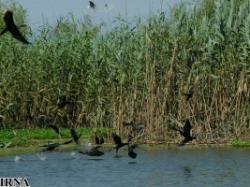 A conference at Azad University in Ahwaz City heard that the Iranian regime's industrial policies are causing environmental chaos in Khuzestan, the Ahwazi Arab homeland, reports the Islamic Republic News Agency (IRNA) (
click here for report
).
A conference at Azad University in Ahwaz City heard that the Iranian regime's industrial policies are causing environmental chaos in Khuzestan, the Ahwazi Arab homeland, reports the Islamic Republic News Agency (IRNA) (
click here for report
).
The conference was hosted by Azad University's Department of Science. At the conference, Dr Hormoz Mahmmodi Rad, the head of Khuzestan's environmental organisation, described situation affecting the province's natural environment as "worrying" and "chaotic" with serious consequences for human health. He emphasised the need for planned industrial development with action to stop the industrial pollutants from pouring into the Karoun River. The Karoun is an essential water source for agriculture as well as fishing, which together provide the largest source of income for indigenous Ahwazi Arabs.
Dr Mahmmodi Rad warned that the province's natural environment was in a perillous state, with biodiversity in the marshlands severely threatened and some animal species could face extinction as a result of industrial pollution.
Khuzestan represents 80-90 per cent of Iran's oil production and also hosts a growing petrochemical industry, with the Arvand Free Zone the focus of government efforts to increase sector output.
Two rare species of fish formerly abundant in Iran's Gamasyab River, flowing from the northern part of the Zagros Mountains, west of Iran, are on the verge of extinction, reports Iran Mania ( click here for report )
Rapid development and industrialization in particular, pollution, overfishing, dam building, aquaculture, breeding and introduction of non-indigenous species of fish has lead to disappearance of two major species of fish unique to Gamasyab River - the Shirbot and Soleymani. The Gamasyab River is the origin of the Karkeh river, which flows through Khuzestan.
Iran Mania states that the Gamasyab River "is the habitat of many endangered species of large tropical and semi-tropical region fresh water fishes. They include Barbus tetrazona and Barbus oligolepis which were formerly seen in abundance in the river."
Speaking to the British Ahwazi Friendship Society (BAFS), Reza Vashahi, an Ahwazi environmental and human rights campaigner, said: "Khuzestan is a major source of pollution from its oil and related industries. Air pollution makes it hard to breathe in areas close to industrial plants.
"The province's water resources are heavily polluted, the ancient palm groves are dying and dead fish are being washed ashore on a daily basis along the coast.
"Environmentalists want the international community to put a pressure on Iran to stop destroying the natural environment, on which Arab Ahwazis depend for their livelihoods."
Labels: environment
permalink
keywords: ahvaz ahwaz ahwazi arabistan khuzestan khuzistan khuzestani arab arabistan iran iranian human rights security oil news ahmadinejad ethnic cleansing
.......................................................................................
02 December, 2006
 The opening of Iran's first private petrochemical unit in Mahshahr (Mashour), on the Gulf coast of Ahwaz (Khuzestan) has sparked fears of an environmental catastrophe among Ahwazi activists.
The first phase of the Rejal Petrochemical Complex is being completed this week, with the opening of a polypropylene plant. The plant will have an initial output of 90,000 tonnes per annum, but is expected to reach 160,000 tonnes when production reaches capacity. The Chairman of the company's board of directors, Ali Mohammad Rejali, claimed that investors from Isfahan had spent IRR950 billion (US$100 million) on the complex so far. He also said that the private sector is currently carrying out preliminaries for the construction of the largest unit to produce mega methanol. The unit is scheduled to come on stream in the next Iranian year (to start March 21, 2007).
Ahwazi environmentalists believe that Mahshahr is already an environmental disaster zone due to high levels of pollution. In October, there were reports that thousands of fish died off the coast of Mahshahr due to toxic chemicals from the petrochemical complex run by the Bandar Imam Petrochemical Company, a subsidiary of the state-owned National Petrochemical Company ( click here for further information ). This has affected the livelihoods and health of local Arab fishermen. Qatar banned imports of seafood from Iran due to radioactive contamination, indicating that marine pollution is a long-term industrial disaster.
Reza Vashahi, an environmentalist who lived for 25 years in Mashahr, told the British Ahwazi Friendship Society: "Mahshahr is one of the most polluted areas in Middle East and Arab Gulf. The Rejal Petrochemical Complex adds to the environmental problems facing this part of the Gulf region.
"Emissions from industries have led to respiratory problems among the local population. While local Ahwazi Arabs are suffering the health problems associated with the petrochemical industry, most are barred from employment due to racial discrimination. For the Ahwazis, it is a lose-lose situation."
Labels: environment
permalink
keywords: ahvaz ahwaz ahwazi arabistan khuzestan khuzistan khuzestani arab arabistan iran iranian human rights security oil news ahmadinejad ethnic cleansing
.......................................................................................
21 October, 2006
In a meeting with Ahwaz's new head of energy, Iran's Deputy Energy Minister, Mohammad Ahmadian, confirmed that the government was studying the possibility of two new nuclear power plants in the province. Ahwaz (Khuzestan) lies in an earthquake zone, bordering Iraq and close to Kuwait on the Gulf coast.
The regime appears to be resurrecting plans drawn up under the Shah, who had signed a contract with the French government in 1969 to construct a nuclear power station near the towns of Falahieh (Shadegan) and Mohamareh (Khorramshahr). The plans were never fully realised. The Iranian regime now plans to use Russian technology to construct a power station.
Reza Vashahi, an Ahwazi human rights activist, said: "Building petrochemical plants and nuclear power stations without the consent of the local population is wrong. It is the same as dropping chemical weapons and atomic bombs on their land. Ahwazi Arabs continue to suffer the effects of chemical and biological weapons used in the Iran-Iraq War. We don't want more pollution and more environmental threats.
"Ahwazi Arabs are concerned about safety, fearing that the use of Russian technology in inexperienced Iranian hands could lead to a Chernobyl-like disaster, which will affect the entire region.
"The land and rivers are already heavily polluted by the oil, petrochemical and steel industries due to a lack of health and safety controls and little or no treatment or monitoring of industrial effluent. The situation is so bad that the province's head of fisheries has recently announced that fish output was down by 4,000 tonnes due to pollution. [ click for further details ]
"Yet, the region's indigenous people are not benefitting from any employment at these plants. The Ahwazi Arabs are suffering the effects of pollution, but are denied jobs in the polluting industries. They don't want potentially disastrous nuclear power plants near their homes."
Labels: environment
permalink
keywords: ahvaz ahwaz ahwazi arabistan khuzestan khuzistan khuzestani arab arabistan iran iranian human rights security oil news ahmadinejad ethnic cleansing
.......................................................................................
14 October, 2006
An Iranian petrochemical company has denied that the death of thousands of fish off the Mahshahr (Mashour) coast was related to its poor environmental standards.
The pollution is believed to have come from a nearby petrochemical complex run by the Bandar Imam Petrochemical Company (pictured), a subsidiary of the state-owned National Petrochemical Company , and has threatened the livelihoods of impoverished Ahwazi Arab fishermen. However, company managers have denied responsibility. Speaking to the Petroenergy Information Network, the manager of the National Petrochemical Company's environment unit Engineer Mohammad Taghi Jafar Zadeh claimed that further research was needed before a conclusion could be reached on the cause of the pollution. He claimed that if the company was responsible, it would have been a one-off accident rather than a long-term pollution problem ( click here for further information ). However, Qatar has today announced that it will ban imports of seafood from Iran due to radioactive contamination, indicating that marine pollution is a long-term industrial disaster ( click for further information ).
 Reza Vashahi, an Ahwazi human rights activist and researcher who lived for 25 years in Mahshahr, said: "This is not the first time the Mahshahr coast has been affected by pollutants from the petrochemical industry. But the government has always denied that state-owned companies are responsible and has suppressed information on environmental damage. It is well known that all effluent from the petrochemical industry is pumped untreated and unmonitored into the sea. Many local people suffer from high levels of dangerous chemical element in their food, particularly the poor fishermen who depend on fishing for their survival."
Labels: environment , poverty
permalink
keywords: ahvaz ahwaz ahwazi arabistan khuzestan khuzistan khuzestani arab arabistan iran iranian human rights security oil news ahmadinejad ethnic cleansing
.......................................................................................
07 May, 2006
A documentary about the Karoon River has highlighted one of the Middle East's most serious environmental problems, which has developed into a major crisis as a result of neglect by the Iranian government and is threatening the lives of thousands of Ahwazi Arabs (
right-click here and save to view film
).
The Karoon River runs through the predominantly Arab city of Ahwaz City in the south-west Iranian province of Khuzestan (Al-Ahwaz), providing an important source of irrigation and drinking water. However, the failure to treat raw industrial and human waste being pumped into the river along with the government's refusal to invest in de-siltation has created a hazardous environment.
Disruptions to water supplies force many Ahwazis to rely on contaminated water from the Karoon, which contains high levels of human sewage and industrial pollutants. Fishermen are reporting outbreaks of disease in fish and a sharp decline in fish numbers, indicating that Iran's mismanagement of water resources has devastated river life.
Since the 1979 Iranian revolution, the Karoon has faced more than 400 incidents of serious contamination. Last year, the government paid 700 billion rials (US$76.5 million) for a pistachio cultivation programme in Rafsanjan province, but just 100 billion rials (US$10.9 million) for water management in Khuzestan province.
Siltation of the river also means that during heavy rains, large areas of farmland are flooded with the contaminated water, killing livestock and ruining crops which the indigenous Ahwazis rely on for a living.
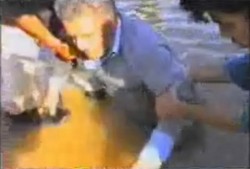 Added to the problem is the government's river diversion programme, which involves the construction of a series of dams to take water to provinces such as Yazd where water is scarce. The result is that when the floods recede, farmers have to deal with drought conditions. The Ahwazis are in a perpetual cycle of flood and drought, exacting a huge toll on their livelihoods and health.
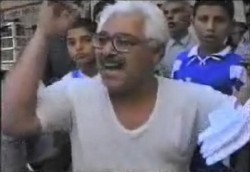
Anger over water management has fuelled anti-government sentiment among Ahwazi Arabs. In the documentary, one Arab tells the interviewer: "We went to the provincial governor, but the government doesn't care. They are feeding the Palestinians, but forgetting about us." Another says: "If we are Israelis, then kill us. But we are Iranians, so why are we treated like dogs?"
 The level of anger has prompted a rare display of opposition to the government from local members of parliament, who are normally loyal to the regime. In December 2005, Khuzestan's Majlis members lodged a petition for the impeachment of Energy Minister Parviz Fattah (
click here for report
).
The level of anger has prompted a rare display of opposition to the government from local members of parliament, who are normally loyal to the regime. In December 2005, Khuzestan's Majlis members lodged a petition for the impeachment of Energy Minister Parviz Fattah (
click here for report
).
Labels: environment , poverty
permalink
keywords: ahvaz ahwaz ahwazi arabistan khuzestan khuzistan khuzestani arab arabistan iran iranian human rights security oil news ahmadinejad ethnic cleansing
.......................................................................................
21 February, 2006
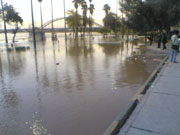 The Iranian regime is allowing the flooding of land in Khuzestan, making it impossible for Ahwazi Arabs to farm or live there.
The Karoon and Karkhe rivers that flow through the province have flooded, although there has been no rain. A 170 km stretch of land from Ahwaz to Mohammara (Khorramshahr) is now under water, according to local politicians. The flooding has devastated crops just one month ahead of the harvest. Already suffering high levels of poverty due to racial discrimination and forced displacement, Ahwazi Arab farmers are facing hunger and homelessness as a result of the regime's refusal to prevent flooding. Most flood-affected Ahwazis are now either stranded on the roofs of their homes or living on roadsides.
Mohammad Said Ansari, a Conservative Majlis (parliament) representative for the Arab city of Abadan, said that the flooding has devastated Ahwazi Arab farms and attacked "bad policies". He alleged that the authorities had deliberately caused the flood by refusing to dredge and desilt the Karoon and Bahmanshir rivers. The government is trying to create the impression that the province has enough water reserves to divert water to dry provinces such as Rafsanjan, he said. Ansari has called for an immediate investigation into the cause of the rising water in Karoon and Karkhe and compensation and housing for those affected.
Reformist Majlis representative for Abadan, Abdullah Kaabi, is also campaigning for assistance for those made homeless by the floods. The Ministry of Energy and Power has ignored his repeated calls for the dredging of the Bahmanshir river and repairs to levees to prevent flooding. Kaabi concludes that the ministry is therefore directly responsible for the humanitarian disaster. He has also attacked emergency services for failing to intervene to alleviate the problems facing Ahwazi Arabs affected by floods.
Khuzestan Majlis members have already called for the impeachment of the Minister of Energy and Power Parviz Fattah over the diversion of the Karoon River to Rafsanjan. Click here for further details .
Ahwazi Arab representatives have long been campaigning against river diversion, but the Iranian government has continued to press ahead with the scheme. At a session of the United Nations Sub-Commission on the Promotion and Protection of Human Rights in May-June 2005, Karim Abdian, Director of Ahwaz Education and Human Rights Foundation, drew attention to the diversion of water from Karkhe River, which passes through an entirely indigenous Ahwazi Arab area of Howizeh and Boustan, to Kuwait and the diversion of the Karoon's water to central Iranian provinces.
Labels: environment , land
permalink
keywords: ahvaz ahwaz ahwazi arabistan khuzestan khuzistan khuzestani arab arabistan iran iranian human rights security oil news ahmadinejad ethnic cleansing
.......................................................................................
29 January, 2006
Majlis (parliament) representatives for Khuzestan have threatened to resign if the project to divert the waters of the Karoon River to the provinces of Rafsanjan and Isfahan continues.
Khuzestan's Majlis members have been fiercely critical of the water diversion scheme, claiming it would seriously undermine water security and the livelihoods of many farmers in the Arab-majority province. In December, the MPs launched a petition to impeach Energy Minister Parviz Fattah over the transfer of Karoon waters.
Water quality is a major problem for residents of Khuzestan. In most of the province's towns and cities, water is polluted with industrial wastes and open sewers run through the middle of the streets. In Khafjieh, in western part of the province, the situation has become so bad that schools are failing to provide safe drinking water to children and have closed. The Iranian government has requested World Bank funding to clean up the province's water supply, although it continues to profit from oil revenue extracted from lands confiscated from Ahwazi Arabs. Meanwhile, the river diversion project along with the construction of dams is already making the situation worse.
The Karoon River is also an important source of water supply for farmers. The diversion project will hit the province's Arab majority hard, exacerbating endemic poverty in the region by reducing water availability. The Arab population is highest in the areas most affected by the river diversion. River diversion could lead to a significant deficit in water in the Ahwazi region, threatening the agricultural sustainability and creating an ecological disaster zone.
Ahwazi Arab representatives have long been campaigning against river diversion, but the Iranian government has continued to press ahead with the scheme. At a session of the United Nations Sub-Commission on the Promotion and Protection of Human Rights in May-June 2005, Karim Abdian, Director of Ahwaz Education and Human Rights Foundation, drew attention to the diversion of water from Karkhe River, which passes through an entirely indigenous Ahwazi Arab area of Howizeh and Boustan, to Kuwait and the diversion of the Karoon's water to central Iranian provinces.
Labels: environment
permalink
keywords: ahvaz ahwaz ahwazi arabistan khuzestan khuzistan khuzestani arab arabistan iran iranian human rights security oil news ahmadinejad ethnic cleansing
.......................................................................................
19 December, 2005
Members of the Iranian parliament representing Khuzestan province have launched a strong protest against the government's Karoon River water diversion project, with a petition to impeach Energy Minister Parviz Fattah.
According to Tehran Times , Majlis Energy Committee Chairman Kamal Daneshyar said on Sunday that MPs from Khuzestan, the homeland of the Ahwazi Arabs, have signed a protest petition. He said: "The people and the parliamentarians of the southern province of Khuzestan have strongly protested about the transfer of water from the Karun River to the city of Rafsanjan for agricultural use."
Daneshyar said that the energy minister will have to give "satisfactory" answers to the complaints lodged by the Majlis members or an impeachment motion will be presented to the Majlis Presiding Board.
The Karoon River is an important source of water supply for Ahwazi farmers. The diversion project will hit the local Arab population hard, exacerbating endemic poverty in the region by reducing water availability. Already, the construction of dams along the Karoon River is causing a decline in the quality drinking water in a land renowned for its rivers. River diversion could lead to a significant deficit in water in the Ahwazi region.
Ahwazi Arab representatives have long been campaigning against river diversion, but the Iranian government has continued to press ahead with the scheme. At a session of the United Nations Sub-Commission on the Promotion and Protection of Human Rights in May-June 2005, Karim Abdian, Director of Ahwaz Education and Human Rights Foundation, drew attention to the diversion of water from Karkhe River, which passes through an entirely indigenous Ahwazi Arab area of Howizeh and Boustan, to Kuwait and the diversion of the Karoon's water to central Iranian provinces.
Nasser Bani-Assad, spokesman for the British Ahwazi Friendship Society (BAFS), said: "Ahwazi Arab leaders have been protesting against the proposed river diversions for a long time, warning of the negative impact on the local population and ecological damage. The Iranian government has responded with indifference and hostility. The diversion of water from the reservoirs created by the dams to other parts of Iran would have a catastrophic effect on the Ahwazi Arabs' economic security and the ecology of their homeland.
"We welcome the move by the Majlis members, but are cautious over their motives. These politicians should have acted sooner if they had such strong concerns over the impact of river diversion, which will be an extension of the massive hydroelectric dam projects in the area.
"It is highly probable that the impeachment move is a political ploy to influence President Ahmadinejad's choice of cabinet members, rather than a serious attempt to stop river diversion. It is a repeat of the controversies surrounding the appointment of the Oil Minister, with Ahmadinejad's choices for the post being rejected by the Majlis. Majlis members from Khuzestan are mostly aligned with the so-called 'reformists', so they are likely to seek to use local grievances against hardliners in Tehran for the sake of gaining political leverage. However, their protests were notably absent during the administration of President Khatami, Ahmadinejad's predecessor."
Like Ahmadinejad, Parviz Fattah has served with the Iranian Revolutionary Guards Corps (IRGC), but has no experience in the areas relevant to his post. Majlis members have reacted strongly against the appointment of former IRGC militants. Many fear that the choice of cabinet does not adequately reflect the vested interests represented in Iran's complex political system, with too much power given to those associated with the IRGC.
Bani-Assad added: "As few Ahwazi Arabs have faith in the Majlis to protect their best interests, we call upon the international community to intervene in the Karoon dam project to ensure that it does not lead to the diversion of river waters which would jeopardise the livelihoods and well-being of local inhabitants. There have been international campaigns against massive hydroelectric schemes elsewhere in the world - such as Brazil and India - due to concerns over indigenous rights and the impact on local ecology. Ahwaz should be no exception."
Labels: environment
permalink
keywords: ahvaz ahwaz ahwazi arabistan khuzestan khuzistan khuzestani arab arabistan iran iranian human rights security oil news ahmadinejad ethnic cleansing
.......................................................................................
05 December, 2005
The Iranian government decided on Sunday to construct a new nuclear power station in the Arab-majority province of Khuzestan, amid controversy over the country's nuclear programme.
Iran is accused by many governments of using nuclear power stations to enrich uranium for use in nuclear weapons, whereas the Iranian regime claims that its intentions are peaceful. The plan for a Khuzestan nuclear power station comes after President Mahmoud Ahmadinejad called for Israel to be wiped off the map. There is also mounting evidence that he intends to use the province as a primary base for the Iranian Revolutionary Guard's operations abroad. This week, Bassij militias are conducting military exercises in Khuzestan's Dasht-e Azadegan (Susangerd) district.
Khuzestan is home to some 4.5 million Ahwazi Arabs, many of whom have been forced off their land for industrial projects and military installations. The government's plans to forcibly remove thousands of Ahwazi Arabs from the borders for the 155 square km military-industrial Arvand Free Zone project , situated along the Shatt Al-Arab dividing Khuzestan and Iraq's Basra province, have generated anxiety within the EU. Last week, delegates from the Congress of Nationalities for a Federal Iran , comprised of Kurdish, Arab, Balochi, Azeri and Turkmen groups, met with senior officials of the European Parliament, Council and Commission - the EU's three main decision-making bodies - to discuss ethnic oppression in Iran, including the impact of the militarisation of the Shatt Al-Arab.
Many Ahwazis and others living near sites for future nuclear power plants in Ahwaz and Bushehr are concerned about safety in this earthquake-prone region. The nuclear power station currently under construction and the source of international controversy is being located near Bushehr city, which has been destroyed by earthquakes on three occasions and is near the same geological faultline as the earthquake that destroyed Bam in 2003. Any tremours on a Richter Scale of 7 could destroy the Bushehr power station and any nuclear facility located in Khuzestan. But we can be sure that of these power plants go ahead, any earthquake on the magnitude of the recent earthquake in Pakistan, which measured 7.6 on the Richter scale, would be of major consequence to the people of the Gulf region.
Nasser Bani-Assad, spokesman for the British Ahwazi Friendship Society, said: "The government claims that a nuclear power station in Khuzestan is essential to achieve its goal of meeting electricity demand with nuclear power supply. Yet, Khuzestan is one of the most oil-rich places on the planet.
"In terms of addressing the country's energy balance, it makes little sense to build a nuclear power station in Khuzestan instead of utilising the abundant local oil resources. Why is the regime not locating the station in the country's energy-poor areas or nearer the most urbanised and populated areas? This would reduce costs and improve transmission. There is just no economic justification for a civilian nuclear power station in Khuzestan, where less than a tenth of the total population lives.
"Neighbouring countries should be concerned over safety issues, as Khuzestan is an earthquake-prone area. The planned power station is being built using local expertise, but nuclear reactors built in earthquake zones need highly skilled engineering to minimise risks. If the nuclear power station is built without the supervision of world-class engineers, Khuzestan could witness a Chernobyl-scale disaster.
"Given that the province is heavily militarised and under de facto martial law, it seems likely that the planned station will have some military use. We have been warning the international community for months over the developments in Khuzestan and the negative impact militarisation this is having on the welfare and human rights of local inhabitants. The international community must act now to stop ethnic cleansing and militarisation in order to support human rights and peace in the region. The last thing the Ahwazi Arabs want is a nuclear power station with possible military uses in their homeland."
Labels: environment , nuclear
permalink
keywords: ahvaz ahwaz ahwazi arabistan khuzestan khuzistan khuzestani arab arabistan iran iranian human rights security oil news ahmadinejad ethnic cleansing
.......................................................................................
