




A hardline Iranian cleric, Shiekh Samir Dorakwandi, has escaped an assassination attempt in the Arab city of Ahwaz in southwest Iran.
Dorakwandi was shot an wounded by gunmen while he was on his way to the Khatam al-Anbiya mosque in the Alawi (Hay al-Thawra) district. He was shot in the shoulder and the stomach. He is currently being treated in hospital and his condition is reportedly stable. Dorakwandi is believed to be a member of the Bassij, which has been used to suppress ethnic Arab unrest in the region.
The assassination attempt follows successful high profile assassinations of a leading hardline the imam of Zahraa mosque in the Hay al-Thawra district, Sheikh Hesham Saimari , in June and a Revolutionary Guards commander, Mehdi Bayat , this month. Iranian security forces have reportedly set up road blocks throughout the region in an effort to capture those responsible.
The Iranian government claimed it had arrested the assassins of Sheikh Saimari in June, but this has not stopped militants from targetting other senior members of the paramilitary Bassij and the Revolutionary Guards. The authorities have described those responsible as Wahhabis (Sunni fundamentalists) and Monafeqin (hypocrites), a term used to refer to the Iraq-based Mujahideen-e-Khalq (MEK). The government has also tried to associate the killings with the Israeli, US and British governments, although it has presented no evidence to substantiate its claims.
The Iranian regime portrays Ahwazi Arab unrest as foreign-instigated religious sectarianism, although human rights groups and UN experts have criticised institutional discrimination against Ahwazi Arabs, who endure the highest levels of poverty in Iran.
The impoverished Hay al-Thawra district of Ahwaz has witnessed significant ethnic unrest in recent years and is the focus of violent repression by the Bassij forces.
Labels: intifada
permalink
keywords: ahvaz ahwaz ahwazi arabistan khuzestan khuzistan khuzestani arab arabistan iran iranian human rights security oil news ahmadinejad ethnic cleansing
.......................................................................................
27 September, 2007
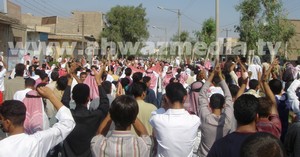 The Arab-majority region in Iran's restive south-west has been swept up in a wave of strikes and protests by workers upset by non-payment of wages by bankrupt industries.
Although the protests have been peaceful, the government has responded with force but has failed to meet any of the demands lodged by workers who are facing increasing hardships. Worker unrest comes a year after similar protests by workers in the port and ship-building industries in Mohammerah (Khorramshahr)
In Ahwaz City, a peaceful protest by 150 workers from a mothballed paper mill in Shoushtar (Tostar) was broken up by Iranian forces using tear gas and baton charges, with five workers reportedly beaten and injured, according to Radio Farda .
Abu Al-Fazel Abidini, a journalist from Ahwaz, told Radio Farda: "Over the past year and a half, these workers have been repeatedly asking the Khuzestan provincial government to reopen the factory and receive their delayed salaries. They have only received one or two months of salaries and haven't been given any official response to their demands."
He added: "They also held three demonstrations in front of President's office, but they were met with ruthless attacks [by the security services]. On Tuesday [25 September], workers gathered to talk to the provincial governor to tell him their problems, including seven months of salary arrears. They also demanded that insurance be paid and the factory reopened following its closure due to financial problems. These workers have suffered many problems during recent months. Most of these workers are tenants and eleven of them have been hospitalised in mental hospitals and have psychological problems. Some of the workers faced family problems which have ended in divorce. The 230 factory workers cannot send their children to the schools and universities due to financial problems."
The clamp-down at the paper mill comes weeks after 600 workers at the "Gama" company and 120 workers at "Pars Hassas" in Asloeyyiah went on strike due to three months of salary arrears. The Gama company sacked 40 workers involved in the strike. The Pars Hassas company, a refinery contractor, has also threatened to dismiss striking workers. ( click here for further details )
On 25 August, workers at Hafttapeh (Saba-atlal) Sugar Cane Company sent a letter to the International Labour Organisation (ILO) informing them that if the authorities did not respond to their demands for payment, they will resume industrial action. They had staged strike action on 11 July. A labour activist said: "We have held 15 strikes since the beginning of the last year, involving thousands of workers and clerks at this company, but each time the authorities failed to abide by their pledge to solve the problems."
Worker demands at the sugar company include:
- the payment of all salaries in arrears
- an end to the sale of foreign sugar on the Iranian market by "mafia" groups
- the right to labour representation
- a rise in salaries to reflect the rising cost of living brought about by poor weather
- right for workers to participate in the election of workers' representatives
- retirement of those workers who have reached retirement age
- provision of adequate safety equipment
- dismissing the company's board of directors
- ending threats to workers.
Labour activists have set a deadline of 27 September for the government to respond to their demands or they will resume industrial action and demonstrations in Ahwaz. A labour activist at Hafttapeh said: "If we had a trade union it would defend our rights, just like the bus workers syndicate in Tehran."
 Privately-owned sugar mills in Khuzestan have suffered as a result of trade liberalisation, which has led to unrestricted imports of sugar. This has led to bankruptcy, non-payment of wages, redundancy and civil unrest.
According to labour activists, the Ministry of Intelligence has taken over the management of the sugar cane projects. However, Mesbah Yazdi, the head of an Iranian sugar "mafia" gang responsible for under-cutting locally produced sugar with cheap foreign imports, has called for the privatisation of "failed" sugar mills taken over by the government.
On 12 September, the Human Rights and Democracy Activists of Iran group published a statement in support of the 5,000 striking workers in Hafttapeh. The group also supported demands for
- an elected committee of workers' representatives
- ending the casualisation of labour and making temporary positions permanent
- an increase in salaries
- providing housing to workers
The sugar industry is built on the suffering of Ahwazi Arabs, dating back to 1962 when US businessman David Lillington's investment in the sector led to the confiscation of 68,500 hectares of Arab-owned land for the purpose of sugar cane cultivation ( click here for more information ).
Nasser Bani Assad, spokesman for the British Ahwazi Friendship Society, said: "Mahmoud Ahmadinejad came to power proclaiming that he would tackle corruption and poverty. Under his administration, the situation facing Ahwazi workers is worsening. Instead of backing the workers, he is calling out the troops to repress them. If they refuse to work, they lose their jobs. This is not an option in a region like Ahwaz (Khuzestan), where unemployment is high, particularly among ethnic Arabs.
"After months of wage arrears many feel they have nothing to lose by going on strike and taking to the streets in protest. Workers are struggling to feed their families and pay for housing. Yet, the Ahwaz region is one of the most oil rich in the world. The oil revenue is going straight into the pockets of the mullahs while workers are forced into virtual slavery. Iran is breaking international labour codes and should be chastised by the international community for its poor treatment of workers."
Labels: labour
permalink
keywords: ahvaz ahwaz ahwazi arabistan khuzestan khuzistan khuzestani arab arabistan iran iranian human rights security oil news ahmadinejad ethnic cleansing
.......................................................................................
26 September, 2007
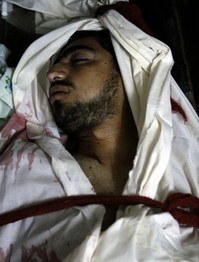 A Revolutionary Guards commander died after an ambush on 20 September by Ahwazi militants, according to Iran's Fardanews this week and confirmed by Ahwazi groups.
Ambush near Hamidiyah
Mehdi Bayat was killed near the Revolutionary Guards base in Hamidiyah, 25km from Ahwaz City, after returning from military training. According to Fardanews, he and his colleagues had escaped one ambush only to fall into a second ambush. He died of his injuries the following day. There are no reports of injuries or deaths among his colleagues. According to some Ahwazi group, the ambush took place in a village called Al-Shuish, near Hamydia, and was assassination was retribution for recent executions.
The actual rank Bayat held has not been announced, but Ahwazi and official Iranian sources indicate he was a commanding officer responsible for training members of the Bassij militia in Khaffajiyah. The town of Khaffajiyah has witnessed a number of disturbances by Ahwazi Arab groups which have been brutally put down by the Revolutionary Guards' Ashura Brigades, which were formed nearly 15 years ago to crush dissent in Iran.
Responsibility
A number of assassinations and attempted assassinations have been carried out in Ahwaz in recent months with members of the Revolutionary Guards, the police and clerics targetted. In June, militants assassinated Hisham Saimeri, the imam of Zahraa mosque in the Hay al-Thawra district of Ahwaz City, which has experienced the highest levels of Arab unrest. At the time, the provincial governor blamed "saboteurs, evildoers and Wahhabis." ( click here for further details )
At the time, the Canada-based Hizb al-Nahda al-Ahwaziya (Ahwazi Renaissance Party (ARP)) welcomed the assassination and warned Hijazi of " the consequences of continuing the criminal policies committed against Ahwazis ." The ARP has also welcomed the assassination of Bayat, stating that "Ahwazis have proved through this heroic act to the Persian invader authorities that their repressive practices and executions would not stop their struggle to regain their usurped rights." ( click here for their report ) It is unclear what, if any, links the ARP has with the assassins. It is a separate group from the Harkat al-Nedhal Alarabi (Arabic Struggle Movement for Liberation of Al-Ahwaz (ASMLA)) which claimed responsibility for a number of bomb attacks in Ahwaz City.
Iranian officials claim that a group called Jebheyia Khalghi Al-Ahwazyeh (Ahwazi Nation or People Front) was responsible. It is unclear which Ahwazi group they are referring to and no group has claimed responsibility for the killing.
Labels: intifada
permalink
keywords: ahvaz ahwaz ahwazi arabistan khuzestan khuzistan khuzestani arab arabistan iran iranian human rights security oil news ahmadinejad ethnic cleansing
.......................................................................................
25 September, 2007
An appeal by the Ahwaz Human Rights Organisation (AHRO) to UN Secretary General Ban Ki-Moon:
We are writing to inform you of the imminent execution of four more ethnic Arab-Iranians (Ahwazi-Arabs) in Ahwaz, provincial capital of Khuzestan in southwestern
On 10 September, three Ahwazis were executed in defiance of the UN and international law, just days after UN High Commissioner for Human Rights, Louise Arbour, visited
1. Hamzah Sawari, 20 years old
2. Zamel Bawi
3. Abdulemam Zaeri
4. Nazem Boryhi
The charges against them include hoisting the Ahwazi flag, naming their children Sunni names, converting from Shi'ism to Sunnism and preaching Wahabbism and being "Mohareb" or enemies of god, which carries death sentence. Other charges are "destabilizing the country", "attempting to overthrow the government", "possession of improvised explosives", "sabotage of oil installations" and being a "threat to national security".
Last year, Mr. Emadeldin Baghi, a leading Iranian human rights
activist
, in a
letter
to the chief of the judiciary, Ayatollah Hashemi Shahroudi, has argued that the trials of Ahwazi Arabs were flawed, the charges baseless, and that the sentencing was based on a spurious interpretation of law and that no evidence has been presented.
Mr. Nkbakht, a prominent defense lawyer in
This new wave of execution is the latest in a series of barbaric hangings, designed to intimidate On 10 January 2007, independent experts appointed by the United Nations Human Rights Council, Mr. Philip Alston, the Special Rapporteur on extrajudicial, summary or arbitrary executions, Mr. Leandro Despouy, the Special Rapporteur on the independence of judges and lawyers, and Mr. Manfred Nowak, the Special Rapporteur on torture, issued a joint statement urging the Iranian Government to "stop the imminent execution of seven men belonging to the Ahwazi Arab minority and grant them a fair and public hearing â. Despite that plea, on 14 February, 2007 Ghasem Salami, 41, married with 6 children, Majad Albughbish, 30, single, were executed in Ahwaz by public hanging and a day later Mr. Risan Sawari, a 32 years old Ahwazi-Arab teacher was killed under torture in Karoon prison.
This is in addition to four executions on 24 January 2007 (Mohammad Chaabpour, Abdolamir Farjolah Chaab, Alireza Asakereh and Khalaf Khanafereh) and three on 19 December 2006 (Malek Banitamim, Abdullah Solaimani and Ali Matorizadeh). This brings the number of executions of Ahwazi Arab political and human rights activists in the past 9 months to at least 13.
The executions are in the context of a brutal clamp-down on Ahwazi Arabs protesting against ethnic discrimination and persecution. Although the Ahwazi Arab homeland in
We appeal to you to condemn the latest wave of execution and call upon Iranian authorities to halt the imminent execution of the others. We also appeal to you to call upon
For further information, please see a
dossier of other human rights violations
against indigenous and ethnic Ahwazi-Arabs in
Labels: death penalty , human rights
permalink
keywords: ahvaz ahwaz ahwazi arabistan khuzestan khuzistan khuzestani arab arabistan iran iranian human rights security oil news ahmadinejad ethnic cleansing
.......................................................................................
20 September, 2007
This is an article published on The Guardian website by human rights campaigner Peter Tatchell in relation to last week's executions of Ahwazi Arab political prisoners. Click here for the original .
The Islamic Republic of Iran has executed three more Arab political prisoners, just days after a visit from the UN High Commissioner for Human Rights, Louise Arbour. In further defiance of the UN and international law, four more Arabs face imminent execution.
There have been no protests from Britain, the EU or the UN. The UN's silence comes on top of the truly appalling vote by UN Human Rights Council to abandon its monitoring of human rights abuses in Iran.
The only thing the west seems to care about is Iran's nuclear programme. Human rights abuses do not concern Washington, London or Brussels. Nor do they concern President Hugo Chavez of Venezuela and President Robert Mugabe of Zimbabwe. Both men have warmly embraced the tyrant of Tehran , President Mahmoud Ahmadinejad.
The Arab League , the supposed defender of Arab peoples worldwide, is equally indifferent. It has refused to protest to Iran about the persecution of ethnic Arabs in the south-west of the country - the oil-rich region Tehran calls Khuzestan, but which the indigenous Arab peoples call al-Ahwaz.
While condemning Israel for abusing the Palestinian people, Arab states are silent about the abuse of fellow Arabs by the Iranian regime. The anti-imperialist left is also mute. Why the double standards? Palestinian Arabs get the support of progressives and radicals everywhere; Iranian Arabs get no support at all. They swing from nooses in public squares like cattle hanging in an abattoir. Does anyone care?
Ahwazi Arabs accuse Tehran of Persian chauvinism, racism and ethnic cleansing, as I previously revealed in Tribune. The response to that article from some Islamists, left-wingers and anti-war activists was to denounce me as racist and anti-Muslim. But how can it be Islamophobic or racist to defend Arab Muslims against Tehran's persecution?
Amnesty International has also expressed concern about the bloody repression and economic exploitation of Iran's Arab minority, as has Dr Karim Abdian of the Ahwaz Human Rights Organisation (AHRO). I recently interviewed Dr Abdian for my Talking With Tatchell TV programme, which you can watch here .
The execution of three Arabs last week is the latest in a series of barbaric hangings, designed to terrorise the Arab population into submission. Ten other Arabs are known to have been executed since December last year. Amnesty International and Human Rights Watch have condemned their trials as unjust and unfair .
In January this year, three UN special rapporteurs also voiced concerns about the way the trials were conducted. Their concerns confirm criticisms by one of Iran's leading human rights advocates, Emad Baghi. In a letter to the chief of the judiciary, Ayatollah Hashemi Shahroudi, he argued that the trials of Ahwazi Arabs were flawed, the charges baseless, and that the sentencing was based on a spurious interpretation of law.
The men hanged last week were Abdulreza Nawaseri, Mohammad Ali Sawari and Jafar Sawari. Charged with bombing the Zergan oilfields in 2005, they were executed secretly in prison using Tehran's sadistic slow strangulation method, deliberately designed to prolong the suffering of the victims.
The men denied all the charges during a summary one-day trial in which they were deprived of adequate legal representation and denied the opportunity to call witnesses in their defence. Their lawyers were not allowed to meet them and were not given time to read their files. When they subsequently complained about the conduct of the trial, five of the seven lawyers (all Arabs) were arrested and summoned to court on allegations that they had threatened national security.
Abdulreza Nawaseri, aged 32, was arrested in 2000 and sentenced to 35 years in prison. He was in jail at the time of the Zergan bombings and therefore could not have committed the attacks, which further suggests that these men were framed on false charges.
Brothers Mohammad Ali Sawari and Jafar Sawari had been in prison since 2005. They were initially accused of promoting Sunni Islam, which is a heinous crime in the sectarian Shia state of Iran. These charges were later supplemented with charges of bombing the Zergan oilfields. No evidence was produced to back up the charges.
Mohammad Ali, a 37-year-old teacher, was an English literature graduate. Some reports claim he was also accused of translating George Orwell's book, Animal Farm, into Arabic, with the aim of sparking an uprising. According to his family, there was no allegation of bombings in his file.
The men's execution prompted spontaneous anti-government demonstrations in Ahwaz. Security forces fired on the crowds. Reports suggest that one person was killed and 20 others wounded.
At least six more Arab political prisoners are facing imminent execution. Four of them are in Karoun prison. These prisoners include Hamzah Sawari, 20 years old, who is accused of giving unauthorised religious instruction in a local mosque, instigating worshippers against the state and displaying the Ahwazi flag in 2005. The other men scheduled to hang with him are Zamel Bawi, Abdulemam Zaeri and Nazem Boryhi. The charges against them have not been made public.
Two more Arabs, who were illegally handed over to Tehran by Syria, are also expected to be hanged. The UN High Commission for Refugees reports that the men were recognised refugees and therefore protected under international and Syrian law from removal to a country such as Iran where they could be at risk of torture and execution.
According to Daniel Brett, chair of the British Ahwazi Friendship Society :
The Iranian government is not only executing innocent men, it is killing or jailing entire families in its attempt to terrorise the Ahwazi Arab people. We know that the entire family of Ahwazi psychologist Dr Awdeh Afrawi have been executed, murdered or imprisoned; Dr Afrawi himself is currently dying in prison, being deliberately denied the medication he needs to survive.
The Nasseri and Bawi tribes appear to be key targets, due to the fact that their lands are oil-rich and members of these tribes have been heavily involved in opposition to the government's land confiscation programme and its forced displacement of Arabs.
Contrary to Tehran's propaganda, most Arab movements in al-Ahwaz are not violent separatists. They primarily want non-discrimination, cultural rights, social justice and regional self-government - not independence.
If, however, Tehran continues to rebuff moderate, mainstream Arab opinion, there is a danger that many Arabs will turn to armed struggle and wage a full-scale national liberation war with the aim of outright independence. This would turn oil-rich al-Ahwaz into another zone of violent instability, with adverse global economic consequences as a result of diminished oil production and rising oil prices.
Quite rightly, most Arabs do not support a US attack on Iran. Military intervention would strengthen the position of the hardliners in Tehran; allowing President Ahmadinejad to play the nationalist card and, using the pretext of defending the country against imperialism, to further crack down on dissent. Many Ahwazis believe the route to liberation is an internal "people power" alliance of Iranian socialists, liberals, democrats, students, trade unionists and minority nationalities.
I have supported the Iranian people's struggle for democracy and human rights for four decades - first against the western-backed imperial fascist Shah and, since 1979, against the clerical fascism of the ayatollahs. Some anti-war leftists refuse to condemn the Tehran dictatorship and refuse to support the Iranian resistance; arguing that to do so would play into the hands of the US neocons and militarists. I disagree. Opposing imperialism and defending human rights are complementary, not contradictory.
Labels: death penalty , features
permalink
keywords: ahvaz ahwaz ahwazi arabistan khuzestan khuzistan khuzestani arab arabistan iran iranian human rights security oil news ahmadinejad ethnic cleansing
.......................................................................................
11 September, 2007
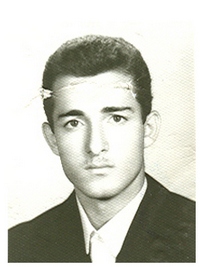 The Iranian regime has executed three Ahwazi Arab political prisoners just days after UN High Commissioner for Human Rights, Louise Arbour, visited Iran.
The three men - Abdulreza Nawaseri (pictured), Mohammad Ali Sawari and Jaffar Sawari - were hanged on charges of preaching Wahabbism and bombing the Zergan oilfields in 2005. They denied the charges in a one-day trial in which they were not given adequate legal representation. Their lawyers complained they were not given time to read their clients' files or meet their clients. The regime has not provided any evidence to substantiate its claims.
Abdulreza Nawaseri, aged 32, was the brother of Mehdi Nawaseri, who was hanged in public in Ahwaz City in March 2006 . He was arrested in 2000 and then sentenced to 35 years in prison. He was in prison at the time of the bomb attacks in Zergan.
Brothers Mohammad Ali Sawari and Jaffar Sawari had been in prison since 2005, along with a third brother, Hamzah Sawari. They were initially accused of attempting to convert Ahwazi Arabs to Sunnism, but they were later blamed for the Zergan oilfield attacks. No evidence has been produced to substantiate the government's charges. Mohammad Ali Sawari is a 37 year old teacher, married with five children.
Following the executions, some Ahwazi Arabs held spontaneous anti-government demonstrations in the streets of Ahwaz. The authorities reportedly fired on the crowds to subdue them. Initial reports suggested that one person has been killed and 20 have been wounded.
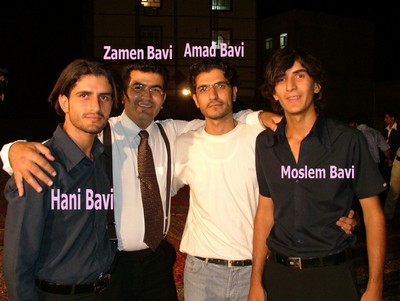 Daniel Brett, Chairman of the British Ahwazi Friendship Society, said: "The Iranian government is not only executing innocent men, it is killing entire families in its attempt to terrorise the Ahwazi Arab people. We know that the entire family of Ahwazi psychologist Dr Awdeh Afrawi have been executed, murdered or imprisoned; Dr Afrawi himself is currently dying in prison. All five sons of tribal leader Hajji Salem Bawi have been sentenced to long prison terms or execution (pictured). Zamel Bawi could be the next Ahwazi Arab to face execution. The wives and children of some executed Ahwazi Arabs have also been imprisoned, including pregnant women and babies.
"The regime is collectively punishing Ahwazi Arabs as part of a broader programme of ethnic cleansing of this indigenous ethnic group. This policy of collective punishment is not applied to ethnic Persians.
"The Sawari and Bawi tribes appear to be key targets, due to the fact that their lands are oil-rich and members of these tribes have been heavily involved in opposition to the government's land confiscation programme and forced displacement of Arabs.
"Every Ahwazi activist is condemned as a separatist, a Wahabbi and a British or Israeli spy and is likely to be executed if arrested. It does not matter if they are accused of distributing Sunni literature or bombing oilfields, they are seen as being mohareb (at war with god) and as such can be executed under Islamic law."
Labels: death penalty
permalink
keywords: ahvaz ahwaz ahwazi arabistan khuzestan khuzistan khuzestani arab arabistan iran iranian human rights security oil news ahmadinejad ethnic cleansing
.......................................................................................
04 September, 2007
The following is a statement released by the Ahwaz Human Rights Organisation concerning the trial of Yusuf Azizi Bani Torof, an Ahwazi Arab journalist and writer who has been charged with threatening national security. Click here for further details on his case .
According to the reports which Ahwaz Human Rights Organization (AHRO) have received, the hearing of Mr. Yusef Azizi Bani Torof was delayed on Tuesday 28 August in the Revolutionary Court branch 15 of Tehran, because his defence lawyer was not attending.
According to reports the court did not invite Mr. Saleh Nikbakhat who is the excellent lawyer of Mr. Yusef Azizi Bani Torof and has been his lawyer since year 2005.
Also the court did not ask for two other top lawyers, Mr. Abdul Fattah Sultani and Mrs. Mahnaz Parakand, who submitted their defence to the court on behalf of Mr. Yusef Azizi Bani Torof.
Labels: human rights , media
permalink
keywords: ahvaz ahwaz ahwazi arabistan khuzestan khuzistan khuzestani arab arabistan iran iranian human rights security oil news ahmadinejad ethnic cleansing
.......................................................................................
The following appeal was made by the Unrepresented Nations and Peoples Organisation (UNPO) . It follows a similar appeal by the British Ahwazi Friendship Society .
In light of the United Nations High Commissioner for Human Rights Ms. Louise Arbour's upcoming visit to Iran, UNPO expresses its deep concerns for the continued degrading human rights situation for Ahwazi Arabs in Iran.
Faced with issues of land confiscation and forced migration, UNPO has received numerous reports highlighting the detrimental effects these events are having on the livelihood of the Ahwazi community. In a report issued by UN Special Rapporteur on Adequate Housing, Mr. Miloon Kothari, following his visit to Iran in July 2005, Mr. Kothari identified the exceptionally adverse housing and living conditions of ethnic and religious minorities, including the Ahwazi Arabs, in Iran as a serious issue. Despite his findings, the Ahwazi continue to be forcibly displaced from their homes due to land development projects hosted by Iranian authorities.
In addition, UNPO has witnessed an alarming number of incidents of extrajudicial executions carried out by Iranian authorities against Ahwazi political dissidents. These executions have been condemned by the international community, including Amnesty International, Human Rights Watch, Special Rapporteur (SR) on Extrajudicial, Summary or Arbitrary Executions Philip Alston, SR on the Independence of Judges and Lawyers Leandro Desouy, and SR on Torture Mandred Nowak. In January 2007 these Special Rapporteurs issued a statement urging the Iranian government to halt the imminent execution of several Ahwazi Arabs. With disregard to their request and in a blatant violation of the individuals' right to a fair and public trial, authorities in Iran carried out the executions, resulting in a clear breach of human rights obligations as set out by the International Covenant on Civil and Political Rights, a legal obligation to which Iran is party to.
UNPO remains deeply concerned about the human rights conditions of the Ahwazi community in Iran and therefore appeals to Ms. Louise Arbour to:
- Inquire about the circumstances surrounding recent land confiscation programmes and extrajudicial executions;
- Investigate the situation regarding landmines on Ahwazi land and the severe effects inflicted upon the Ahwazi community;
- Urge Iran to end immediately its use of land displacement and executions as a weapon of fear and oppression; and
- Urge Iran to immediately halt its ongoing persecution of minority communities, including the Ahwazi Arab community, and to afford all its citizens their full catalogue of political and human rights.
Labels: human rights , land
permalink
keywords: ahvaz ahwaz ahwazi arabistan khuzestan khuzistan khuzestani arab arabistan iran iranian human rights security oil news ahmadinejad ethnic cleansing
.......................................................................................
02 September, 2007
 Iran's Department of the Environment is examining the environmental crisis that has hit the Ahwazi Arab homeland, following years of campaigning by Ahwazi activists.
Scientists are to assess the impact of pollutants from both the oil and non-oil industries on the marine environment in the Arab-majority province of Khuzestan as well as Hormozgan and Bushehr on the Gulf coast, said the deputy head of marine environment at the Department of the Environment, Mohammad Baqer Nabavi, in an interview with the Iranian Students News Agency (ISNA).
"Pollution from oil, gas and petrochemical industries and other factories located in the south will be assessed," he said, adding the plan will start next month. Nabavi said Mahshahr, Asalouyeh and Bandar Abbas are the three main environmental crisis areas. Special environmental teams and experts will measure the level of pollution of oil and non-oil wastes such as chemical agents.
 The British Ahwazi Friendship Society (BAFS) has placed the environment at the centre of its campaign against the economic marginalisation of indigenous Ahwazi Arabs. Many Ahwazis traditionally depend on fishing for their livelihoods and have complained that pollution from oil and petrochemicals industries is poisoning the fish and reducing fish stocks.
In March, two of Iran's leading ecologists claimed that the Bandar Imam petrochemical complex is causing environmental devastation. Research by Dr Abbas Ismail Sari and Dr Bahram Kiaee found that a large area of Khuzestan is seriously affected by pollution from mercury and other dangerous chemicals used in petrochemicals manufacturing ( click here for article ).
In December, a conference Azad University in Ahwaz City heard that the Iranian regime's industrial policies are causing environmental chaos in Khuzestan. At the conference, Dr Hormoz Mahmmodi Rad, the head of Khuzestan's environmental organisation, described situation affecting the province's natural environment as "worrying" and "chaotic" with serious consequences for human health. He emphasised the need for planned industrial development with action to stop the industrial pollutants from pouring into the Karoun River. The Karoun is an essential water source for agriculture as well as fishing, which together provide the largest source of income for indigenous Ahwazi Arabs. Dr Mahmmodi Rad warned that the province's natural environment was in a perillous state, with biodiversity in the marshlands severely threatened and some animal species could face extinction as a result of industrial pollution ( click here for more details on the conference ).
Earlier in 2006, controversy erupted over pollution from the Bandar Imam Petrochemical Company, a subsidiary of the state-owned National Petrochemical Company, following the death of thousands of fish off the Mahshahr (Mashour) coast. Some Gulf states banned seafood imports from Iran due to radioactive contamination, indicating that marine pollution is a long-term industrial disaster ( click for further information ).
Labels: environment
permalink
keywords: ahvaz ahwaz ahwazi arabistan khuzestan khuzistan khuzestani arab arabistan iran iranian human rights security oil news ahmadinejad ethnic cleansing
.......................................................................................
01 September, 2007
Iran is destabilising Iraq to expand its influence in the Middle East, said BAFS spokesman and treasurer Mansour Silawi al-Ahwaz in a live interview on Baghdad's Al-Sharqiyah Television on Friday.
In a programme that examined the role of Iranian militias in Iraq, Al-Ahwazi said: "It goes without saying that Iran will not seek the security and stability of Iraq as long as it has not achieved any understanding with the United States on all outstanding issues. Iran has a huge intelligence and military clout in Iraq."
He added that Iran exploited several factors to "go to extremes in its plans with a view to implementing its ambitious project of expanding at the expense of Iraqis in particular and the Arabs of the region in general."
A resident of Al-Saydiyah, Abu Yusuf, claimed that militias in Iraqi uniforms were attacking civilians. In a telephone interview with Al-Sharqiyah Television, he said: "Individuals donning Interior Ministry commandos' uniform have stormed the Uqbah Bin-Nafi Secondary School in the Al-Saydiyah neighbourhood of southern Baghdad and beaten and humiliated its teaching staff. They also opened fire on four women who were martyred instantly." He claimed that some 20 school pupiles were arrested.
Meanwhile, "Open Doors", an international nongovernmental organization, claimed that more than 1,000 Christian families were threatened by militias in Baghdad for their refusal to convert to Islam, pay jizyah (Islamic tax), and marry off their girls to Muslim men. In a statement, the organization added that a real campaign has been unleashed with the aim of evicting the Christian residents of the Al-Dawrah area in southern Baghdad and nearby neighbourhoods.
Labels: terrorism
permalink
keywords: ahvaz ahwaz ahwazi arabistan khuzestan khuzistan khuzestani arab arabistan iran iranian human rights security oil news ahmadinejad ethnic cleansing
.......................................................................................
