




The following appeal was made by the Unrepresented Nations and Peoples Organisation (UNPO) . It follows a similar appeal by the British Ahwazi Friendship Society .
In light of the United Nations High Commissioner for Human Rights Ms. Louise Arbour's upcoming visit to Iran, UNPO expresses its deep concerns for the continued degrading human rights situation for Ahwazi Arabs in Iran.
Faced with issues of land confiscation and forced migration, UNPO has received numerous reports highlighting the detrimental effects these events are having on the livelihood of the Ahwazi community. In a report issued by UN Special Rapporteur on Adequate Housing, Mr. Miloon Kothari, following his visit to Iran in July 2005, Mr. Kothari identified the exceptionally adverse housing and living conditions of ethnic and religious minorities, including the Ahwazi Arabs, in Iran as a serious issue. Despite his findings, the Ahwazi continue to be forcibly displaced from their homes due to land development projects hosted by Iranian authorities.
In addition, UNPO has witnessed an alarming number of incidents of extrajudicial executions carried out by Iranian authorities against Ahwazi political dissidents. These executions have been condemned by the international community, including Amnesty International, Human Rights Watch, Special Rapporteur (SR) on Extrajudicial, Summary or Arbitrary Executions Philip Alston, SR on the Independence of Judges and Lawyers Leandro Desouy, and SR on Torture Mandred Nowak. In January 2007 these Special Rapporteurs issued a statement urging the Iranian government to halt the imminent execution of several Ahwazi Arabs. With disregard to their request and in a blatant violation of the individuals' right to a fair and public trial, authorities in Iran carried out the executions, resulting in a clear breach of human rights obligations as set out by the International Covenant on Civil and Political Rights, a legal obligation to which Iran is party to.
UNPO remains deeply concerned about the human rights conditions of the Ahwazi community in Iran and therefore appeals to Ms. Louise Arbour to:
- Inquire about the circumstances surrounding recent land confiscation programmes and extrajudicial executions;
- Investigate the situation regarding landmines on Ahwazi land and the severe effects inflicted upon the Ahwazi community;
- Urge Iran to end immediately its use of land displacement and executions as a weapon of fear and oppression; and
- Urge Iran to immediately halt its ongoing persecution of minority communities, including the Ahwazi Arab community, and to afford all its citizens their full catalogue of political and human rights.
Labels: human rights , land
permalink
keywords: ahvaz ahwaz ahwazi arabistan khuzestan khuzistan khuzestani arab arabistan iran iranian human rights security oil news ahmadinejad ethnic cleansing
.......................................................................................
02 June, 2007

This week marks the 27th anniversary of Black Wednesday, when the Iranian regime massacred 817 Ahwazi Arabs shortly after the overthrow of the monarchy. The Black Wednesday massacre led to the formation of Ahwazi insurgent groups, including the group involved in the Iranian Embassy Siege of 1980.
General Madani imposed a brutal clamp-down on Arabs in Mohammerah (Khorramshahr) in May 1979 which Ahwazi Arabs regards as a crime against humanity. At the time, Arabs were demonstrating for cultural rights and were supported by Ayatollah Mohammed Taher al-Khaqani, an Ahwazi Shi'ite mullah. Following the massacre, al-Khaqani was put under house arrest in Qom, where he died. His son Sheikh Mohammed Kazem al-Khaqani continues to campaign for secularism, religious tolerance and human rights. In March, Sheikh al-Khaqani addressed a meeting at the House of Commons in London ( click here for further details ). Meanwhile, Ahwazi groups have raised their demands for Madani's arrest and prosecution for the massacre which was intended to strengthen the power of the Islamic revolutionaries.
The following is the declaration submitted by the Ahwazi Arab delegates to the Interim government on April 1979 which was published in Iranian newspapers. The appeal centred on demands for regional autonomy and cultural identity, while demanding equal rights in a modern economy:
In the name of God, the most Compassionate, Most Merciful
April 1979
Mr. Mehdi Bazargan, the respected Interim Premier of Iran,
The Muslim Arab people's delegates appeal to your ministry to listen to the demands of a consensus among Arab people, in cities and rural areas, that has emerged through demonstrations. These demands have been supported by Ayatollah Sheikh Mohammed Taher al Shobair Khaqani. The demands include the legitimate rights of the Arab people and their right to self-government, within the framework of the Islamic Republic, and maintaining the unity of Iranian territory.
Mr. President,
The delegates assure you that matters relating to foreign policy, the army, defence of the country's borders, currency, international agreements and long-term economic policies are under the jurisdiction of the central state, and our people condemn all conspiracies designed to fragment the unity of Iran. We condemn imperialism, racism, reactionary ideologies and defend a political Non-Aligned Movement, and reject all colonial agreements, which are harmful to Iran national independence.
Our people believe in the autonomy of "Khuzestan", which was historically called Arabistan and geographically belongs to the Arab people.
The basic demands of the Arab people are as follows:
1. Recognition of the Arab people as a distinct ethnic group and enshrine this in the Constitution of the Islamic Republic of Iran.
2. Establish a local parliament in the autonomous area with powers to legislate and enforce laws and ensure the participation of the Arab people in the Iranian Constituent Assembly, the National Council and the cabinet on the basis of their proportion of tht total population.
3. Establishing an Arab-led judiciary in Arab areas, conforming with the laws of the Islamic Republic.
4. Arabic language should become the official language in the autonomous region, while the Persian language should remain the official language for all Iran.
5. The Arabic language should be taught in primary schools, while education in the Persian language will be conducted in the autonomous area.
6. An Arabic language university along with Arabic language schools and educational institutions should be established in the autonomous regime in order to enhance the role of the Arab people, with support given to young Arab people to study abroad.
7. Freedom of expression and publication should be emphasised with the independent publication of Arabic language books and newspapers and independent broadcasting on radio and television networks, without any kind of censorship.
8. Priority should be given to employment for Arabs in the autonomous area in public and private sectors.
9. Oil revenues should be used to develop the Arab region's industry and agriculture.
10. The names of cities, villages and districts should revert to their original Arabic names, which the fascist Pahlavi regime had changed to Persian.
11. Arabs should be able to participate in the army and local security forces, operating under the autonomous govenment, with the possibility of promotion to high military ranks, which had been denied under the Pahlavi regime.
12. A review of the agrarian reform law, with land redistributed to peasants, based on the laws of the Islamic Republic which say that "the earth is for people who cultivate it."
Finally, we ask the government of Mehdi Bazargan to refrain from negotiations with the opportunistic and reactionary elements on resolving issues related to the Arab people.
Signed,
Delegates of the Muslim Arab people of Iran.
Labels: human rights , intifada , land
permalink
keywords: ahvaz ahwaz ahwazi arabistan khuzestan khuzistan khuzestani arab arabistan iran iranian human rights security oil news ahmadinejad ethnic cleansing
.......................................................................................
03 May, 2007
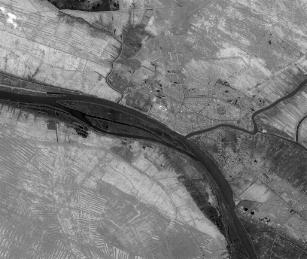 A major political row has erupted over the military-industrial
Arvand Free Zone
following the sacking of its chairman Dr Mohammed Reza Abbasi, according to
a report by the semi-official Iranian Labour News Agency
.
A major political row has erupted over the military-industrial
Arvand Free Zone
following the sacking of its chairman Dr Mohammed Reza Abbasi, according to
a report by the semi-official Iranian Labour News Agency
.
The AFZ has been created from land confiscated from indigenous Arabs living along the Shatt al-Arab in a 155 sq km area. It is the latest development in Iran's campaign of ethnic cleansing of its restive Arab population from the border with Iraq. The focus of the row is the four billion rials (US$435,000) earned every day by the AFZO from activities from the port of Khorramshahr. Dr Abbasi stood in the way of those who wished to transfer this income to Anzali, a port on the Caspian Sea in the northern Gilan province.
Dr Abbasi, a supporter of President Mahmoud Ahmadinejad, was dismissed from his job by Arvand Free Zone Organisation (AFZO) managers connected to a top official in the Iranian government who wanted full control over the zone and its income. He was appointed chair of the AFZO on 16 August 2006 under a three year contract, but was replaced by Ramazan Ahmadi.
Syed Baheralolum, the chief inspector of the AFZ, lent his support to Abbasi, saying "a high-ranking government manager disliked Dr Abbasi from the beginning. This high-positional manager had previously vetoed the order appointing Dr Abbasi as AFZO chair and appointed someone else. The President intervened to ensure that Abbasi's position was secured."
Abbasi claimed he was sacked because he was not part of a corrupt and politically well-connected clique running the AFZO, accusing local members of parliament of bribing the organisation's officials. In an interview with ILNA, he said: "My aim was to implement a management based on [Islamic] revolutionary principles. As such, I refused to provide benefits to certain groups and I resisted their demands to share profits. Consequently, they discharged me using calumny, fiction and sedition."
According to ILNA, Abbasi's supporters are holding a hunger strike in Jame'a mosque in Khorramshahr (Mohammerah) until he is reinstated and they have received a response from President Mahmoud Ahmadinejad. Abbasi claimed his term as AFZO chairman saw a number of investment projects, with 100 projects to be started in 2007. However, according to Abbasi, corruption has upset efforts to lure more foreign investment.
Abbasi claimed that "some people do not want Khorramshahr and Abadan to be developed." He accused those who undermined his work of "obstructionism" and counter to Iran's revolutionary ideals.
Baheralolum claims that poor results for President Ahmadinejad's supporters in recent municipal elections prompted some political opportunists to move against Abbasi. He accused the free zones Secretariat High Council, provincial and municipal authorities and members of parliament of obstructionism and claimed that "officials in the province and cities were working in a way that made it impossible for the chair of AFZO to carry out his job." He added that "on one occasion I witnessed one of the board members ask for bribes. This person has instated his nephews to monitor Dr Abbasi and issue false reports against him."
Baheralolum stated that an MP gathered a petition against him for backing Abbasi and that an arrest warrant has now been issued against him. In his interview with ILNA, Baheralolum claimed that tribal leaders and the families of war martyrs had joined the protest over Abbasi's sacking and stated that up to 3,000 riot police had been sent to Abadan to prevent demonstrations.
Nasser Bani Assad, a spokesman for the British Ahwazi Friendship Society (BAFS), said: "The struggle over the AFZO is a consequence of the struggle between Iranian hardliners and so-called reformists. It seems that opponents of President Ahmadinejad within the establishment have used underhand tactics against Dr Abbasi.
"While Abbasi is portraying himself as a 'man of the people', there is no evidence that he has done anything to redistribute wealth from the AFZ to the local population. Abbasi has not stopped the mass land confiscation effort conducted by AFZO officials, which is leading to the ethnic cleansing of local Arab inhabitants.
"The Abbasi affair demonstrates that sections of the establishment are prepared to play on local grievances to undermine their rivals. Baheralolum's statements are close to incitement to riot, suggesting the President's own supporters are prepared to provoke ethnic unrest for their own ends. The result will be arrests, torture and executions. Not one Iranian government official or Iranian politician cares what happens to the indigenous Arab population that has suffered decades of neglect, poverty and displacement. The current row is no exception.
"BAFS calls on Ahwazi Arabs not to become pawns in Tehran's internal political battles and to assert their own political agenda. Ahwazis have heard many empty promises from those who pretend to be on their side, but have later been betrayed. Neither Abbasi nor his opponents have done anything to stop the criminal land confiscation campaign along the Shatt al-Arab, conducted for control of the profits of the Arvand Free Zone Organisation. This row is about greed, not ideals."
permalink
keywords: ahvaz ahwaz ahwazi arabistan khuzestan khuzistan khuzestani arab arabistan iran iranian human rights security oil news ahmadinejad ethnic cleansing
.......................................................................................
24 April, 2007
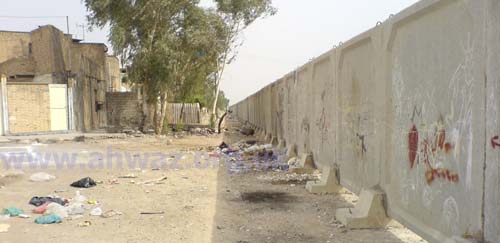
The US and Israel have faced international condemnation for the construction of separation walls in the West Bank and Baghdad, but the world continues to turn a blind eye to Iran's construction of walls around Arab ghettoes in Ahwaz.
 Separation walls in Ahwaz such as the one pictured above are designed to segregate the indigenous Arab population from wealthier non-Arab districts built on land confiscated from Arabs. In 2003, the regime bombed hundreds of homes in the Arab populated Sepidar district of Ahwaz City, displacing thousands of indigenous Ahwazi Arabs to make way for homes for ethnic Persians. Ethnically exclusive residential developments such as Shirinshahr and Ramin have been built in recent years to house Persians from Yazd and Fars provinces who have been brought into the area to take up jobs denied to Arabs (
click here for details
).
Separation walls in Ahwaz such as the one pictured above are designed to segregate the indigenous Arab population from wealthier non-Arab districts built on land confiscated from Arabs. In 2003, the regime bombed hundreds of homes in the Arab populated Sepidar district of Ahwaz City, displacing thousands of indigenous Ahwazi Arabs to make way for homes for ethnic Persians. Ethnically exclusive residential developments such as Shirinshahr and Ramin have been built in recent years to house Persians from Yazd and Fars provinces who have been brought into the area to take up jobs denied to Arabs (
click here for details
).
Following a visit to the traditionally Arab province of Khuzestan in July 2005, UN Special Rapporteur for Adequate Housing Miloon Kothari said that Arab districts endured "very adverse conditions" with "thousands of people living with open sewers, no sanitation, no regular access to water, electricity and no gas connections. I think that the kind of question that arises is, why is that? Why have certain groups not benefited?" ( click here for an interview with Kothari )
He criticised the "attempt being made by the government to build new towns and bring in new people from other provinces", singling out Shirinshah for criticism ( click here to view a documentary on Shirinshahr ).
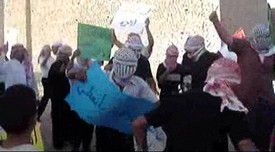
Nasser Bani Assad, spokesman for the British Ahwazi Friendship Society, said: "Ahwazi Arabs are constantly demonstrating against the separation walls in their homeland and the creation of ethnically exclusive settlements. [ click here to download a video of a demonstration near a separation wall ]
"Iran is enforcing its system of ethnic apartheid by constructing physical barriers. But no-one is listening and there is no media coverage, even when the UN's own experts condemn Iran's actions.
"When the Americans create such barriers in Baghdad for security purposes, there is outrage. When the Iranians create barriers to keep Arabs in their deprived neighbourhoods and prevent social mobility, there is absolute silence from the UN Human Rights Council.
"The Iranian regime's separation walls are no different from the walls the Nazis created around Jewish ghettoes in Warsaw. Time and time again, the Iranian regime is shown to be essentially fascist in nature, yet some still call it a democracy and place their faith in 'reformists'. Fascism cannot be reformed, it can only be overthrown."
permalink
keywords: ahvaz ahwaz ahwazi arabistan khuzestan khuzistan khuzestani arab arabistan iran iranian human rights security oil news ahmadinejad ethnic cleansing
.......................................................................................
25 March, 2007
Iran's capture of 15 British navy personnel at gunpoint on the Shatt al-Arab, purportedly in Iraqi waters, is inextricably linked to the regime's long-term ambition to impose its territorial control over the strategic waterway and hold Baghdad hostage to its interests.
The left bank of the Shatt al-Arab is witnessing a large-scale militarisation programme which is being conducted under the auspices of the Arvand Free Zone Organisation (AFZO), a state-run group that aims to extend the regime's economic, political and military influence over the Shatt al-Arab and ultimately Iraq. The AFZO's plans for the military-industrial zone were outlined in a letter issued to indigenous Ahwazi Arab residents living within the zone instructing them that their land would be confiscated ( click here to download the BAFS report ). The confiscation programme is nothing short of ethnic cleansing for the sake of Iran's neo-imperialism.
Arab Shia tribes have populated regions on both sides of the Shatt al-Arab for centuries if not millennia. The leaders of the Bani Kaab tribe owned land on both banks of the waterway, giving them considerable influence and political autonomy. Any foreign power wishing to gain influence over trade along the Shatt al-Arab had to deal with the Bani Kaab leadership, which controlled the Sheikhdom of Mohammara. The Ottomans confiscated the land belonging to the Bani Kaab in the 19th century and Reza Pahlavi deposed Sheikh Kazal, the de facto ruler of the oil-rich Arabistan region, following his military coup in 1925. Arabistan was renamed Khuzestan and Mohammara was renamed Khorramshahr. The area came to prominence in 1980, when Iraq invaded Khuzestan ostensibly to âliberateâ the Ahwazi Arabs, although Saddam was no doubt taking advantage of Iranâs post-revolutionary turmoil to seize the regionâs massive oilfields. The narrowness of the Shatt Al-Arab also enabled Iran and Iraq to stage large-scale amphibious assaults during the war. In February 1986, 30,000 Iranian troops crossed the Shatt Al-Arab in a surprise attack to invade and occupy Iraq's Al-Faw peninsula and create a bridgehead for further advances into Iraq.
The Marsh Arabs of Iraq's Basra province suffered ethnic cleansing and repression under Saddam's regime while in Iran the Ahwazi Arabs have endured violent persecution under the Pahlavi dynasty and the Islamic Republic. On both sides of the waterway, the governments of Iran and Iraq have viewed the indigenous population as disloyal and a threat to their territorial claims. They were perceived as a threat by Saddam because they are predominantly Shia, while the Iranian regime sees them as having innate pan-Arab sympathies. Ethnic cleansing has been used by both countries as a method of securing control and territorial claims over the Shatt al-Arab.
The AFZ is the latest development in the Iranian regime's campaign to rid the left bank of Ahwazi Arabs and impose Iranian control over the Shatt al-Arab. The latest seizure of British personnel is a symptom of this quiet militarisation programme. Land acquisition and ethnic cleansing are intimately bound up with militarisation. Over recent years, the Iranian regime has confiscated large tracts of land from local Arabs and transferred ownership to the Iranian Revolutionary Guards Corps (IRGC) and state-owned enterprises. Around 47,000 hectares of Ahwazi Arab farmland in the Jofir area near the Ahwazi city of Abadan has been transferred members of the security forces and government enterprises. More than 6,000 hectares of Ahwazi farmland north of Shush (Susa) has been taken to "resettle" the faithful non-indigenous Persians, following directives issued by the Ministry of Agricultures and the Revolutionary Guards Corp Command. These policies have forced Ahwazi Arabs into poor shanty towns.
The AFZ is located along the narrowest and most strategically sensitive part of the Shatt al-Arab and includes a large number of Revolutionary Guards naval posts, which are used to patrol the waterway and protect Iranian arms smugglers entering Iraq. It stretches 30km from Abadan along the Shatt Al-Arab to the land border between Basra and Khuzestan. The zone is in three segments: an island and adjacent land measuring 30 square km, a strip of land north of Khorramshahr measuring 25 square km and an in-land eastern segment measuring around 100 square km in area. The total land area of the Arvand Free Zone is around 155 square km and includes Arab towns and villages. At certain points, the zone is literally within a stone's throw of Basra.
The Shatt al-Arab is the most politically sensitive area of the Middle East. Whoever controls the waterway controls movements from Iraq to the Gulf, including oil shipments, as well as serving as an important trade route for the entire west of Iran. Control over the disputed waterway led to wars between the Persian and Ottoman empires in the 17th and 19th centuries and more recently Iraq and Iran.
The AFZ has seen the mass expulsion of Arabs, the destruction of their villages and the creation of an exclusive military-industrial zone. The expulsion campaign began with the Arab farmers located on Minoo Island, near Abadan ( click here for information ). The islanders were bullied by AFZO officials into giving up their land before the official deadline, indicating an increasing sense of urgency associated with establishing the zone. In all, up to 500,000 indigenous Ahwazi Arabs are being displaced by the creation of a 5,000 square km security zone, of which the AFZ is just a part, along the Shatt al-Arab.
The zone's security element has strengthened covert operations inside Iraq, with the objective of securing an early exit of Coalition troops, influencing Iraq's political system and using patronage to control local authorities in Basra. The zone is also being used to train, fund and organise militias loyal to Tehran. Mahdi Army leader Moqtada al-Sadr and several Iranian-backed politicians belonging to the ruling United Iraqi Alliance have recently visited the area.
Documents from the Iranian Revolutionary Guards Corps' (IRGC) Fajr Garrison in Khuzestan, which serves as the organisation's main headquarters for southern Iran, show that Tehran is employing up to 40,000 agents in Iraq. The information was first revealed in March 2005 by former Iranian agents who defected due to pay cuts and subsequently confirmed by Coalition troops in Iraq. Fajr Garrison hosts the IRGC's Qods Force, which runs the vast underground network in Iraq. Agents are paid by middle-men, who carry out regular visits to Ahwaz City to obtain payments and be debriefed by Qods commanders.
The regime's activities in Khuzestan and the left bank of the Shatt al-Arab are related to the rise of militias in Basra and the British government's discovery that weapons used by insurgents were likely to have originated from the IRGC via the Iranian-backed Lebanese Hezbollah. It is no coincidence that attacks on British troops, a sudden upsurge in militia activity in Basra province and the seizing of British naval personnel on the Shatt al-Arab have occurred at the same time as Ahwazi Arabs are being removed from the area to make way for the AFZ. Greater international attention to the plight of the Ahwazi Arabs would hinder the pace of militarisation along the Shatt al-Arab and stymie Iranian efforts to control Iraq.
Labels: features , land , terrorism
permalink
keywords: ahvaz ahwaz ahwazi arabistan khuzestan khuzistan khuzestani arab arabistan iran iranian human rights security oil news ahmadinejad ethnic cleansing
.......................................................................................
25 February, 2006
Windows Media
| Launch in external player |
Al-Ahwaz TV has produced a short documentary on Shirinshahr, which is based on unique footage shot on the road to the ethnic Persian township currently under construction. The new town is being built on land confiscated from Ahwazi farmers. The film shows the constrast between the abject poverty of Ahwazi Arabs compared to the large investments being ploughed into exclusive Persian settlements built on their land. For more information, see " Ethnic Cleansing in Full Force in Iran ", 25 February 2006, British Ahwazi Friendship Society.
permalink
keywords: ahvaz ahwaz ahwazi arabistan khuzestan khuzistan khuzestani arab arabistan iran iranian human rights security oil news ahmadinejad ethnic cleansing
.......................................................................................
The Iranian regime is stepping up its land confiscation programme in order to expand Persian settlements in Al-Ahwaz (Khuzestan), despite condemnation by the UNCHR and European Parliament last year.
The Shahinshahr and Ramin settlements are the focus of a new wave of land confiscations, in addition to the ethnic cleansing being carried out along the Arvand Free Trade Zone along the Shatt Al-Arab.
The regime is encouraging ethnic Persians to settle on the land confiscated from Ahwazi Arab farmers by placing advertisements in Faris-speaking provinces and cities. The adverts promise cheap fully furnished apartments with all amenities, which is in stark contrast to the squalor of the slums and villages where most Ahwazi Arabs reside.
A number of exclusively Persian settlements have already been built on Ahwazi Arab land, including the Ramin-1 and Ramin-2 townships, Shahinshahr, Shirinshar and Jufir. New Persian townships are being constructed on a daily basis. Similar ones are being built daily.
Some of these settlements were highlighted by Miloon Kothari, the UN's Special Rapporteur on Adequate Housing, following a visit to Al-Ahwaz last year ( click here for report ).
In an interview, Kothari said: "when you visit Ahwaz ... there are thousands of people living with open sewers, no sanitation, no regular access to water, electricity and no gas connections ... why is that? Why have certain groups not benefited? ... Again in Khuzestan, ... we drove outside the city about 20 km and we visited the areas where large development projects are coming up - sugar cane plantations and other projects along the river - and the estimate we received is that between 200,000-250,000 Arab people are being displaced from their villages because of these projects. And the question that comes up in my mind is, why is it that these projects are placed directly on the lands that have been homes for these people for generations? I asked the officials, I asked the people we were with. And there is other land in Khuzestan where projects could have been placed which would have minimised the displacement."
 A recent official announcement by the Iranian regime states: "The new company that oversees the new city of Ramin (outside Ahwaz) in accordance with the article 2 of the below law and other laws pertaining to purchase and confiscation of lands for building cities and other military and civilian developments, law # 1358/11/117, issued and approved by the respected revolutionary council, is planning to expand the first phase of the New city of Ramin, and needs take over and possess parts of area of Sanicheh and Jalieah, plaque # 29 and 42 of zone 5 of Ahwaz, in accordance with the attached layout [pictured].
"Therefore, this announcement will be published only twice in one month, for informing the owners of said properties, who must repond within 15 days from the publication of this announcement, with their ownership documents, to this location, for their submittal (relinquishment) of their properties to us. Attend the office of this company located in Kianpars corner of Sixth Street West, 2nd floor.
"If owners do not visit the office, the expropriation and confiscation will continue to take place according to the law."
The land confiscation programme - including the Arvand Free Zone - is in line with the "ethnic restructuring" programme outlined in a top secret letter written by Sayed Mohammad-Ali Abtahi when he served as Iran's Vice-President. The letter was leaked to the international media last year, prompting the April intifada in Al-Ahwaz. ( click here to download the letter )
Labels: land
permalink
keywords: ahvaz ahwaz ahwazi arabistan khuzestan khuzistan khuzestani arab arabistan iran iranian human rights security oil news ahmadinejad ethnic cleansing
.......................................................................................
21 February, 2006
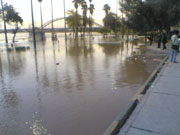 The Iranian regime is allowing the flooding of land in Khuzestan, making it impossible for Ahwazi Arabs to farm or live there.
The Karoon and Karkhe rivers that flow through the province have flooded, although there has been no rain. A 170 km stretch of land from Ahwaz to Mohammara (Khorramshahr) is now under water, according to local politicians. The flooding has devastated crops just one month ahead of the harvest. Already suffering high levels of poverty due to racial discrimination and forced displacement, Ahwazi Arab farmers are facing hunger and homelessness as a result of the regime's refusal to prevent flooding. Most flood-affected Ahwazis are now either stranded on the roofs of their homes or living on roadsides.
Mohammad Said Ansari, a Conservative Majlis (parliament) representative for the Arab city of Abadan, said that the flooding has devastated Ahwazi Arab farms and attacked "bad policies". He alleged that the authorities had deliberately caused the flood by refusing to dredge and desilt the Karoon and Bahmanshir rivers. The government is trying to create the impression that the province has enough water reserves to divert water to dry provinces such as Rafsanjan, he said. Ansari has called for an immediate investigation into the cause of the rising water in Karoon and Karkhe and compensation and housing for those affected.
Reformist Majlis representative for Abadan, Abdullah Kaabi, is also campaigning for assistance for those made homeless by the floods. The Ministry of Energy and Power has ignored his repeated calls for the dredging of the Bahmanshir river and repairs to levees to prevent flooding. Kaabi concludes that the ministry is therefore directly responsible for the humanitarian disaster. He has also attacked emergency services for failing to intervene to alleviate the problems facing Ahwazi Arabs affected by floods.
Khuzestan Majlis members have already called for the impeachment of the Minister of Energy and Power Parviz Fattah over the diversion of the Karoon River to Rafsanjan. Click here for further details .
Ahwazi Arab representatives have long been campaigning against river diversion, but the Iranian government has continued to press ahead with the scheme. At a session of the United Nations Sub-Commission on the Promotion and Protection of Human Rights in May-June 2005, Karim Abdian, Director of Ahwaz Education and Human Rights Foundation, drew attention to the diversion of water from Karkhe River, which passes through an entirely indigenous Ahwazi Arab area of Howizeh and Boustan, to Kuwait and the diversion of the Karoon's water to central Iranian provinces.
Labels: environment , land
permalink
keywords: ahvaz ahwaz ahwazi arabistan khuzestan khuzistan khuzestani arab arabistan iran iranian human rights security oil news ahmadinejad ethnic cleansing
.......................................................................................
09 February, 2006
Majid Naasseri-Nejad, a member of parliament representing the Arab populated area of Fallahieah (Shadegan), called on Iran's Oil Minister Kazem Vaziri-Hamaneh to ensure equitable employment practices in the oil-rich Arab-majority province of Khuzestan or face impeachment, according to reports.
Naasseri-Nejad claimed that the Oil Ministry had been placing recruitment advertisements in Shiraz, Isfahan, Mashhad, Tehran and other cities and provinces, but was not actively recruiting from the local Arab population. Some Arab districts are enduring unemployment rates of up to 90 per cent, he claimed.
The practice of moving non-Arabs into the area to fill job vacancies is highly controversial among the impoverished local Ahwazi Arabs. Discriminatory employment practices are rooted in the government's long-term programme of reducing the proportion of Arabs in the province from 70 per cent to around a third through "ethnic restructuring". This was outlined in a top-secret letter written by the then Vice-President Mohammad Ali Abtahi which was leaked last year. The Abtahi letter led to an Ahwazi uprising that was crushed by the regime, killing more than 160 people.
Last month, Portuguese Socialist MEP Paulo Casaca, who heads the European Parliament's delegation to NATO, condemned the Iranian government's policies in Khuzestan as "ethnic cleansing".
Links
Abtahi's secret letter on ethnic restructuring
Paulo Casaca's condemnation of ethnic cleansing against Ahwazis - BAFS, 19 January
Labels: labour , land , poverty
permalink
keywords: ahvaz ahwaz ahwazi arabistan khuzestan khuzistan khuzestani arab arabistan iran iranian human rights security oil news ahmadinejad ethnic cleansing
.......................................................................................
26 January, 2006
The controversial military-industrial Arvand Free Zone (AFZ), a large zone from which thousands of local Ahwazi Arab inhabitants are being forcibly expelled, could be "physically separated" from Iran, according to the Hamsayeha newspaper
which covers the southern Iranian province of Khuzestan.
Nasser Kermani, director of Iran's custom service, told the newspaper that the AFZ should be separated from the cities of Abadan and Muhammarah (Khorammshahr) and adjacent areas along the Shatt Al-Arab waterway "to prevent people and others goods into the area." A bill has been submitted to the Majlis (parliament) to enable the AFZ, which encircles the two cities, to carry out the construction of walls and barricades.
Nasser Bani-Assad, spokesman for the British Ahwazi Friendship Society, said: "The establishment of the AFZ is an act of ethnic cleansing. The walling up of the AFZ will enable the government to militarise the border with Iraq without civilians nearby. As the AFZ completely encircles the Arab majority cities of Abadan and Muhammarah, hundreds of thousands of Ahwazi Arabs will be living under a state of siege.
"The AFZ is little different from other infrastructural projects in Khuzestan, such as the Sugar Cane Project of the 1990s which made up to 250,000 Arabs homeless. The AFZ is being built at the expense of Arabs who will lose their farmland and be forced to live in city slums. Like the Sugar Cane Project, few will gain employment and compensation will be derisory.
"While the world media promotes the Iranian regime's racist claim that Ahwazi Arabs are violent terrorists, the ethnic cleansing and economic injustices go unreported. But the AFZ is of immense geopolitical importance, acting as a base for Iran to extend its influence over Iraq and organise its network of agents behind a wall of secrecy."
Links
BAFS report on the Arvand Free Zone
Safeguarding the Ahwazi Arabs: Essential for a Stable and Democratic Middle East
Kidnapping of Iraqis indicates Iran's plans for Shatt Al-Arab
Iran is ethnic cleansing Ahwazis claims senior European politician
Labels: land
permalink
keywords: ahvaz ahwaz ahwazi arabistan khuzestan khuzistan khuzestani arab arabistan iran iranian human rights security oil news ahmadinejad ethnic cleansing
.......................................................................................
