




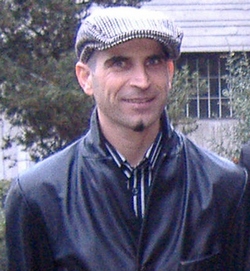
 The Swedish government is preparing to deport Ahwazi novelist and playwright Farid Morshidi back to Iran, where he faces arrest, torture and possible execution.
Mr Morshidi has been living in Sweden for the past eight years as an asylum seeker.
On 30 May 2007, the Swedish police arrested him after his asylum claim was refused, allegedly due to lack of evidence. The Swedish lawyer who was appointed by Pen International Organisation to represent Mr Morshidi told the Ahwaz Human Rights Organisation (AHRO) that the Swedish government is serious about deporting him and he could be returned to Iran within days.
Mr Morshidi has published two books in Farsi, which were printed in the UK, Netherlands and Denmark. His first book, Promise, was published in 2001 and contains three plays and a number of short stories about the ethnic persecution of the Ahwazi Arab people by the Iranian regime. The second book published in Europe in 2006, entitled The Night of Star and Dark, comprises of three stories. One of the stories revolves around the Black Wednesday massacres of 1979 , which were carried out in the city of Mohammerah (Khorramshahr), an Arab city which was besieged by the Khomeinist revolutionaries led by General Ahmed Madani.
Mr. Morshidi is a member of the Democratic Solidarity Party of Al-Ahwaz , which is a banned Ahwazi Arab political party in Iran. He is also an activist within the Congress of Nationalities for a Federal Iran (CNFI). He is regularly interviewed on dissident radio and television networks. Three months ago he was interviewed on Kurdish television, attacking the Iranian government's ethnic cleansing of Ahwazi Arabs and other non-Persian nationalities in Iran. His prominent role in the Ahwazi movement means he is certain to be arrested and possibly executed on his return to Iran.
Mr Morshidi is likely to face the same treatment meted out to Faleh Abdullah al-Mansouri , a Dutch national and UNHCR-registered refugee was deported to Iran by the Syrian authorities in May 2006. Al-Mansouri is currently being tortured in Section 209 , a notorious prison run by the Ministry of Intelligence. He was sentenced to death while in exile and is likely to be executed in the near future.
AHRO, the British Ahwazi Friendship Society (BAFS), the DSPA and CNFI are appealing to the European Commission and the Swedish government to delay Mr Morshidi's deportation and reconsider his application for asylum or give him leave to remain in Sweden.
Labels: refugees
permalink
keywords: ahvaz ahwaz ahwazi arabistan khuzestan khuzistan khuzestani arab arabistan iran iranian human rights security oil news ahmadinejad ethnic cleansing
.......................................................................................
01 May, 2007
The British Ahwazi Friendship Society (BAFS) is putting pressure on the British government to reveal details of the UK's Memorandum of Understanding with Iran over the return of failed asylum seekers after a government spokesman announced that the MoU had been abandoned.
In March, Home Office Minister Baroness Scotland announced that the British government had "not been able to implement our MoU with Iran as the arrangements originally negotiated are no longer appropriate or practical." However, she insisted that the " content of MoU negotiations is confidential for operational reasons ." BAFS has been campaigning for the publication of the MoU since May 2006, when a request for disclosure was made under the Freedom of Information Act. But the government has refused the requests. BAFS's campaign for disclosure has been backed by British Conservative and Green MEPs, who have also demanded answers from the government.
At the heart of the issue surrounding the UK's MoU with Iran is the transfer of confidential information on asylum seekers fleeing persecution in Iran, the forced deportation of Iranian asylum seekers before their cases were heard and the forcing asylum seekers to apply for passports with the Iranian Embassy in London.
The British Ahwazi Friendship Society (BAFS) has received reports that returned asylum seekers are being arrested and interrogated by Iranian officials about information contained in their asylum applications. Some allege that the Iranian authorities are in receipt of British Home Office documents on these failed asylum seekers. This information is often incriminating as it details political activities. BAFS is the only advocacy group that has campaigned against the MoU, which affects all Iranian refugees and not just Ahwazi Arabs.
BAFS Chairman Daniel Brett said: "While we welcome the government's decision to abandon the MoU, we still do not know the details of this memorandum or the reasons why the British government abandoned it. As the MoU is no longer in force, there is no reason for the government to withhold information on its details.
"We suspect that there may be some link with the illegal deportation of Ahwazi UNHCR-registered refugees from Syria to Iran in May 2006. The refugees are now suffering brutal torture at the hands of their interrogators. If Iran cannot abide by the UN Convention relating to refugees , then it cannot be trusted to respect any MoU which is not legally enforceable. The government refuses to say why the MoU has been suspended and in what circumstances it will come back into force, which creates considerable uncertainty for asylum seekers waiting for their cases to be heard. Some Ahwazi asylum seekers are suicidal and some are thinking of disappearing due to the lingering uncertainties over the UK's MoU with Iran."
Mr Brett has written to Deputy Speaker Sir Alan Haselhurst to urge the government to reveal the details of the MoU. He also called for an investigation into any weaknesses within the asylum process which could have been exploited by the Iranian regime to extract information on asylum seekers.
Labels: refugees
permalink
keywords: ahvaz ahwaz ahwazi arabistan khuzestan khuzistan khuzestani arab arabistan iran iranian human rights security oil news ahmadinejad ethnic cleansing
.......................................................................................
14 April, 2007
An international campaign by Ahwazi and international human rights organisations has succeeded in freeing five Ahwazi Arab refugees who had been arrested in Damascus in March.
Human rights activists had been alarmed at the arrests, fearing the men would share the fate of four Ahwazi refugees and a Dutch citizen of Ahwazi descent who were deported from Syria to Iran last year. The men are now believed to be in prison and undergoing severe torture . The illegal deportations of Ahwazi refugees prompted protests from the UNHCR , while the Ahwazi population in Damascus is living in fear .
The British Ahwazi Friendship Society (BAFS) led lobbying efforts at the European Parliament, the UN Human Rights Commission and Syrian embassies in London and Brussels. Meanwhile, the Ahwaz Human Rights Organisation issued a number of appeals to High Commissioner António Guterres and the Arabic media.
Last week, Human Rights Watch called for the immediate release of Ahwazi Arab refugees or "disclose a credible legal basis for detaining them." ( click here for report ) The Tehran-based Ahwazi journalist Youssef Azizi Bani Torouf, the father of detained refugees Afnan Azizi (20), had also written public appeals to the Syrian government. ( click here for report )
The Arabic language Elaph news website today reported that Afnan Azizi along with Ahmad Asadi (28), Jaber Ebayat (19), Kamal Naseri (27) and Salahuddin Helali Majd (26) were released without charge. ( click here for report ) However, the fate of 24-year-old Ali Bouazar, who had fled Iran after being sentenced to death by a Revolutionary Court, is still unknown. BAFS has received information that he was deported back to Iran soon after his arrest. Unlike the other five men, Bouazar had not been registered as a refugee with the UNHCR and was technically an illegal immigrant. BAFS is concerned that Bouazar's life is in danger and is continuing to research his whereabouts.
There are at least 90 Ahwazi Arabs in Syria who have applied for asylum or have been registered with the UNHCR. BAFS is campaigning for all Ahwazi asylum seekers and refugees to be evacuated from Syria to other countries in the region and temporarily resettled while their claims are processed or while they wait for permanent resettlement.
Labels: refugees
permalink
keywords: ahvaz ahwaz ahwazi arabistan khuzestan khuzistan khuzestani arab arabistan iran iranian human rights security oil news ahmadinejad ethnic cleansing
.......................................................................................
07 April, 2007
US House of Representatives Speaker Nancy Pelosi's recent visit to Syria has been denounced by the British Ahwazi Friendship Society (BAFS) as an insult to Ahwazi Arab refugees currently living in fear for their lives in Damascus.
Pelosi met with Syrian Baathist dictator Bashar al-Assad in an effort to showcase her Democrat party's agenda on foreign policy. This came at a time when al-Assad is ordering the arrest and deportation of Ahwazi Arab UNHCR-registered refugees, in violation of international law ( click here for report ). According to media reports, Pelosi did not address the Baathist regime's human rights record in her meeting with the Syrian dictator.
Ahwazi refugees are being hunted down in Damascus and a number have been detained and deported to Iran. On their arrival in Tehran, the refugees are arrested, held in solitary confinement in Section 209 of Evin Prison and tortured to the extent that they cannot walk and suffer injuries to internal organs ( click here for report ). The Syrian security forces have placed the UNHCR's office in Damascus under surveillance, forcing refugees into hiding.
BAFS spokesman Nasser Bani Assad said: "Pelosi is a disgrace. She did not confront President Bashar al-Assad on human rights violations and Syria's breach of international law by deporting refugees under the UNHCR's protection. Her cosy meetings with this hated dictator brought legitimacy to a corrupt and despotic regime at a time when it should be confronted on state terrorism and its human rights atrocities.
"Pelosi and the Democrats have no interest in human rights and don't care about the people suffering under the Baathist regime, who include Ahwazi Arab refugees who have fled from persecution, torture and execution in Iran. Pelosi doesn't impress anyone."
Labels: refugees
permalink
keywords: ahvaz ahwaz ahwazi arabistan khuzestan khuzistan khuzestani arab arabistan iran iranian human rights security oil news ahmadinejad ethnic cleansing
.......................................................................................
04 April, 2007
Human Rights Watch has called for the immediate release of six Ahwazi Arab refugees or "disclose a credible legal basis for detaining them" in a statement released today.
Click here for report
The human rights organisation has expressed concern that the men will be forcibly returned to Iran, where they are at risk of persecution. One of the men has already been sentenced to death in absentia .
The subjects of the appeal are:
- Afnan Azizi, 20, a civil engineering student in Damascus
- Ahmad Asadi, 28, a student of Arabic literature at the University of Damascus
- Ali Bouazar, 24, who fled to Syria after he was sentenced to death by a branch of Iran's Revolutionary court; he has been living in Syria since the end of December
- Jaber Ebayat, 19, a sociology student at the University of Damascus
- Kamal Naseri, 27, who had been living in Syria for eight months at the time of his arrest
- Salahuddin Helali Majd, 23, a science student at the University of Damascus
The six men were all arrested on 5 March ( click here for details ). Five of the six were all living in Syria legally and were all registered as refugees with the UNHCR. The British Ahwazi Friendship Society (BAFS) understands that two of the men - Bouazar and Naseri - have already been forcibly returned to Iran. BAFS has also received reports that many UNHCR-registered refugees are now in hiding, with the UN agency failing to meet its obligation to ensure their safety.
"Last year Syria forcibly sent four refugees of Arab ethnicity back to Iran, where they are in prison and at risk of execution," said Sarah Leah Whitson, Middle East director at Human Rights Watch. "Syria must not return refugees to the risk of persecution or detain them without legal cause."
In December 2006, the UNHCR condemned the return of Ahwazi refugees forcibly returned to Iran ( click here for report ). BAFS has received reports that one of the refugees has been tortured so badly that he can no longer walk, he has lost all his teeth and his kidney and liver are damaged. ( click here for report )
According to their friends and family, the six men left Iran out of fear that they would be persecuted as part of the Iranian government's crackdowns following a series of bombings in 2005 and 2006 in Ahwaz City, which caused the death of a number of civilians. Iran has executed at least 12 Ahwazi Arabs in connection with these bombings, and at least 13 others have received a death sentence. The trials have been condemned by human rights organisations, UN human rights experts and lawyers as deeply flawed.
Syrian human rights organizations that have been following the case and advocating for the release of the detainees told Human Rights Watch that they too have been unable to obtain information about the reasons for the arrests, the conditions of the detainees, or what the authorities plan to do with the six men.
Labels: refugees
permalink
keywords: ahvaz ahwaz ahwazi arabistan khuzestan khuzistan khuzestani arab arabistan iran iranian human rights security oil news ahmadinejad ethnic cleansing
.......................................................................................
30 March, 2007
Appeals for the release of Ahwazi Arab UNHCR-registered refugees detained in Damascus have been stepped up as Ahwazi activists have revealed that two refugees have been illegally deported to Iran by the Syrian Baathist regime.
Ali Bouzar, who was waiting for refugee status after fleeing for his life from Iran, was deported just 12 hours after his arrest earlier in March. His mother has reportedly travelled to Damascus and has held a vigil outside the Syrian Foreign Ministry in protest at his deportation. According to reports, she is challenging all officials and ministers entering the ministry building.
Kamal Nawaseri is also believed to have been deported. A UNHCR-registered refugee, Kamal Nawaseri, is also believed to have been returned to Iran, contrary to international law.
A further five are understood to be in custody, although they may also have been returned to Iran. Among them is Afnan Azizi Bani Torouf, the son of Ahwazi Arab writer Youssef Azizi Bani Torouf, who remains in Tehran despite harassment by the authorities.
This week, Youssef sent an appeal to international human rights organisations and the Syrian government for the release of his son ( click here for report ). He has also issued an appeal to Bashar al-Assad, which said: "I ask you to consider the release of my son Afnan, who wasarrested in Damascus. I am sure he has never opposed the Syrian regime, or his country's regime ... I send this letter to you as a father with a wounded heart and from a mother who is dumbfounded over the arrest of our son, which has yet to be explained. However, I know that my son ... has not been politically active either in Iran or Syria and spent his life in Tehran before leaving Iran for studying at the university. I am sure that he did not commit a crime, because if he did I would oppose him myself." ( click here for the text of the letter )
Youssef's appeal has been backed by Syrian human rights groups. He is well-known in Syria for his work in cross-cultural relations between Syria and Iran and has translated the works of Syrian authors into the Persian language.
Ahwazi groups are continuing to mediate through UNHCR with the Syrian authorities for the release of Ahwazi detainees.
In February, the British Ahwazi Friendship Society (BAFS) reported that Abdul Rasoul Mazrae, one of the Ahwazi refugees currently being tortured in an Iranian prison, will soon face trial. Mazrae has spent the past 10 months in solitary confinement in a prison in Ahwaz. He has also undergone physical and psychological torture. As a result of his torture, he is urinating blood and has lost all his teeth. His kidneys and liver are also damaged and injuries to his spine have left him unable to walk. His torturers have ordered him to give a televised confession for crimes he did not commit ( click here for more information ). If young men arrested in Syria are forcibly returned to Iran, they are likely to meet the same fate.
Labels: refugees
permalink
keywords: ahvaz ahwaz ahwazi arabistan khuzestan khuzistan khuzestani arab arabistan iran iranian human rights security oil news ahmadinejad ethnic cleansing
.......................................................................................
21 March, 2007
 Ahwazi journalist Youssef Azizi Bani Torouf has issued an appeal to human rights organisations to help him discover the fate of his son, Afnan Azizi, who was one of the five refugees arrested in Syria (
report in Al-Qabas newspaper
).
Ahwazi journalist Youssef Azizi Bani Torouf has issued an appeal to human rights organisations to help him discover the fate of his son, Afnan Azizi, who was one of the five refugees arrested in Syria (
report in Al-Qabas newspaper
).
Afnan was arrested after submitting a request for asylum with the UNHCR in Damascus, although he has not been politically active in Syria. The Syrian regime has so far deported five UNHCR-registered Ahwazi refugees back to Iran, in contravention of international law. These refugees are arrested as soon as they land in Tehran. The British Ahwazi Friendship Society (BAFS) has received reports that the refugees have been severely tortured by members of Iran's Ministry of Intelligence. Meanwhile, Syrian agents have put the UNHCR building in Damascus under surveillance and are relaying information on Ahwazi refugees' asylum claims to Iran.
The treatment of Ahwazi refugees has prompted Youssef Azizi Bani Torouf to issue his appeal for more information on his son. Youssef is a respected writer in Iran and has published 24 books in Persian and Arabic, including research on Ahwazi Arabs and modern Arab thought, translations and novels. Twelve years ago, Youssef visited Damascus at the invitation of the Syrian Ministry of Culture in acknowledgement of his contributions to Arabic literature. However, his call for an end to state violence against persecuted Ahwazi Arabs at the height of the Ahwazi intifada of April 2005 led to his brief incarceration for "threatening national security", although no charges were brought against him. Since then, Youssef has been threatened with arrest and prosecution in relation to hardline claims that he supports separatism, although he has stated that the "Arabs of Khuzestan, as a nation or an ethnic group or whatever you like to call it, are inseparable parts of the Iranian nation."
Afnan's claim for asylum is possibly in relation to his father's treatment by the authorities and fears that he could be targetted by the regime. In the past year, the wives and children of Ahwazi human rights activists have been imprisoned in order to force them into giving false confessions to terrorist acts that they have not committed.
Labels: refugees
permalink
keywords: ahvaz ahwaz ahwazi arabistan khuzestan khuzistan khuzestani arab arabistan iran iranian human rights security oil news ahmadinejad ethnic cleansing
.......................................................................................
09 March, 2007
 The Syrian Baathist regime has once again defied international law and arrested six young Ahwazi Arab UNHCR-registered refugees and a seventh Ahwazi who had fled Iran after he was sentenced to death.
British Ahwazi Friendship Society (BAFS) activists learned last week that Iranian security forces have been deployed in Damascus and have maintained a presence outside the UNHCR office in the city. The Iranian regime has reportedly complained that the UNHCR is showing a bias in favour of Ahwazi asylum seekers. BAFS was informed about the arrests on Tuesday but waited until the men's lawyers publicly confirmed their names.
One of the seven who was arrested, Ali Bouzar, had not received UNHCR refugee status but had fled Iran after being sentenced to death, was deported to Iran just 12 hours after his arrest. The rest are registered as refugees with the UNHCR and some were waiting for transfer to other countries, including Australia and the US.
The National Organization for Human Rights in Syria has issued a statement demanding that "the Syrian authorities respect the legal status of those students residing in Syria and stresses its fears and concern that the men will be transferred to Iran, especially as most of the men have the protection of the Office of the High Commissioner for Refugees. It calls on the UNHCR to expedite the processing of the Ahwazis' refugee files."
BAFS is calling for the UNHCR to evacuate all Ahwazi Arab refugees and asylum seekers from Syria to safe countries in the region, even as a temporary measure while their claims are processed. BAFS has been contacted by a number of Ahwazis living in Syria who are deeply concerned that they will be next on the Syrian hit list.
Syrian dictator Bashar al-Assad has complied with orders from its chief ally, the Islamic Republic of Iran, to detain Ahwazis resident in Damascus despite heightened concerns about the treatment of Ahwazi refugees deported to Iran last May. Last week, Abdul Rasoul Mazrae, one of the Ahwazi refugees currently being tortured in an Iranian prison, will soon face trial, his son has told BAFS. Mazrae has spent the past 10 months in solitary confinement in a prison in Ahwaz. He has also undergone physical and psychological torture. As a result of his torture, he is urinating blood and has lost all his teeth. His kidneys and liver are also damaged and injuries to his spine have left him unable to walk. His torturers have ordered him to give a televised confession for crimes he did not commit ( click here for more information ). If the five young men arrested this week are forcibly returned to Iran, they are likely to meet the same fate.
The UNHCR has repeatedly condemned the treatment of the refugees arrested last May and the violation of international law by the Syrian and Iranian refugees. The latest arrests confirm that both governments are prepared to ignore the Geneva Conventions and UN convenants and conventions they are obliged to obey.
BAFS activist Yasser Assadi, writing on the BAFS website's Arabic language section , said: "The Syrian regime ... is serving the Iranian regime by deporting Ahwazi refugees in return for access to barrels of oil stolen from the land of the Ahwazi Arabs by the Iranian regime. The Syrian regime is responsible for everything that happens to Ahwazi Arabs handed over to Iran and held in detention camps."
BAFS Chairman Daniel Brett said: "The Syrian government is always concerned that it is in a position of economic and political weakness, both internally and externally. Consequently, it survives on alliances with larger and more powerful governments and does their bidding. Syria's Baathist government has never been interested in Arab solidarity. The regime's sole purpose is the preservation of a corrupt and nepotic Alawite elite under the guise of secular nationalism, and it is willing to forge deals with anyone that can maintain that supremacy.
"The Ahwazi Arabs are among those who are paying a heavy price for this alliance to prop up a discredited and unpopular regime. But Syria's alliances do not last too long as the Syrian regime has so little to offer its allies in return and it can be prompted to change its policies by other powers when it is politically expedient to do so.
"The best thing the international community can do is to punish Syria severely for its treatment of Ahwazi Arab refugees to the point where it is no longer pragmatic for Bashar al-Assad to carry out Tehran's bidding. We believe a full range of diplomatic and financial sanctions on the ruling elite will force the Syrian regime to stop these illegal arrests and deportations of Ahwazi Arab refugees."
Labels: refugees
permalink
keywords: ahvaz ahwaz ahwazi arabistan khuzestan khuzistan khuzestani arab arabistan iran iranian human rights security oil news ahmadinejad ethnic cleansing
.......................................................................................
28 February, 2007
The Iranian regime is preparing to put Abdul Rasoul Mazrae, a UNHCR-registered refugee illegally deported to Iran by the Syrian government in May last year, on trial in the next 20 days, his son has told the British Ahwazi Friendship Society (BAFS).
Mazrae - who is also known as Abdullah Abdulhamid Al-Tamimi (UNHCR file registration number 15010) - was accepted for asylum in Norway, after he was recognised as a refugee by the UNHCR office in Damascus. However, on 11 May 2006, shortly before he was due to be resettled, he was detained by Syrian authorities. For weeks after his arrest, the UNHCR repeatedly requested access to Mazrae and four other Ahwazi refugees detained by the Syrian authorities - Dutch national and Ahwaz Liberation Organisation (ALO) leader Faleh Abdullah Al-Mansouri, Saeed Saki, Taher Mazrae and Jamal Obidawi. The Syrian government repeatedly told the UNHCR that the men were safe in custody, when in fact they had been transferred to Tehran just days after their arrest. Taher Mazrae, Abdul Rasoul Mazrae's brother, and his family were granted asylum in Sweden. According to IRIN , following Taher's deportation to Iran, his family were prevented from leaving Damascus.
According to Mazrae's son, Taregh Abdullah Al-Tamimi, who lives in Norway, he has spent the past 10 months in solitary confinement in a prison in Ahwaz. He has also undergone physical and psychological torture. As a result of his torture, he is urinating blood and has lost all his teeth. His kidneys and liver are also damaged and injuries to his spine have left him unable to walk. His torturers have ordered him to give a televised confession for crimes he did not commit. Mazrae is a member of the ALO, a separatist Ahwazi group based in the Netherlands.
Amnesty International has accused Syria of breaking international law by deporting refugees to Iran ( click here for report ). In August 2006, it said: "Returning refugees or any other individual to a country where they are at risk of torture or ill-treatment or other serious human rights abuses is a violation of Syria's obligations under international law, including the Convention against Torture and Other Cruel, Inhuman or Degrading Treatment or Punishment, to which it is a state party."
In December 2006, UNHCR spokesman Ron Redmond appealed to Iranian authorities "to ensure the well-being of the four and allow for a fair trial and the right to due process."
"Extradition does not mean that a refugee or asylum seeker loses his or her international protection status," he added. "UNHCR also appeals for access to the four refugees and we are prepared to find alternative solutions for them."
The Iranian regime does not appear to have taken notice of the UNHCR's appeals and BAFS believes that the refugees are likely to face show trials and receive the death penalty. All five men left Iran long before the bomb attacks in Ahwaz of 2005 and 2006, so it is unclear what crimes they will be charged with.
BAFS member Reza Vashahi, who spoke to Al-Tamimi, said: "Iran is a state party to the International Covenant on Civil and Political Rights (ICCPR), which includes the right not to be compelled to testify against oneself or to confess guilt (Article 14.3.g). Principle 21 of the UN Body of Principles for the Protection of All Persons under Any Form of Detention or Imprisonment states that it should be prohibited to take undue advantage of the situation of a detainee for the purpose of compelling him to confess or incriminate himself.
"Iranian must stop the torture and imprisonment of Ahwazi Arabs. Ahwazis must also receive a fair and public trial with access to their legal representatives.
"The secret nature of the trials of Ahwazi political prisoners and the way Iranian sentenced Ahwazi Arabs to death and executed them not only violate international standards of justice but also contravene Iranian law and sharia. For example, Ahwazis were executed during the month of Moharam, in which it is not permitted to kill."
BAFS Chairman Daniel Brett said: "Syria was part of a conspiracy to send Ahwazi Arab refugees to Iran. Consequently, it should face the same censure as the Iranian government for the illegal detention, deportation, torture and any future execution of these refugees. There is little doubt that both governments have blatantly violated international law and should face consequences.
"We urge European governments to do what they can to give asylum to Ahwazi political dissidents escaping Iran. The traditional safe havens for Ahwazis - Syria, Iraq and Kuwait - can no longer be regarded as safe. Syria is willing to break to international law on Iran's behalf and send Arabs to their death. Ahwazi exiles have been ejected from their homes in Iraq and some have been murdered. Kuwait also has an understanding with Iran under which Ahwazi activists may be deported to Iran, although no deportations have yet been carried out. Ahwazis also feel unsafe in the UAE and Bahrain, where Iranian intelligence agents are active.
"Iran's sphere of influence covers a large part of the Middle East and Ahwazi opposition activists cannot rely on international law to protect them. European states must hasten the transfer of Ahwazi refugees registered with the UNHCR to Europe."
Labels: human rights , Mansouri , refugees
permalink
keywords: ahvaz ahwaz ahwazi arabistan khuzestan khuzistan khuzestani arab arabistan iran iranian human rights security oil news ahmadinejad ethnic cleansing
.......................................................................................
22 December, 2006
The UN High Commissioner for Refugees (UNHCR) has suggested that the Syrian government lied to the UN and broke international law when it secretly deported four Ahwazi Arab refugees to Iran in May (
click here for UNHCR's statement
).
UNHCR spokesman Ron Redmond said the organisation was "extremely worried" about the four Ahwazis who Syria deported to Iran despite promising not to, and despite resettlement places already having been secured abroad for them. The Syrian regime, which is allied to Iran, lied to the UN that the four were in custody after they had been forcibly removed to Tehran.
The British Ahwazi Frienship Society (BAFS) has learned that the prominent Ahwazi dissident Faleh Abdullah Al-Mansouri, a refugee who obtained Dutch nationality, is being held in Section 209 of Evin Prison, which operates as a torture centre run by the Ministry of the Interior. He had fled Iran after being sentenced to death in 1989 for his activities.
Redmond appealed to Iranian authorities "to ensure the well-being of the four and allow for a fair trial and the right to due process."
"Extradition does not mean that a refugee or asylum seeker loses his or her international protection status," he added. "UNHCR also appeals for access to the four refugees and we are prepared to find alternative solutions for them."
In a statement released to the media, the UNHCR calls on Syria to abide by its obligations under international law and to ensure that the principle of non-refoulement is recognised. According to Article 34 of the Syrian Constitution, the deportation of refugees to countries where they will face persecution should be prevented. Moreover, non-refoulement is a principle of customary international law which prohibits states from returning a refugee or asylum seeker to territories where there is a risk that his or her life or freedom would be threatened on account of race, religion, nationality, membership of a particular social group, or political opinion. This principle has precedence over any bilateral or multilateral extradition agreement.
Amnesty International has been among those who have accused the Syrian regime of defying international law with the illegal deportation of Ahwazi refugees.
Labels: human rights , Mansouri , refugees
permalink
keywords: ahvaz ahwaz ahwazi arabistan khuzestan khuzistan khuzestani arab arabistan iran iranian human rights security oil news ahmadinejad ethnic cleansing
.......................................................................................
11 December, 2006
The following report was published by IRIN, a UN humanitarian news and information service - click here for the original article
Ethnic Arab (Ahwazi) refugees from Iran now living in Damascus have expressed fear as news emerged that Syria has deported three more Ahwazi activists to Iran, where they face torture and execution.
Three Ahwazi activists, thought to be imprisoned in Damascus since their arrest in April, were deported to Iran in May, Sima Watling of Amnesty International's East Gulf team told IRIN on 6 December.
Watling said relatives of two of the men, Rasool Mazra - whose family has resettled in Norway - and Taher Mazra - whose family was prevented from leaving Syria for Sweden in October - had received telephone calls from the men to say they were being held in Karoun Prison, in Ahvaz, the capital of Khuzestan.
On 7 December, a source who spoke directly to the family of Taher Mazra told IRIN that Taher Mazra was, indeed, forcibly returned from Syria to Iran in May. The source, who spoke on condition of anonymity, said Rasool Mazra had also called his family in Khuzestan to say he was imprisoned and was facing imminent execution.
Both men had been recognised as refugees by the office of the UN High Commissioner for Refugees (UNHCR).
Laurens Jolles, acting head of the UNHCR in Damascus, said that despite numerous requests, the agency had been unable to obtain information about the status of the Ahwazis arrested in Syria.
"Syria is aware that its own constitution prevents the deportation of refugees to countries where they will face persecution, as do international laws," he said.
Both men are members of the Ahwazi Liberation Organization (ALO), the Ahwazis' leading political opposition movement, and according to their families they had been tortured since their recent captivity in Iran.
 The third Ahwazi, Jamal Obaidy (pictured), Chair of Ahwazi Student Union in Syria, is also believed to have been deported to Iran, though no contact has been made with his family. Neither Iran nor Syria have confirmed or denied any of the three returns.
The UNHCR in Damascus is currently unable to confirm that Rasool Mazra, Jamal Obaidy and Taher Mazra have been deported from Syria to Iran.
The news followed two similar cases of deportation.
Faleh Abdullah Mansuri, the 60-year-old head of the ALO who holds Dutch citizenship, was also arrested by Syrian security in April while he was visiting an Ahwazi friend in Damascus.
Syrian authorities confirmed earlier this year that Mansuri, also a UNHCR recognised refugee, was deported to Tehran in May at the request of Iran, just a few weeks before the two countries signed a landmark agreement on military and security cooperation.
Mansuri is now reportedly in prison in Tehran, facing a sentence of death by hanging imposed on him in 1988 by a military court, apparently in connection with his activities as a member of the ALO.
Saeed Saki, also a member of the ALO and a UNHCR refugee, had been due to be resettled in Norway when he was arrested and extradited to Tehran. Only high-level intervention from international officials prevented his execution, and he remains imprisoned in Iran.
Since an uprising by Ahwazis in April 2005 - a two-month campaign of civil unrest that culminated in a bomb attack on an oil installation east of Ahvaz - Iran has intensified its campaign against the Ahwazis, detaining more than 25,000, executing at least 131 while more than 150 have disappeared, according to the US-based Ahwazi Human Rights Organisation.
Amnesty International report that following the uprising hundreds of Khuzestan's Arabs were arrested, some were reportedly tortured, and at least two men were executed following unfair trials.
A source at the Iranian embassy in Damascus, speaking on condition of anonymity, denied that any prisoners of conscience had been extradited from Syria to Iran.
"There is an agreement between Syria and Iran that any Iranian who has been jailed in Syria for a crime can be transferred to complete his sentence in Iran," he said. "But no prisoners of conscience have been handed over to Iran by Syria."
Ahwazi refugees first began arriving in Iraq and Syria in the 1980s during the Iran/Iraq war as Tehran accused them of supporting Baghdad.
The past two years has seen concern rising about the deteriorating human rights situation in Khuzestan where activists estimate some 1.5 million Arabs have been driven off their land by a series of vast state-sponsored industrial projects, coupled to massive organised influxes of Persian workers and their families.
According to human rights organisations, individuals promoting Arab rights in Khuzestan have been targeted, and access to the region has been denied to foreign and local journalists.
Labels: Amnesty , Mansouri , refugees , UN
permalink
keywords: ahvaz ahwaz ahwazi arabistan khuzestan khuzistan khuzestani arab arabistan iran iranian human rights security oil news ahmadinejad ethnic cleansing
.......................................................................................
09 December, 2006
 This report is based on an article by Danya Chaikel, a Maastricht resident, in the on-line Crossroads magazine.
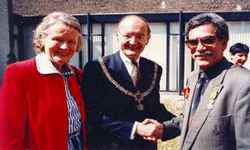
Dutch Foreign Minister Ben Bot has received assurances from his Iranian counterpart, Manouchehr Mottaki, currently on a visit in the Netherlands, that Ahwazi dissident and Dutch citizen Faleh Abdullah Al-Mansouri (pictured with the mayor of Maastricht) is still alive in Iran and that he will get an open trial.
Al-Mansouri, a UNHCR registered refugee and leader of the Ahwaz Liberation Organisation (ALO), was abducted by Syrian authorities while on a visit to Damascus in May and illegally deported to Iran, in contravention of the Geneva Conventions on Refugees. He is currently being held in Section 209 of Evin Prison, which is run by the Ministry of the Intelligence and where opposition activists are tortured by interrogators.
An open trial will mean that representatives of the Dutch embassy or consulate will be allowed in court. Mottari added that Al-Mansouri's family would be allowed to visit him in Iran. He did not however give any information about the visa application submitted by Al-Mansouri's Dutch lawyer Gerard Spong. Iran does not recognise Al-Mansouri's Dutch nationality.
According to Dagblad De Limburger, Amnesty International Maastricht spokesperson Sigrid Haenen comments that the human rights group is caustiously optimistic about this latest development, but that it will advise Al-Mansouri's family not to accept Iran's offer ( click here for report ). Al-Mansouri's son believes that his father's lawyer Gerard Spong would be more helpful to him at this point in Iran than his direct family ( click here for more information ).
Dagblad De Limburger further reports that Amnesty International Maastricht hopes that the city will send an official representative - "preferably Gerd Leers himself" - to Iran in order to ensure that Al-Mansouri, who is charged by Iranian authorities for "terrorist activities", receives a fair trial.
Al-Mansouri was a former high-ranking officer in the Iranian military who rebelled against the Islamic Republic during the Iran-Iraq War. He was sentenced to death by an Iranian military court in 1988, but escaped from custody and fled to Baghdad. He, his wife and four children were relocated to the Netherlands by the UNHCR in 1989 and later acquired Dutch citizenship.
It is unclear whether the Dutch government has accepted the methods by which Al-Mansouri was abducted and transferred to Iran or whether it is making representations to move the dissident from Section 209. The Iranian government has not given any assurance of open trials for four other Ahwazi refugees abducted from Damascus and it is unclear whether the Dutch government is pursuing these cases. The UNHCR has issued complaints on behalf of all five men.
Labels: Amnesty , Mansouri , refugees
permalink
keywords: ahvaz ahwaz ahwazi arabistan khuzestan khuzistan khuzestani arab arabistan iran iranian human rights security oil news ahmadinejad ethnic cleansing
.......................................................................................
27 November, 2006
Below is a joint appeal to the global human rights community by the Human Rights Activists in Iran (H.R.A.I), the Committee Defense for Human Rights in north-west of Iran (H.RN.W.I), the Kurdish Human Rights defense organization (R.M.M.K) and the Ahwazi Human Rights Organization (A.H.R.O) concerning the situation of the Evin Prison in Iran. Click here to sign the petition .
To: The Secretary General of the United Nations, The UN Human Rights Council , Amnesty International, Human Rights watch
An appeal to all Human Right Organizations of the World
Section 209 of Evin Prison in Iran is run by the Ministry of Intelligence of the Islamic Republic and except for the ministry agents no other government bodies have any control over the prison affairs.
During the last years many of Iran political prisoners have died in this Section under torture and many others kept in it have ended up being executed by firing squads or hanged. At this moment of time hundreds of similar prisoners are kept in this Section and the Ministry of Intelligence would not allow their names to be added to the long list of Iran political prisoners.
Most of these prisoners are held in solitary confinement and are constantly interrogated while under physical and psychological torture. The families of these prisoners very rarely have any information about the health or conditions of their loved ones, who are most of the time handcuffed and blindfolded, are denied of medical care and legal representation and do not even know on what charges they have been arrested. In Section 209 of Evin Prison even the very own repressive rules of the regime are not followed.
Those currently held at the Section include political dissidents, human rights activists, students, trade union officials and workers, as well as many other Iranians from all walks of life.
The following people are among the prisoners at Section 209:
Ali Akbar Mussavi Khoini, Dr. Saeed Masoori, Ahmad Batebi, Kayvan Rafii, Kianoosh Sanjari, Dr. Kayvan Ansari, Abulfazl Jahandar, Kheirullah Derakhshandi, Abdullah Al Mansouri, Ayatollah Kazemi Boroujerdi and many of his followers, as well as many prisoners from other provinces of Iran who have been transferred to Evin from their local prisons.
We, the undersigned, would therefore urge the Secretary General of the United Nations, the UN Human Rights Council, Amnesty International and Human Rights Watch to assign a special investigating committee to visit Section 209 of Evin Prison in Iran and publish a report on their findings.
1- Human Rights Activists in Iran (H.R.A.I)
2- Committee Defence for Human Rights in North-West of Iran (H.R.N.W.I)
3- Kurdish Human Rights defence organization (R.M.M.K)
4- Ahwazi Human Rights organization (A.H.R.O)
Labels: human rights , Mansouri , refugees , UN
permalink
keywords: ahvaz ahwaz ahwazi arabistan khuzestan khuzistan khuzestani arab arabistan iran iranian human rights security oil news ahmadinejad ethnic cleansing
.......................................................................................
22 November, 2006
The Syrian Human Rights Committee (SHRC) has denounced the deportation of another group of Ahwazi citizens living in Syria to Iran in a press released issued this week (
click here to download
).
Human rights organisations and the UNHCR have received credible reports that Syria deported three more UNHCR-registered refugees in addition to Saeed Saki and Faleh Abdullah Al-Mansouri (a Dutch national): Taher Mazrae, Rasool Ali Mazrae and Jamal Obaidawi (pictured).
An SHRC media spokesman claimed that Syria have breached its obligations under human rights conventions that commit it to protect recognised refugees. Syria had agreed to host the refugees and permit them to carry out their political activities. The SHRC spokesman called on the Syrian authorities to cease breaking its human rights obligations and to use their influence on Iran to release the Ahwazi detainees.
Amnesty International has previously condemned the deportation of Ahwazi Arab refugees as a violation of international law.
Currently, 11 Ahwazi Arabs are awaiting execution in Iran. Last week, four more Ahwazis - Risan Sawari, Aqil Sawari, Mohammad Ali Sawari and Jafar Sawari - were sentenced to death.
Related stories:
Iran/Netherlands: Dutch Ahwazi activist in Evin prison torture chamber - 19 October
UNHCR deeply concerned about Ahwazi refugees in Syria - 16 September
UNPO: "Iran Must End Repression against Minority Groups" - 15 August
"Syria has violated international law" - Amnesty International - 11 August
Ahwazi Arabs unite against Syrian "treachery" - 11 August
Netherlands abandons Dutch Ahwazi activist - 11 August
Syria deports Ahwazis to Iran, including Dutch national - 9 August
Ahwazis face arrest, deportation and execution - 1 July
UNPO highlights plight of Ahwazis on International Refugee Day - 20 June
UNHCR calls on Syria not to extradite Ahwazi refugees - 6 June
Syria releases three Ahwazis, but four remain in custody - 19 May
Kuwaiti newspaper publishes call for an end to Syria's anti-Ahwazi policy - 18 May
Syria's deportation scandal - 16 May
Lebanese democrats support Ahwazis - 16 May
Ahwazi Arabs arrested in Syria on Iran's request - 13 May
More arrests of Ahwazi Arabs in Syria - 15 May
Ahwazis arrested in Syria - 1 May
Labels: Mansouri , refugees , UN
permalink
keywords: ahvaz ahwaz ahwazi arabistan khuzestan khuzistan khuzestani arab arabistan iran iranian human rights security oil news ahmadinejad ethnic cleansing
.......................................................................................
18 October, 2006
Faleh Abdullah Al-Mansuri, a Dutch citizen and the leader of the Ahwaz Liberation Organisation (ALO) (pictured with the mayor of his home town Maastricht), has been transferred to Evin prison after being extradited to Iran by the Syrian authorities.
Al-Mansuri is being held in Section 209 of the notorious Evin prison, according to Iranian human rights activists. Section 209, where high-profile political prisoners are held, is under the control of the Ministry of Intelligence, which conducts continuous interrogations involving torture. In the prison's torture chambers, inmates are forced to confess to crimes and repent. Prisoners are shackled and kept in solitary confinement with many dying from poor sanitary conditions. Summary executions are often carried out by firing squad.
The ALO advocates Ahwazi Arab independence from Iran and views itself as a government-in-exile. However, no proof has been provided that it has been involved in any terrorist activities, nor is it among the number of different organisations that have claimed responsibility for bomb attacks in Ahwaz over the past 18 months.
Links
Ahwazi refugees remain in Syrian custody - AHRO - 18 August
UNPO: "Iran Must End Repression against Minority Groups" - 15 August
"Syria has violated international law" - Amnesty International - 11 August
Ahwazi Arabs unite against Syrian "treachery" - 11 August
Netherlands abandons Dutch Ahwazi activist - 11 August
Syria deports Ahwazis to Iran, including Dutch national - 9 August
Statement by Amnesty Maastricht on the detention of Faleh Abdullah Al-Mansouri (in Dutch)
U.N. tells Syria not to extradite Ahwazi refugees - 7 June 2006, Ya Libnan
Amnesty International report on fear of forcible return and torture of Ahwazi refugees - 2 June 2006, Amnesty International
Syria releases three Ahwazis, but four remain in custody - 19 May 2006, BAFS
Syrian human rights activists arrested amid Ahwazi deportation scandal - 17 May 2006, BAFS
Syria's deportation scandal - 16 May 2006, BAFS
Syria arresting Ahwazi Arabs to please Iran - 16 May 2006, Ya Libnan
Labels: Mansouri , refugees
permalink
keywords: ahvaz ahwaz ahwazi arabistan khuzestan khuzistan khuzestani arab arabistan iran iranian human rights security oil news ahmadinejad ethnic cleansing
.......................................................................................
16 September, 2006
Press release from the UN High Commissioner for Refugees:
UNHCR is deeply concerned about the fate of three Ahwazi refugees (Iranian Arabs) in Syria. The three men were arrested by Syrian authorities last May in Damascus and have been detained since that time. Prior to their detention, they had been recognized as refugees by UNHCR under the 1951 Refugee Convention, and have been accepted for resettlement in Western European countries.
We have been in regular contact with Syrian authorities in Damascus as well as in Geneva to discuss the situation of the three men. Our staff have been promised several times that they be able to meet with the three detainees, but so far we have had no access despite numerous requests.
We are appealing for the immediate release of the three Ahwazi. We are also calling on the Syrian authorities to refrain from extraditing the three refugees to Iran, and instead to allow their departure to their countries of resttlement.
Deportation of recognized refugees represents a violation of the principle of non-refoulement. This principle of customary international law prohibits states from returning a refugee or asylum seeker to territories where there is a risk that his or her life or freedom would be threatened on account of race, religion, nationality, membership of a particular social group, or political opinion. It is also embodied in Article 3 of the 1984 Convention against Torture and other Cruel, Inhumane or Degrading Treatment or Punishment, to which Syria is a party
We are all the more concerned about these three detained refugees following Syria's previous extradition to Iran of an Arab-Iranian Ahwazi last May. This refugee had been recognized under UNHCR's mandate at the end of 2005 and had been accepted for resettlement to a third country. Nevertheless, he was arrested in March and detained by the Syrian authorities until his extradition to Iran, where he is reportedly detained.
Ahwazi refugees arrived from Iran in Syria and Iraq at various times, most recently in 2005 following a confrontation between members of the Ahwazi community and government forces in the Ahwaz region.
Links
"Syria has violated international law" - Amnesty International - 11 August
Netherlands abandons Dutch Ahwazi activist - 11 August
Syria deports Ahwazis to Iran, including Dutch national - 9 August
UNHCR calls on Syria not to extradite Ahwazi refugees - 6 June
Ahwazis face arrest, deportation and execution - 1 June
Syria releases three Ahwazis, but four remain in custody - 19 May
Kuwaiti newspaper publishes call for an end to Syria's anti-Ahwazi policy - 18 May
Syrian human rights activists arrested amid Ahwazi deportation scandal - 17 May
Syria's deportation scandal - 16 May
Lebanese democrats support Ahwazis - 16 May
More arrests of Ahwazi Arabs in Syria - 15 May
Ahwazi Arabs arrested in Syria on Iran's request - 13 May
Ahwazis arrested in Syria - 1 May
Labels: refugees
permalink
keywords: ahvaz ahwaz ahwazi arabistan khuzestan khuzistan khuzestani arab arabistan iran iranian human rights security oil news ahmadinejad ethnic cleansing
.......................................................................................
09 August, 2006
The British Ahwazi Friendship Society (BAFS) has learnt that the Syrian government has deported all Ahwazis, including UNHCR registered refugees and a Dutch national, in its custody to Iran where they will face arrest, torture and execution.
Eight Ahwazis were detained by the Syrian authorities in May, including Faleh Abdullah Al-Mansouri, a 60 year old Dutch national and leader of the Ahwaz Liberation Organisation.
 Three were later released, but Said Awdeh Saki (pictured), a UNHCR registered refugee who was due to be relocated to Norway, was deported to Iran by the Syrian authorities. Saki is now being held at an unknown location in Iran.
Syria has defied calls by the Dutch government, the UNHCR, Amnesty International and Arab human rights groups, including the Ahwaz Human Rights Organisation, to release the remaining detainees and instead sent them to Iran ( click here for AHRO's appeal ).
At the weekend, members of Amnesty International protested outside the Syrian embassy in Brussels calling for Al-Mansouri's release (
click here for more information
). The ALO leader is well-known in Maastricht, where he lived before he was kidnapped by the Syrian regime, and is friends with the city's mayor (picture shows Mayor of Maastricht with Al-Mansouri).
The ALO has confirmed that Al-Mansouri has been deported after receiving a letter from the Dutch government informing them of Syria's deportation decision. The UNHCR has also received notification of the deportations.
Others sent to Iran include Gamal Obaidy (pictured), a 34 year old student at Damascus University and Chair of Ahwazi Student Union in Syria, and Ahwazi political activists Taher Ali Mazrae and Abdulrasoul Ali Mazrae, who are both brothers.
BAFS spokesman Nasser Bani Assad said: "The regime of President Bashar Al-Assad has chosen to align himself with the Islamic Republic of Iran against the indigenous Ahwazi Arabs. The move belies his claims of pan-Arab solidarity. The Syrian regime is nothing but a puppet of Tehran and has no respect for humanitarian conventions or international law. President Assad's decision to deport Ahwazis puts the entire Ahwazi community in Damascus, which is thousands strong, under threat.
"Syria's decision comes amid threats against Ahwazi political refugees in the UAE and Kuwait and the assassination of an Ahwazi opposition leader in Iraq's Basra province earlier this year. The European Union must protest strongly at Syria's illegal actions."
Links
Statement by Amnesty Maastricht on the detention of Faleh Abdullah Al-Mansouri (in Dutch)
U.N. tells Syria not to extradite Ahwazi refugees - 7 June 2006, Ya Libnan
Amnesty International report on fear of forcible return and torture of Ahwazi refugees - 2 June 2006, Amnesty International
Syria releases three Ahwazis, but four remain in custody - 19 May 2006, BAFS
Syrian human rights activists arrested amid Ahwazi deportation scandal - 17 May 2006, BAFS
Syria's deportation scandal - 16 May 2006, BAFS
Syria arresting Ahwazi Arabs to please Iran - 16 May 2006, Ya Libnan
Labels: Mansouri , refugees
permalink
keywords: ahvaz ahwaz ahwazi arabistan khuzestan khuzistan khuzestani arab arabistan iran iranian human rights security oil news ahmadinejad ethnic cleansing
.......................................................................................
06 June, 2006
The following article was published by the UN's news centre -
click here to download the original article
. For the UNHCR's statement,
click here
.
The United Nations refugee agency today called on Syria not to extradite Iranian Arabs to their homeland, reminding the Government of its obligations not to return refugees or asylum seekers to territories where their lives or freedom might be threatened due to race, religion, nationality or political opinion.
The UN High Commissioner for Refugees (UNHCR) "is increasingly concerned about the fate of several Ahwazi (Iranian Arab) refugees recognized by our office in Damascus," spokesman Ron Redmond told a news briefing in Geneva, citing the recent arrest of seven Ahwazis.
Six of these are recognized by UNHCR as refugees under the 1951 Refugee Convention and one is a former refugee recently naturalized by the Netherlands. The Agency immediately raised its concerns at the highest levels, stressing that the recognised refugees should immediately be released. As a result, three have been freed but four remain in detention.
"UNHCR is particularly concerned about the fate of these Ahwazis, as the Syrian authorities recently deported to Iran an Arab-Iranian Ahwazi who was recognised as a mandate refugee by UNHCR Damascus at the end of 2005 and who had been accepted for resettlement in Norway," Mr. Redmond said.
According to the Syrian Foreign Ministry, the extradition was requested by the Iranian authorities. "Extradition does not mean that a refugee or asylum seeker loses his or her international protection status. We therefore strongly appeal to both Syrian and Iranian authorities to allow the refugee to depart to Norway as scheduled," Mr. Redmond added.
Ahwazi refugees came to Iraq and Syria during various periods. Recent human rights reports have expressed concerns about the deteriorating human rights situation in Al-Ahwaz (Khuzestan) in Iran, home to nearly 2 million Iranians of Arab descent. Individuals promoting rights of the Arab people in the Ahwaz region have reportedly been targeted, and access to the region has been denied to foreign and local journalists, Mr. Redmond said.
"UNHCR strongly appeals to Syria to abide by its obligations under international law and to ensure that the principle of non-refoulement is recognised," he added.
"The principle of non-refoulement prohibits states from returning refugees or asylum seekers to territories where there is a risk that their lives or freedom would be threatened on account of race, religion, nationality, membership of a particular social group or political opinion."
Links
Syria's deportation scandal - British Ahwazi Friendship Society
Ahwazis face arrest, deportation and execution - British Ahwazi Friendship Society
Further information on fear of forcible return and new concern: Torture - Amnesty International
Syria arresting Ahwazi Arabs to please Iran - Ya Libnan
Ahwazi refugees arrested and deported to Iran - Syrian Human Rights Committee
Labels: refugees , UN
permalink
keywords: ahvaz ahwaz ahwazi arabistan khuzestan khuzistan khuzestani arab arabistan iran iranian human rights security oil news ahmadinejad ethnic cleansing
.......................................................................................
01 June, 2006
Six Ahwazi Arabs have been sentenced to death this week at Section 3 of the Ahwaz Revolutionary Court.
 They were convicted of involvement in bomb attacks in the city, although the names of those sentenced have not been confirmed. Reports suggest that three of those facing execution are among the six sons of moderate Ahwaz tribal leader Hajj Salem Bawi who have been the subject of an intense campaign for their release. The Bawi brothers are believed to be among the victims of the government's retribution against the Ahwazi population for unrest that has gripped the province of Khuzestan, the Ahwazi Arab homeland. However, reports from Ahwaz are unclear as the proceedings of the Revolutionary Courts are held in private, with defendents denied access to defence lawyers. In a recent report, Amnesty International has listed 11 men threatened with execution, including Zamal and Imad Bawi, pictured (
click here for report
).
They were convicted of involvement in bomb attacks in the city, although the names of those sentenced have not been confirmed. Reports suggest that three of those facing execution are among the six sons of moderate Ahwaz tribal leader Hajj Salem Bawi who have been the subject of an intense campaign for their release. The Bawi brothers are believed to be among the victims of the government's retribution against the Ahwazi population for unrest that has gripped the province of Khuzestan, the Ahwazi Arab homeland. However, reports from Ahwaz are unclear as the proceedings of the Revolutionary Courts are held in private, with defendents denied access to defence lawyers. In a recent report, Amnesty International has listed 11 men threatened with execution, including Zamal and Imad Bawi, pictured (
click here for report
).
 Meanwhile, a number of Ahwazi refugees are being held in custody in Syria while their fate is decided by the Syrian government, an ally of the Iranian regime. Saeed Saki, an Ahwazi refugee registered with the Office of the UN High Commissioner for Refugees, has already been extradited to Iran by Syria and human rights groups have expressed concern over his treatment (
click here for details
).
Meanwhile, a number of Ahwazi refugees are being held in custody in Syria while their fate is decided by the Syrian government, an ally of the Iranian regime. Saeed Saki, an Ahwazi refugee registered with the Office of the UN High Commissioner for Refugees, has already been extradited to Iran by Syria and human rights groups have expressed concern over his treatment (
click here for details
).
Syria's extradition of registered Ahwazi refugees contravenes the Geneva Convention on refugees and Ahwazi activists have appealed to the Syrian government to release the refugees. The refugees' UNHCR registration documents state that they should be "protected from forcible return where he/she would face threats to his or her life or freedom." The British Ahwazi Friendship Society (BAFS) has obtained proof of the UNHCR refugee registration for Jamal Obeidi, a 34-year-old student and Chair of Ahwazi Student Union in Syria (click on picture for larger version).
Dutch national Faleh Abdullah al Mansouri (60), who leads the Ahwaz Liberation Organisation (ALO), is also being held by Syria. The Iranian regime claims all those arrested in Syria are Salafists, followers of a Sunni Islamist sect. However, the ALO has never propagated any religious views and has a secular nationalist ideology.
Labels: death penalty , Mansouri , refugees
permalink
keywords: ahvaz ahwaz ahwazi arabistan khuzestan khuzistan khuzestani arab arabistan iran iranian human rights security oil news ahmadinejad ethnic cleansing
.......................................................................................
19 May, 2006
The British Ahwazi Friendship Society (BAFS) has received reports that the Syrian authorities have released three Ahwazi Arab refugees arrested in the past two weeks, apparently on the instruction of the Iranian government.
Ahmad Abiat, Mousa Sawari and Issa Alyassin were reportedly released. Little is known of the other captives, which include Dutch national Faleh Abdullah Al-Mansouri (60), leader of the Ahwaz Liberation Organisation (ALO) which was founded in 1990 and supports independence for Arab regions of Iran. According to the Gulf Times, the Dutch government has demanded an explanation from Syria over Al-Mansouri's detention. Al-Mansouri has been a resident of Maastricht in the Netherlands since he fled to the country in 1989.
There is mounting concern for Saeed Saki, an Ahwazi refugee with protection from the UNHCR who was deported by the Syrian government to Iran. Saki is believed to be in Iranian custody and is in danger of torture and execution ( click here for more information ).
Over the past year, international NGOs and UN agencies have documented the persecution of Ahwazi Arabs in Iran. Many Arabs believe that the Syrian government's decision to detain Ahwazis, most of whom are registered as refugees with the UNHCR, indicates that President Bashar Al-Assad is willing to sacrifice solidarity with persecuted Arabs for the sake of his new-found allegiance to Tehran.
The arrests of Ahwazi refugees were followed by the arrests of human rights activists in Syria who called for their release and the release of Syrians who backed the Damascus-Beirut Declaration which calls for Syria to respect Lebanese independence and sovereignty.
BAFS spokesman Nasser Bani Assad said: "The Syrian government's actions have been condemned by many Arab organisations and have generated solidarity behind the Ahwazi cause, particularly among Lebanese and Syrian democrats. Iran is taking increasingly desperate measures to halt the rise in anti-regime politics among Ahwazi Arabs, but its increasingly brutal methods - the imprisonment of the babies of Ahwazi dissidents, summary killings, torture, assassinations and other crimes against humanity - have merely attracted publicity and solidarity. We are getting messages of support from Lebanon, Syria, Kuwait, the UAE as well as Europe and North America as a direct result of Al-Assad's actions which were carried out on behalf of the Iranian regime.
"The arrest of eight Ahwazis in Syria has brought more solidarity and publicity than the thousands of Ahwazis arrested in Iran over the past year. The scandal surrounding Saki's deportation to Iran shows Al-Assad up as something of a blundering clown who has sold out Arabs to align with a hardline religious theocracy. Facing with criticism over Syria's alleged involvement in the assassination of former Lebanese prime minister Rafik Hariri, Al-Assad is seeking protection from Tehran. Ahwazi refugees are paying a blood price for his desire for Iranian support."
In reporting the arrests of Ahwazis in Syria, the BBC has wrongly portrayed the Ahwazi struggle as a religious conflict between Sunni Arabs and the Shia-led Iranian state. In fact, 80 per cent of Ahwazi Arabs are Shia. The BBC has also claimed that the Ahwazi activists are involved in communal violence, but there is no evidence of attacks by Ahwazi Arabs on members of other ethnic groups in Khuzestan, where most Ahwazi Arabs live. Ahwazi resistance has mainly taken the form of non-violent demonstrations against the regime and its anti-Arab policies, rather than a campaign against Persians or other Iranian nationalities. Despite forced displacement of Arabs for the construction of settlements for non-Arabs brought in from outside the province, there has been little if any communal violence from Ahwazi Arabs against settlers.
Labels: Mansouri , refugees
permalink
keywords: ahvaz ahwaz ahwazi arabistan khuzestan khuzistan khuzestani arab arabistan iran iranian human rights security oil news ahmadinejad ethnic cleansing
.......................................................................................
17 May, 2006
Kuwait's independent newspaper Alqabas has published an open letter to Syria's President Bashar Al-Assad by eight Ahwazi Arab groups calling him to release Ahwazi Arab refugees arrested in Syria over the past week ( click here for further information ).
Referring to the deportation of UN-registered Ahwazi refugee Saeed Saki (pictured), the Ahwazi groups claimed that the the arrests were "the first time that Syrian Arab nationalist government handed an Ahwazi Arab to the Iranians," calling the arrests "a dangerous dark spot policy in Syrian history directed against our just cause."
The letter added: "The Ahwazis always have been grateful for Syrian nation to welcome them in their second homeland and they have always taken a responsible approach towards the rule of law in Syria"
The letter was signed by the Ahwazi Arab Liberation Front, the Arabistani National Party, the Ahwazi Cultural Committee, the Ahwazi National United Movement, the Ahwazi Patriotic Solidarity Party, the Ahwazi Arab Struggle Movement, the Ahwazi Democratic Assembly and the Ahwazi Patriotic Democratic Movement. Click here to read the letter .
Further information:
Amnesty International report - Syria: Fear of forcible return Syria's Deportation Scandal
More Arrests of Ahwazi Arabs in Syria
Ahwazi Arabs arrested in Syria on Iran's request
Syrian human rights activists arrested amid Ahwazi deportation scandal
Lebanese democrats support Ahwazis
permalink
keywords: ahvaz ahwaz ahwazi arabistan khuzestan khuzistan khuzestani arab arabistan iran iranian human rights security oil news ahmadinejad ethnic cleansing
.......................................................................................
 The director of the France-based
Arab Commission for Human Rights
(ACHR), Mahmood Marai, and activists from the organisation have been arrested after it published a series of statements in response to Syria's arrest of Ahwazi refugees.
The director of the France-based
Arab Commission for Human Rights
(ACHR), Mahmood Marai, and activists from the organisation have been arrested after it published a series of statements in response to Syria's arrest of Ahwazi refugees.
In the past few days, the ACHR, an international NGO with special consultative status with the UN's Economic and Social Council, has released details regarding the arrest and detention of eight Ahwazis, mostly refugees registered with the UNHCR but also including a Dutch national. Damascus is home to a significant Ahwazi Arab community, which includes many refugees who fled persecution in their native homeland in Khuzestan, Iran. One Ahwazi UN-registered refugee, Saeed Saki, has been deported back to Iran, where he has been detained by the authorities and is in danger of torture and execution ( click here for more details ).
ACHR's campaign led to an appeal by Amnesty International, which said the men were "at risk of torture and of being forcibly returned to Iran, where they would face persecution and possibly the death penalty" ( click here for Amnesty's report ).
Among the human rights activists under arrest are Nidhal Darwish, a key member of Defence Committees for Human Rights and Democratic Freedoms in Syria, and the AHCR's Mahmood Issa and Dr Safwan Taifour. The ACHR has condemned the arrests, along with the detention of Syrian writer Mishel Kilo and Communist leader Fateh Jamoos over their support for Lebanon's independence from Syria. The organisation claims the arrests were an attempt by the Syrian authorities to intimidate Syrian civil society and has called for a demonstration at the UN's Human Rights Commission next month.
Labels: Mansouri , refugees
permalink
keywords: ahvaz ahwaz ahwazi arabistan khuzestan khuzistan khuzestani arab arabistan iran iranian human rights security oil news ahmadinejad ethnic cleansing
.......................................................................................
16 May, 2006
 The Lebanese Ya Libnan news agency has called on the intervention of the Arab League to support the Ahwazi Arabs and "chastise" Syria for detaining and deporting Ahwazis to Iran.
Eight Ahwazis, mostly refugees and asylum seekers but also including a Dutch national, have been detained by the Syrian authorities over the past week. One is known to have been deported to Iran and his life is in grave danger.
Criticism by Ya Liban comes amid growing awareness in the Arab world of the injustices faced by the Ahwazi Arabs under Iranian rule. The news service was founded to support democracy and independence for Lebanon following the assassination of former prime minister Rafik Hariri, which UN investigators believe had Syrian backing. It was supportive of the "Cedar Revolution" which forced Syrian troops to leave Lebanon after 30 years of military occupation.
Ya Libnan criticised the problem of illiteracy among Arabs, who are denied the right to learn their own language. In the article, the writer gave a personal account of a visit to Ahwaz: "I met by accident one prominent Arab Ahwazi and found out later that he is a poet. Unfortunately I discovered later that none of his poetry was ever documented, because he could not write or read Arabic. He was so happy when I was able to write down one of his poems as he recited it. The poem was about Gamal Abd el Nasser and only a true Arab could have ever written such an emotional poem about an Arab leader."
The writer Ali Hussein added: "It is about time for the Arab League to step in and support the Arabs of Iran. Arab League Secretary General should immediately call for a summit to. The question is: Will he?"
Nasser Bani Assad, spokesman for the British Ahwazi Friendship Society (BAFS), said: "Many democrats and progressives across the Arab world are beginning to recognise the abuses suffered by the Ahwazis and are supporting their struggle for human rights, self-determination and freedom. Lebanese, Egyptians, Syrians and Iraqis are among the various nationalities who have expressed their support for the Ahwazis in recent weeks.
"The Cedar Revolution in Lebanon has inspired many Ahwazis to take up non-violent resistance against state terrorism and occupation. It shows that people power can work."
Click here for Ya Liban article
Labels: Mansouri , refugees
permalink
keywords: ahvaz ahwaz ahwazi arabistan khuzestan khuzistan khuzestani arab arabistan iran iranian human rights security oil news ahmadinejad ethnic cleansing
.......................................................................................
15 May, 2006
Syria is undermining the Geneva Refugee Convention and the work of the Office of the UN High Commissioner for Refugees by detaining and deporting Ahwazi Arab asylum seekers and refugees to Iran, the British Ahwazi Friendship Society (BAFS) has told officials at the Syrian embassy today.
The deportation of Saeed Saki (pictured), a 40-year-old Ahwazi asylum seeker resident in Damascus, to Iran is not only a breach of his human rights but will almost certainly lead to his death at the hands of the Iranian regime, which is seeking to silence opposition. The arrests and deportation come in the context of growing government aggression against Ahwazi Arabs in Iran's Khuzestan province, which has witnessed growing anti-government unrest.
Seven other Ahwazis have been arrested and detained by the Syrian authorities, including Dutch national, Faleh Abdullah al Mansouri (60), who leads the Ahwaz Liberation Organisation (ALO) ( click here for more details ).
BAFS has called on the Syrian government to stop deportations and release the men if there are no criminal charges against them. It has reminded the government of its duties and obligations to refugees under international law.
BAFS spokesman Nasser Bani Assad said: "We believe that Mr Saki's life is in danger as a direct result of the Syrian government's actions. Damascus has a large Ahwazi Arab community, including many refugees and opposition groups, that has never posed a challenge to the Syrian government. Indeed, it was not long ago that Syria professed sympathy for the persecuted Ahwazi Arabs of Iran.
"By arresting and detaining Ahwazi refugees, who have abided by Syrian law and have sought sanctuary in Damascus, the Syrian government is participating in the oppression and persecution of Arabs. We do not believe that the Syrian people support these deportations. We think Syria's actions, particularly the deportation of Mr Saki, could further alienate the government both in the Arab world and in the wider international community."
Labels: Mansouri , refugees
permalink
keywords: ahvaz ahwaz ahwazi arabistan khuzestan khuzistan khuzestani arab arabistan iran iranian human rights security oil news ahmadinejad ethnic cleansing
.......................................................................................
The British Ahwazi Friendship Society (BAFS) has learned that more Ahwazi Arabs have been arrested in Syria, including the leader of the Al-Ahwaz Liberation Organisation, and at least one Ahwazi political refugee has been deported to Iran.
ALO leader Faleh Abdullah al Mansouri (60) has lived in exile in Maastricht in the Netherlands since 1989 and is believed to have Dutch nationality. He was arrested along with a colleague from his party, Abdulrasoul Ali Mazraeh (51), who is registered with the UNHCR as a refugee and lives with his six children in Damascus.
Asylum seeker Saeed Owdeh Saki has also been arrested and BAFS has received reports that he has been deported to Iran where his life is in danger.
Al-Mansouri, Mazraeh and Saki are among eight Ahwazi men known to have been detained by the Syrian authorities ( click here for information on arrests ).
The ALO was formed in 1990 by a number of Ahwazi Arab organisations campaigning for a separate state of Al-Ahwaz. The ALO's Ahwaz Revolutionary Council (ARC) regards itself as the Ahwazi government in exile with Al-Mansouri as its President, although there are many Ahwazi groups that do not accept the ARC's assumed leadership of the Ahwazi movement.
BAFS and its allied groups, including the Democratic Solidarity Party of Al-Ahwaz, do not recognise Al-Mansouri's leadership, but are concerned for his welfare and the welfare of other Ahwazis currently in Syrian custody. BAFS activists are appealing to the Syrian embassy in London to explain the charges against all those detained in the past week and are calling on the Syrian government to respect the Geneva Refugee Convention and the Universal Declaration on Human Rights. If Al-Mansouri has EU citizenship, any attempt to deport him to Iran could have a negative impact on Iran-EU relations.
Saki's deportation could pave the way for further deportations of Ahwazi Arabs from Syria, which has for many years been regarded as a sanctuary for Ahwazis fleeing persecution in Iran. Ahwazi refugees in Middle Eastern countries are facing increased insecurity as Iran seeks to stamp out all opposition to its regime, both inside and outside the country. Iranian agents are known to have assassinated an Ahwazi opposition leader Ra'ad De'ayer Al-Bestan Banitorfi in Iraq's Basra province ( click here for report ). Refugees in Kuwait and the UAE have also received death threats and are now in the process of being relocated. The Iranian government now appears to be expanding its state terror tactics against opposition activists outside Iran.
Many Ahwazi activists in the UK now fear that Iran may try to carry out assassinations in Europe in an attempt to halt the growing Ahwazi Arab uprising in Iran. Some Austrian politicians have accused President Mahmoud Ahmadinejad of involvement in the assassination of Iranian Kurdish leader Abdul Rahman Ghassemlou and two of his associates in Vienna in 1989 during peace negotiations with the Iranian government. At the time, Ahmadinejad was an engineer serving with a unit of the Iranian Revolutionary Guards specialising in extra-territorial activities; some organisations claim he gave logistical support to the assassination campaign in Austria. Now he is President, many fear he is seeking to step up violence against exiled dissidents.
Deportations from Syria and the assassination in Iraq, along with reports that Ahwazi Arab refugees are being expelled by the Iranian-influenced Iraqi government, indicates that the Iranian regime is prepared to export the kind of terror tactics it has used against Ahwazi Arabs in their homeland in Khuzestan.
BAFS spokesman Nasser Bani Assad said: "The Syrian authorities need to explain why they are suddenly arresting Ahwazi Arabs who have been resident in Syria for many years and are legally recognised as refugees. Due to Saki's deportation, it appears that the Ahwazis are being detained on the request of the Iranian government rather than any allegation that they have broken Syrian law.
"If the Ahwazis are being charged with any crime committed in Syria, then we request the Syrian authorities to ensure the accused are guaranteed a free, fair and transparent trial that meets international standards. If they are not being held in connection with any alleged crime, then they should be released immediately.
"We would like to remind the Syrian and Iraqi governments that any assassination or kidnap of residents and citizens of other countries is illegal and in our view constitutes an act of terrorism. Syria's deportation of Saki, who has not to our knowledge broken any Syrian law, indicates that the Syrian government is a participant in Iran's terror tactics against Ahwazis.
"If this is all about creating a good impression with the Iranian regime, then Syria is playing a dangerous game. Al-Mansouri's detention could prompt interest in the arrests by EU officials as he is a permanent Dutch resident and possibly and EU citizen. If he is not released, then Syria's involvement with Iran's repression of Ahwazi groups will come under scrutiny by the Dutch government and the European Commission.
"It remains to be seen whether Syria is willing to heighten diplomatic tensions with the EU over the Ahwazi issue at a time when President Bashar al-Assad is facing mounting pressure over the assassination of former Lebanese prime minister Rafik Hariri."
Labels: Mansouri , refugees
permalink
keywords: ahvaz ahwaz ahwazi arabistan khuzestan khuzistan khuzestani arab arabistan iran iranian human rights security oil news ahmadinejad ethnic cleansing
.......................................................................................
13 May, 2006
The Arabic Network for Human Rights Information in Syria has revealed that Ahwazis were arrested by Syrian intelligence services on Thursday afternoon, although the charges against them are unknown. have been arrested with unknown reason in Syria on Thursday 11/5/06 afternoon.
The arrested include:

Mousa Sawari - English Literature student at Damascus University, 32 years old, single

Issa Alyassin - English Literature student at Damascus University, 30 years old, married
Gamal Obaidy -Politics student at Damascus University, 34 years old, single, Chair of Ahwazi Student Union in Syria

Ahmad Abiat - father's name: Abdul Jabbar, 20 years old, Student of Arabic literature at Damascus University)
Taher Ali Mazraeh: married, 40 years old, father's name Ali
The men are all registered as refugees with the UNHCR's office in Syria and were waiting to be transferred to the EU or Canada. Of those arrested, only Mazraeh is known to be a member of the Al-Ahwaz Arab Peoples Democratic Popular Front (ADPF), a group which Iran has previously accused of carrying out bomb attacks in Ahwaz. However, the organisation is not affiliated to the groups that have claimed responsibility for attacks and has not advocated armed struggle. Ahwazi activists fear that if the men are deported to Iran, they are likely to be put on trial and executed. Any deportation would constitute a breach of the Geneva Refugee Convention by the Syrian government.
Syria has a large Ahwazi Arab community, which includes many political refugees. However, the new alliance between Syria and Iran has prompted Syrian security services to intimidate opponents of the regime in the Ahwazi community. Ahwazi refugees were arrested in Syria in April last year, but were quickly released without charge ( click here for report ).
Since President Mahmoud Ahmadinejad became president in August, Iran has taken an increasingly aggressive stance towards dissidents in neighbouring countries. In April, Ahwazi opposition politician Ra'ad De'ayer Al-Bestan Banitorfi was kidnapped by Iranian-backed militias in Basra, Iraq, and murdered. Ahwazi dissidents in Kuwait and the UAE have also reported death threats by Iranian agents.
Labels: Mansouri , refugees
permalink
keywords: ahvaz ahwaz ahwazi arabistan khuzestan khuzistan khuzestani arab arabistan iran iranian human rights security oil news ahmadinejad ethnic cleansing
.......................................................................................
22 April, 2006
Iraqi Prime Minister Ibrahim al-Jafaari is ordering the expulsion of Ahwazi Arab refugees, according to the el-Fekr-el-Eslami website.
Some 2,500-3,000 Ahwazi Arabs in Iraq are registered with the UNHCR as refugees, most of whom fled the fighting in the Iran-Iraq War (1980-88). Al-Jafaari has reportedly ordered the their expulsion from the Iraqi provinces of Basra and al-Ammarah, under the orders of the Iranian regime. El-Fekr-el-Eslami website says the refugees will be handed over to the Iranian authorities.
Many Ahwazi Arab Sunnis have already fled Basra and al-Ammarah for Sunni areas of Iraq, including Fallujah, Morsel and Diali, to escape Iranian-backed Shia militias. Last year, the UNHCR raised concerns over the expulsion of Ahwazi refugees from Basra following the overthrow of Saddam Hussein ( click here for report ). Both Shia and Sunni Ahwazi refugees have expressed concern that they will be imprisoned or even executed on their arrival in Iran.
Meanwhile, Iraq's Al-Zaman daily newspaper has quoted Basra's director of education as stating that children of Ahwazi Arab descent are being expelled from Iraqi schools and universities.
The expulsions follow the kidnapping and murder of Ahwazi political leader Ra'ad De'ayer Al-Bestan Banitorfi, reportedly by Iraqi intelligence and on the orders of Iraq's Ministry of the Interior ( click here for report ).
Nasser Bani Assad, spokesman for the British Ahwazi Friendship Society (BAFS), said: "The Iraqi government is reneging on its commitments under the Geneva Convention relating to the Status of Refugees. According to the UNHCR, those Ahwazis who have tried to resettle in Iran following the Iraq War have returned to Iraq due to the situation in Al-Ahwaz (Khuzestan). Even the unstable and hostile situation in Iraq is preferable to Al-Ahwaz, where the Iranian regime is carrying out a campaign of ethnic cleansing of Ahwazi Arabs.
"The Iraqi government is effectively acting as Iran's henchmen in the Middle East and the Shia areas are under Tehran's de facto control. The Iranian-sponsored Iraqi parties in government are willing to break the law to serve their masters in Tehran and refugees - the most vulnerable people in the Middle East - are paying the price.
"Ahwazis are not the only victims of Iraq's contravention of Geneva Conventions. Palestinian refugees are also being purged from Iraq. It is time for Arab solidarity to counter the menace of encroaching Iranian power in the Middle East. Instead, we find that the UAE and Kuwait are signing security pacts with Iran, which could result in the expulsion or imprisonment of Ahwazi Arab opposition activists in these countries. It seems that every Arab and European leader is falling to their knees in front of President Ahmadinejad to appease the fascist government in Tehran."
Labels: refugees
permalink
keywords: ahvaz ahwaz ahwazi arabistan khuzestan khuzistan khuzestani arab arabistan iran iranian human rights security oil news ahmadinejad ethnic cleansing
.......................................................................................
15 April, 2006
 An Ahwazi Arab politician living in exile in Iraq has been murdered after he was kidnapped in Basra, where he and his family live.
Ra'ad De'ayer Al-Bestan Banitorfi was kidnapped on 9 April and four days later his mutilated body was found. It is believed that he was tortured to death. Reports from Iraq suggest the kidnapping and assassination was carried out by militias under the influence of Iraq's Interior Ministry and at the behest of the Iranian regime. Relatives say that Al-Bestan had been followed by Iraqi intelligence officials for weeks. They fear his close family are at risk and they have no financial means to support themselves.
Several Ahwazi groups have condemned the assassination of Al-Bestan, whose father was killed by the monarchist regime in the 1970s. The killing came at the same time as Iraqi Interior Minister Bayan Jabr admitted there were sectarian death squads present in Iraq, but although many wore uniforms, they were not under the ministry's control.
Last year, the UN High Commissioner for Refugees highlighted the problems facing exiled Ahwazi Arabs in Iraq. It says some 2,500 Ahwazi refugees were ordered to leave their homes by Iraqi militias and are now camped out in the desert or are occupying derelict buildings ( click here for report ). Palestinian refugees are also affected by death squad activity, with 88 refugees currently camped at Iraq's border with Jordan after a series of killings ( click here for Amnesty International's report ). In 2005 the Minister of Displacement and Migration is reported to have said that Palestinians were not welcome in Iraq and should leave the country, according to Amnesty.
Nasser Bani-Assad, spokesman for the British Ahwazi Friendship Society (BAFS), said: "The Iraqi administration is failing in its obligation to protect refugees under international law. Dominated by parties that were bankrolled by Tehran, the administration is permitting, if not encouraging, the assassination of political dissidents from foreign countries by armed militias. There has never been any suggestion that Al-Bestan broke Iraqi laws. If there were any such allegations, then he should have been given a free and fair trial. The real reason for Al-Bestan's assassination is that Iran wanted him dead and sent its Iraqi henchmen to kill him, probably with the full knowledge of the Basra authorities.
"We are concerned about Iran's growing influence in the region. Earlier this year, Kuwait and Iran agreed a security deal on regional security that could have implications for Kuwait's large Ahwazi Arab population, where Ahwazi opposition groups are active. Last year, the Syrian authorities arrested and later released Ahwazi activists, apparently on the orders of the Iranian authorities. Iran has also supported Shi'ite extremists in Bahrain, which are seeking to overthrow the island's monarchy and could be used to carry out assassinations.
"There are no safe places for Ahwazi political refugees in the Middle East due to growing Iranian influence. We appeal to the governments of the European Union to allow Ahwazi refugees to seek asylum in Europe, even if they have travelled through Kuwait, Iraq, Syria and Bahrain before arriving. These countries are no longer safe for Ahwazi Arabs to claim asylum. We hope that Ahwazi asylum applications will be met with sympathy by authorities in Europe."
Labels: human rights , refugees
permalink
keywords: ahvaz ahwaz ahwazi arabistan khuzestan khuzistan khuzestani arab arabistan iran iranian human rights security oil news ahmadinejad ethnic cleansing
.......................................................................................
28 November, 2005
Hundreds of Ahwazi refugees in southern Iraq are living in deteriorating conditions, with little access to basic services such as education and healthcare, say UN officials.
According to a report released in early November by the UN refugee agency, UNHCR, there are some 2,500 refugees from the Iranian city of Ahwaz currently in Iraq. They are mainly concentrated in the south, in rural areas near Dujail, a majority Shi'ite city 80km south of the capital, Baghdad. [see: UNHCR Highlights Plight of Ahwazi Refugees in Iraq ]
Most Ahwazi refugees sought asylum in Iraq after fleeing neighbouring Iran, where they were accused by the government of serving as Iraqi fifth columnists during the ruinous Iran-Iraq war that lasted throughout much of the 1980s.
"People just came to my house and told us that we had 24 hours to leave Ahwaz," recalled 31-year old Salah Ali, who now lives in an empty government building near Dujail.
In Iraq, however, with prevailing insecurity, conditions for the Ahwazis have worsened.
The UNHCR report highlights dismal living conditions faced by most Ahwazis, who often live in abandoned government buildings and empty schools with little or no access to potable water or electricity.
"Most Ahwazi refugees are either living in public buildings or mud houses that lack water, electricity and sewage services," the report reads. The smell of open sewage in these make-shift dwellings, the report adds, is pervasive.
The report also goes on to state that most public buildings will almost certainly be repossessed by the government in the future, and also remain at risk from mines and unexploded ordnance.
Ziad Kardash, 27, an Ahwazi who lives in an abandoned school in Dujail, said that several of his close relatives had been injured by unexploded ordinance.
"If we leave, we'll have nowhere to go, but if we stay, we could be the next victims," said Kardash.
The report also notes that the lack of healthcare has resulted in widespread malnutrition among children.
"My son is seriously sick because we don't have enough food," said Ali. "Sometimes we have to divide the same plate of rice between more than 10 people."
In an effort to prevent a further deterioration of the health situation, the Iraq Red Crescent Society (IRCS) recently announced it would form a committee to study the case of the refugees and prepare to send medical supplies.
Ahwazis, meanwhile, complain that the current Iraqi government is indifferent to their plight.
"We don't know where to go," said Kardash. "When we go to other governorates, they just tell us it's not their problem and that it is best for us to leave the country."
Government officials, however, point out the difficulties involved in offering refuge in an already poor and war-torn country.
"If we give residence permits to all of them, we'll have more foreigners in our country than Iraqis," said Maj Omar Lattif, a senior official in the department for residency claims.
"We need time to study all the cases. We can't just give residency permits to anyone who comes to our office," he added.
During the Saddam Hussein era, Ahwazi refugees were provided with homes and monthly food rations. Because of their association with the former regime, however, Ahwazis now often face discrimination and harassment.
"My boss fired me after he found out I was Ahwazi," Ali said. "He said Ahwazis don't deserve money from Iraqis because we were Saddam's helpers."
The UNHCR report notes that 80 Ahwazi families were forced out of their homes recently by supporters of the current Iraqi government.
These families, the report adds, were subsequently relocated to a transit centre on the outskirts of Basra City.
This report was written by IRINnews , a project of the UN Office for the Coordination of Humanitarian Affairs.
Labels: refugees
permalink
keywords: ahvaz ahwaz ahwazi arabistan khuzestan khuzistan khuzestani arab arabistan iran iranian human rights security oil news ahmadinejad ethnic cleansing
.......................................................................................
04 November, 2005
A report on Iraq published by the UN High Commissioner for Refugees (UNHCR) has drawn attention to the plight of Ahwazi Arab refugees in Iraq.
There are at least 2,500 Ahwazi refugees in Iraq, most of whom arrived after fleeing conflict between Iran and Iraq. According to the UNHCR, "they are predominantly of rural background, and live in local settlements in Southern Iraq near the Dujailah area 45 kilometres west of Al-Kut."
Before the Iraq War, the refugees had been provided with land and houses by the Iraqi government, having been forced off their land by the Iranian regime. This created resentment among local Iraqis, who have persecuted the Ahwazis since the fall of Saddam Hussein.
According to the UNHCR, around 80 Ahwazi families forced out of their homes by supporters of the new government, which contains parties sponsored by the Iranian regime, have been relocated to its transit centre on the outskirts of Basra City. The report adds that "they were later evacuated by the Iraqi authorities and ever since have been scattered throughout the Southern Governorates. Many attempted to return to Iran, but came back to Iraq due to alleged harassment by the Iranian authorities and difficulties reintegrating following years in exile."
The UN agency's report states that "most Ahwazi refugees are either living in public buildings or mud houses that lack water, electricity and sewage services. Most public buildings will almost certainly be repossessed by the Government in the future, and also remain at risk from mines and unexploded ordinance."
The UNHCR says that the Ahwazis now face problems obtaining new residency permits, which has been an obstacle to obtaining public services such as education. The agency is in the process of conducting an in-depth survey to register them and acquire necessary data. It also said it had received reports that child labour was prevalent among Ahwazi refugees and that Ahwazi refugees were being denied equal access to health services. The agency added that "most Ahwazi children are suffering malnutrition".
The report states that "many Ahwazi refugees face severe problems as regards adequate housing and access to public services such as education and health. The 104 Ahwazi refugees in the Baghdad area face similar problems to those faced by Syrian and Palestinian refugees."
Click here to read the original document
Labels: refugees
permalink
keywords: ahvaz ahwaz ahwazi arabistan khuzestan khuzistan khuzestani arab arabistan iran iranian human rights security oil news ahmadinejad ethnic cleansing
.......................................................................................
31 October, 2005
The British Ahwazi Friendship Society (BAFS) has pledged to challenge any attempt to extradite Ahwazi Arab exiles from Europe to Iran following the Iranian regime's claims that it will seek the arrest of any Ahwazi exile it accuses of responsibility for bomb attacks in Ahwaz City.
On Sunday, the Iranian Ministry of Information claimed that the 30 people it arrested in connection with the June and October bombings in Ahwaz had confessed to the bombings and had "disclosed many secrets about their connection with their ringleaders who are based in other countries."
The Iranian regime has repeatedly claimed that dissident groups based in Britain and Canada, along with the US, Canadian, British and Saudi governments, helped train and direct the bombers. The security forces have reportedly forwarded the names of those in foreign countries - possibly including the names of Ahwazi exiles - to the Foreign Ministry to begin extradition from these countries, using UN Resoluton resolution 1373 (2001) .
BAFS spokesman Nasser Bani Assad said: "Human rights groups such as Amnesty International have repeatedly warned that Ahwazis recently arrested by the regime are at risk of torture. We believe that any 'evidence' or confession has been extracted through torture and will not stand up in a court of law operating on international standards.
"In addition, we believe that there is no Ahwazi group capable of carrying out such attacks, that no Ahwazi group would kill Arab civilians and that British and Iraqi forces would have nothing to gain from intability in Khuzestan, the Ahwazi Arab homeland. The only people that can gain anything from terrorist attacks in Ahwaz are those who want to militarise Iran and who are seeking excuses for increasing violent repression. Even reformists within the Iranian political system have accused hard-liners of planting bombs to portray Iran as a country that requires a hard-line leader.
"This threat to call for the extradition of Ahwazi exiles is an attempt to intimidate and close down solidarity groups like BAFS as well as Ahwazi opposition parties. The regime also wants to portray foreign governments as harbouring terrorist groups to distract world attention from Iran's proven support for international terrorism. The extradition threat is an act of desperation by a regime that fears that it may collapse in the face of popular revolt and international pressure.
"The European Parliament, the UNCHR, Amnesty International and Human Rights Watch have all highlighted and condemned the persecution of Ahwazi Arabs. I am convinced that no British, European or international institution will permit the extradition of law-abiding dissidents who have advocated non-violent resistance against one of the world's most repressive states and the largest sponsor of terrorism.
"Any attempt to extradite any Ahwazi Arab on the basis of evidence gained under torture will be resisted in the courts and we will triumph over Tehran's attempts to silence the opposition.
"Moreover, we believe that if such extraditions were legally possible, then President Ahmadinejad should be extradited to Austria to face charges relating to his role in the murder of Iranian Kurdish leader Abdorrahman Qassemlou in Vienna in 1989, as well as a string of assassinations across the Middle East."
Labels: refugees
permalink
keywords: ahvaz ahwaz ahwazi arabistan khuzestan khuzistan khuzestani arab arabistan iran iranian human rights security oil news ahmadinejad ethnic cleansing
.......................................................................................
