




This article appeared on the Pajamas Media website
Are American taxpayers unwittingly funding the Iranian regime's own propaganda? Ali Ghaderi and Karim Abdian contend that US government-funded Voice of America Persia and Radio Farda are ultimately damaging to American interests. Not only do these broadcasting services have sympathy for the ruling theocracy, but their inherent Persian bias alienates Iranian ethnic and religious minorities.
Last month, Iran launched Press TV, an English-language television station to broadcast propaganda to the West, utilizing a network of loyal and well-paid correspondents across the world. But their task could have been made easier if they had simply translated broadcasts from the Voice of America Persian Service and Radio Farda, which are both funded by US taxpayers.
Millions of Congress-approved dollars are poured into the VOA-Persian Service and Radio Farda ostensibly to promote democracy and break the Iranian regime's overbearing censorship. However, they are facing increased scrutiny following damning reports by Senator Tom Coburn of Oklahoma, the General Accountability Office (GAO), and the government's inter-agency Iran Steering Group. These reports condemned both VOA-Persian and Radio Farda for sympathy with sections of the Iranian regime and for often recycling the regimeâs own propaganda. The situation is so bad that some Iranians in the US have begun to question whether the journalists employed by VOA-Persian and Radio Farda are agents for the Iranian Ministry of Intelligence.
Some have also pointed to the inherent ethnic (Persian) chauvinism and cronyism in these broadcasts, which are alienating the non-Persian nationalities who are at least half, and by some estimates as high as two-thirds, of the total population in Iran. Activists representing a coalition of non-Persian parties campaigning for ethnic minority rights who monitor VOA Persian Service have released a study that shows that of the 132 people interviewed by VOA-Persian in May of 2007, just over two percent were from the ethnic minority groups of Kurds and Balochis. Thus, Ahwazi Arabs, Azeri-Turks, Turkmens, and others were completely excluded from these broadcasts despite the documented ongoing human rights violations against minorities by the Iranian regime.
These Farsi broadcasts (especially of VOA-Persian Service), claim Iranian minorities are controlled and managed by staunch supporters of the deposed Shah's son, Reza Pahlavi II, and share the regime's antipathy towards non-Persian ethnic groups. Reza Pahlavi and his senior advisors such as Shahriar Ahi and Draiush Homayoun are frequentlyâsometimes dailyâfeatured on VOA-Persian TV.
The "guests" on these broadcasts are usually hand-picked Persian monarchists, ultra-nationalists or individuals with nationalist inclinations, who depict Iran as a Persian nation period, ignoring the claims of non-Persian Iranians who insist that Persians, despite their political dominance, are in a minority, and no more than a third of the total population. Most of the ultra-nationalists featured on VOA-Persian service believe and practice the ideology of Arian or Persian supremacy and don't believe that one can be Iranian and non-Persian at the same time.
In addition to these paid and unpaid guests who are consultants and senior advisers to Reza Pahlavi, former cabinet ministers and former diplomats of the Shah are also frequently featured on VOA-Persian TV. One was interviewed 15 times, and the rest multiple times in the single month of May alone. Aside from one Kurd and one Baloch, no members of the remaining non-Persian minorities were heard. US-funded radio and TV stations are targeting Persian monarchists, who represent an extreme minority in Iran.
Be it imperial or republican, Iran is clearly an ethnically diverse society, and ethnic dynamics have always been present throughout its history. Non-Persian ethnic groups are a major part, and play a dominant role in the current socio-political struggle for democratic transformation. The VOA broadcast should reflect this diversity. Under an ideal situation US government sponsored broadcasts should dare to be a platform for oppressed minorities and not a propaganda tool for the regime that portrays Iran as a Persian nation with no minority discontent.
Incredibly, VOA and Radio Farda refuse to broadcast news of human rights violations against ethnic and linguistic minorities, according to Iranian minority rights activists. Yet, according to Amnesty International, "Minorities are subject to discriminatory laws and practices," including restrictions on housing, the confiscation of land and property, denial of employment, and restrictions on cultural expression. This discrimination, AI adds, often results in "other human rights violations such as the imprisonment of prisoners of conscience, grossly unfair trials of political prisoners before Revolutionary Courts, corporal punishment and use of the death penalty, as well as restrictions on movement and denial of other civil rights." Amnesty International's Iran desk has campaigned intensively for the release of prisoners of conscience campaigning for minority rights as well as an end to policies amounting to discrimination and persecution.
In November 2006, the European Parliament and the UN General Assembly also joined in the chorus of condemnation of the Iranian regime's discriminatory practices. In a rare display of unanimity, all the political groups in the European Parliament - from Conservatives to Communists â backed a resolution that condemned "the current disrespect of minority rights and demands that minorities be allowed to exercise all rights granted by the Iranian Constitution and international law." Further, the UN General Assembly voiced concern over "increasing discrimination and other human rights violations against ethnic and religious minorities," and called on Iran to eliminate ethnic discrimination.
But a listener to VOA-Persian or Radio Farada would not hear a word against the regime's practices against minorities â especially against Arabs and Balochis - who have been subjected to ethnic cleansing, subject to population transfer, land confiscation and occasional aerial bombardment.
The State Department has oversight responsibility over VOA, but in this case they are clearly not exercising any influence to manage the overall message of the broadcasts. Undersecretary Karen Hughes, on behest of Secretary Rice, occupies a seat on the Broadcast Board of Governors (BBG), the main controlling body with oversight responsibility for all US Government non-military broadcasts. It is not clear if this body is aware that the overall message implied by VOA Persian language broadcast is that the US supports a strategy of re-establishing monarchy and favors keeping intact the rule of Persian minority dominance in Iran.
In a letter to VOA Director Dan Austin, representatives of Iranian Kurds, Arabs, Azerbaijanis, Baloch, Lors and Turkmen argue that "on the rare occasions when someone from a minority group is invited to express an opinion on VOA-Persian TV, they have been subjected to an inquisition, on-and off-air, in which they are required to state their allegiance to the Iranian or Persian nation over their own ethnic group." Those who dare to describe themselves as Kurdish, Arab, Baloch, or simply refer to themselves as even Arab-Iranian, Balochi-Iranian, Kurdish-Iranian, etc, are not welcomed or deprived of further appearances. The existence of this discriminatory vetting process in a US government sponsored broadcast service is incredibly disturbing. One can only assume that it was allowed to continue because neither the VOA director nor the BBG were aware of what was and is going on.
Representatives of Iranian ethnic and religious minorities living in the US claim that VOA is violating its charter by its practical discrimination against non-Persian groups and has called for the dismissal of the Persian Service Director and key managers who are responsible for executing the current editorial policy. According to these representatives, VOA-Persian Service management argue that only a restored monarchy in Iran, or the current Persian-dominated theocratic regime are necessary to ensure Iran's territorial, cultural, and linguistic integrity.
Unless there is a radical shake-up in these US-funded TV and radio stations, they risk becoming a greater threat to US interests than Iran's Press TV will ever be. The millions of dollars spent on VOA and Radio Farda could be better spent on the dozens of financially poor grassroots radio and television stations run by genuine Iranian opposition groups that enjoy high ratings in their target ethnic audiences and beyond.
Ali Ghaderi is U.S. Representative of the Democratic Party of Kurdistan. Karim Abdian, Ph.D., Executive Director of the Ahwaz Human Rights Organization, is U.S. Representative of the Ahwazi-Arab Ethnic Minority in Iran.
Labels: human rights , media , minorities
permalink
keywords: ahvaz ahwaz ahwazi arabistan khuzestan khuzistan khuzestani arab arabistan iran iranian human rights security oil news ahmadinejad ethnic cleansing
.......................................................................................
26 April, 2007
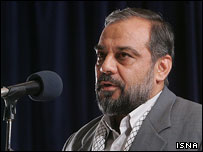 Deputy Minister of the Intelligence Department Mohammad-Bagher Zolghadr, has threatened Western states with "heavy bombardment" if they interfere in Iranian affairs.
Zolghadr, a key ally of President Mahmoud Ahmadinejad who was recently promoted from his position as Deputy Commander of the Revolutionary Guards, accused Western states of using ethnic minorities to ignite a war with Iran. He pledged to target Western interests in the Middle East with rocket attacks, according to the Baztab website which is run by Mohsen Rezai, a former chief commander of the Revolutionary Guards ( click here for report ).
The former General made the threats during a visit to Iranian Kurdistan, which is witnessing ethnic unrest and clashes between Kurdish rebels and Iranian forces. Zolghadr is currently one of the 15 top Islamic Republic officials specifically designated by the UN for travel limitation. He is associated with the killings of leading Iranian dissident intellectuals in 1998.
Zolghadr's remarks come amid revelations by former Iranian diplomat Adel Assadinia that the Iranian consulate in Dubai has established sleeper cells throughout the Gulf region to attack Western interests in the event of any hostilities between Iran and Western governments ( click here for report ). Assadinia's claims came after the Deputy Chief of Staff of the Iranian Armed Forces Ali Reza Afshar warned that even a "small move" against Iran would lead to a "great explosion" throughout the Gulf region ( click here for report ).
The Iranian regime has since declared the British Ahwazi Friendship Society (BAFS) an illegal terrorist organisation and condemned the Metropolitan Police for allowing the organisation to stage demonstrations in London. Foreign Ministry spokesman Mohammad Ali Hosseini said in September 2006 that pro-Ahwazi Arab activism by groups in the UK was a "sign of Britain's meddling in the internal affairs of other countries."
BAFS Chairman Daniel Brett said: "Taking all these statements together, the regime appears to be threatening to kill Western citizens if Western governments continue to allow ethnic rights activists to mobilise against persecution. It is clear that the regime thinks the ethnic rights movements in Iran are a direct threat and is trying to portray them as proxies in a war of attrition. The very existence of groups such as BAFS is regarded as an act of war against Iran.
"While we do not foresee a bombardment in the near future, there is a danger that the regime will conduct an assassination campaign in Europe. The Revolutionary Guards killed three Kurdish leaders in Vienna in 1989. Austrian Green Party leader Peter Pilz claims that Ahmadinejad played a role in the assassinations while serving as a Revolutionary Guards commander. Given the recent round of threats by senior military figures and government officials, there is reason to believe that the regime has prepared a plan to assassinate Ahwazi, Kurdish and Balochi opposition leaders in Europe if ethnic groups continue to challenge the regime."
Labels: minorities , terrorism
permalink
keywords: ahvaz ahwaz ahwazi arabistan khuzestan khuzistan khuzestani arab arabistan iran iranian human rights security oil news ahmadinejad ethnic cleansing
.......................................................................................
26 February, 2007
Below is a report by Amnesty International. Click here to download the original .
Amnesty International is greatly concerned by continuing violations of the rights of members of Iran's ethnic minorities, including Iranian Azerbaijanis, Kurds, Baluchis, and Arabs. Within the past two weeks, hundreds of Iranian Azerbaijani linguistic and cultural rights activists have been arrested in connection with demands that they should be allowed to be educated in their own language; Kurdish rights activists have been detained, and demonstrators killed or injured; and a Baluchi accused of responsibility for a bomb explosion on 14 February 2007 was executed just five days later.
As Iran's ethnic minorities face growing restrictions, Amnesty International is calling on the government to ensure that all Iranian citizens are accorded, both in law and practice, the linguistic and cultural rights set out in Iran's constitution as well as in international law, and are able peacefully to demonstrate in support of such rights. The Iranian authorities must also ensure that the police and other law enforcement agencies do not use excessive force, that all detainees are protected from torture or other ill-treatment, and that all reports of torture or other ill treatment, excessive use of force or killings by the security forces are investigated promptly, thoroughly and independently, with the methods and findings made public. Anyone suspected to be responsible for abuses should be brought to justice promptly in a trial that complies with international standards of fairness, and without recourse to the death penalty.
Iranian Azerbaijanis
The arrests of Iranian Azerbaijanis occurred in the run up to, and during, peaceful demonstrations on International Mother Language Day, an annual commemoration initiated by the United Nations Educational, Scientific and Cultural Organisation (UNESCO) on 21 February.
The demonstrations were held to support demands that their own language should be used as the medium of instruction in schools and places of education in those areas of north-west Iran where most Iranian Azerbaijanis reside. The protest organizers are reported to have sought official authorisation in advance, though it is not known whether it was granted. Most of those detained in advance of the demonstrations, which were held in Tabriz, Orumiye and other towns in the north-west, were soon released as of 26 February between 10-20 people may still be held.
Ebrahim Kazemi, Ja'afar 'Abedini and Mehdi Mola'i, were among a group of up to 12 people detained in Qom on or around 11 February 2007, at least two of whom were reportedly arrested for having painted slogans on walls, including 'Türk dilinde medrese' (Schooling in [Azerbaijani] Turkic). They were reportedly held for several days before being released on bail. Ja'afar 'Abedini and Mehdi Mola'i were reportedly ill treated while in detention by being forced by Ministry of Intelligence officials to drink liquids which caused them to vomit.
In Orumiye, up to 60 Iranian Azerbaijanis have reportedly been arrested, including Esmail Javadi, a journalist and Iranian Azerbaijani cultural rights activist. He was arrested on 18 February 2007 and may continue to be held in a Ministry of Intelligence detention facility in the Doqquz Pilleh district of the city.
At least 15 arrests are said to have been made in Zenjan, where a reportedly peaceful demonstration was held in the city's Sabze Square. Those detained include journalist Sa'id Metinpour, well-known locally for his human rights activities; he is said to have had blood on his lips when he was taken away raising concern that he may have been assaulted by police.
Ramin Sadeghi, who was detained in Ardabil on 19 February 2007, is one of approximately 20 who were detained in the city in connection with International Mother Language Day events. Only he remains in detention at the time of writing and his family are reportedly concerned about his medical condition.
Kurds
On 20 February 2007, Kurdish students held an event at Tehran University's Department of Literature. They called for the teaching of Kurdish in Iran's education system and at the University of Sanandaj, the capital of Kurdistan province. The students reportedly signed a public statement which stated, in part, that 'In today's multicultural climate in the world, based on the Universal Declaration of Human Rights and other humanitarian principles, every nation should have a right to develop and advance its language.'
In recent months, several Kurdish journalists and human rights defenders have been detained and some are facing trial. In addition, on 16 February 2007, three Kurds, including one woman, were reportedly killed in the course of a demonstration in Mahabad. An unconfirmed report states that a dispute between demonstrators and security forces resulted in the death of Bahman Moradi, aged 18, a woman called Malihe, whose surname is not known to Amnesty International, and one other. Dozens were reportedly injured in the course of the demonstration.
Iranian security forces have a history of the violent suppression of demonstrations by Kurds. For example, in February 2006 similar clashes between Kurdish demonstrators and the security forces in Maku and other towns reportedly led to at least nine deaths and scores, possibly hundreds, of arrests. In March 2006, Kurdish members of parliament (Majles) wrote to Iranian President Mahmoud Ahmadinejad demanding an investigation into the killings and calling for those alleged to be responsible to be brought to justice. An investigation was reportedly set up, but its findings are not known. Some of those detained later reportedly received prison terms of between three and eight months.
Baluchis
In the province of Sistan-Baluchistan, the circumstances surrounding the extremely summary trial and execution of an Iranian Baluchi man, Nasrollah Shanbeh-Zehi, who was executed on 19 February 2007, calls into question the standards of administration of justice enjoyed by minorities without discrimination. Among five people reportedly arrested following the 14 February bombing of a bus carrying Revolutionary Guard security officials, which to date has killed a total 14 and injured around 30, Nasrollah Shanbeh-Zehi was shown âconfessingâ to the bombing on Iranian television on behalf of an Iranian Baluchi armed opposition group, Jondallah, and was executed in public at the site of the bombing.
Jondallah, which has carried out a number of armed attacks on Iranian officials and has on occasion killed hostages, reportedly seeks to defend the rights of the Baluchi people, though government officials have claimed that it is involved in drug smuggling and has ties to terrorist groups and to foreign governments. In March 2006, Jondallah killed 22 Iranian officials and took at least seven hostage in Sistan-Baluchistan province. Following the incident, scores, possibly hundreds, of people were arrested; many were reportedly taken to unknown locations. In the months following the attacks, the number of executions announced in Baluchi areas increased dramatically. Dozens were reported to have been executed by the end of the year
Amnesty International condemns unequivocally the killing of hostages and urges Jondallah to desist from such and similar practices immediately. However, Amnesty International is concerned that Nasrollah Shanbeh-Zehi's "confession" may have been forced, and that the rapidity of his execution indicates that he did not receive a fair trial and was not permitted an adequate opportunity to appeal against his death sentence, if that was imposed by a court.
Arabs
In January and February 2007, Amnesty International deplored the execution of eight Iranian Arabs convicted after unfair trials of bombings in Khuzestan province in 2005. Other Iranian Arab prisoners are also at risk of execution after unfair trials.
Labels: Amnesty , death penalty , human rights , minorities
permalink
keywords: ahvaz ahwaz ahwazi arabistan khuzestan khuzistan khuzestani arab arabistan iran iranian human rights security oil news ahmadinejad ethnic cleansing
.......................................................................................
16 February, 2007
The Iranian regime has accused the US of backing a group it says is linked to Al-Qaeda for a bomb attack on a bus in Balochistan in the east of Iran, which killed 12 members of the Revolutionary Guards.
Jundullah (Army of Allah), an Islamist group operating in the Balochi homeland, claimed responsibility for the attack in Zahedan. Police say they have arrested 65 suspects with links to British and US intelligence and the Al-Qaeda terrorist network. They also claim that the bombs were manufactured by US forces.
The regime's far-fetched conspiracy theory has parallels with its claim of British and US involvement in bomb attacks in the Ahwazi Arab homeland in Khuzestan, bordering Iraq, during 2005 and 2006. It has made various unproven claims relating to the perpetrators of the Ahwaz attacks, including British soldiers, British-sponsored Arab separatists, Arab reformist groups, the Iraq-based Mujahideen-e-Khalq, Iraqi Ba'athists and Saudi Wahhabists. The regime does not appear to make any distinction between the ideological differences between the groups it says are backed by Western forces.
Balochistan straddles the Iran-Pakistan border and is predominantly Sunni. Balochis have long-standing grievances relating to religious persecution by the Shia-dominated regime in Tehran, high rates of poverty and state terrorism. The situation in the Balochi and Ahwazi Arab homelands is similar, although the Ahwazis are mostly Shia. The regime's treatment of Balochis and Arabs is identical: ethnic repression, mass arrests of dissidents, arbitrary and illegal killings, land confiscations and forced displacement. The regime tends to blame any reaction among these ethnic groups to its brutal oppression on foreign governments.
Labels: minorities , terrorism
permalink
keywords: ahvaz ahwaz ahwazi arabistan khuzestan khuzistan khuzestani arab arabistan iran iranian human rights security oil news ahmadinejad ethnic cleansing
.......................................................................................
16 December, 2006
This article has been submitted for publication on the BAFS website by Muhammad Tahir based in Aq Qala, northern Iran. He is a Prague-based journalist specializing in Afghan, Iranian and Central Asian affairs and is author of "Illegal Dating-a journey into the private life of Iran".
Amangeldi sits cross-legged in his shop, surrounded by heavy silver jewelry and handmade carpets, sipping green tea pondering the future of his failing business.
He was one of the first merchants to set up shop when Iran launched a special economic zone here in Inche Borun, a town in northeast Iran right on the border with Turkmenistan. He was drawn by the prospect of easy access to traditional handicrafts from Turkmenistan, and thought he would find a ready market in what was promised as a flourishing duty-free zone visited by people on both sides of the border.
It should have worked. The people in this part of Iran are mostly ethnic Turkmen, who would welcome contact with their kin across the border, which was hermetically sealed until the Soviet Union collapsed in 1991. Inche Borun lies on the main route into Turkmenistan from Gunbad-e-Kavus, the major town in this part of Iran.
"We had very good contacts with our Turkmen brothers over the border. They used to come to this bazaar to sell their handicrafts and buy staple goods," said Amangeldi, 32. "It was beneficial to both communities - on one side [Iran] it helped reduce unemployment, while for the people on the other side, it was the nearest place to come and get basic goods, as the major towns in Turkmenistan are a long way away."
The idea was driven by Iranian officials in a bid to boost border trade and create employment. Initial success after the special zone was launched in 1997 led them to expand the number of shops to around 250, although local Iranian officials say Turkmenistan never delivered on its promises to invest in the project.
Nearly ten years on, the plan has failed due to lack of support from both governments, neither of which has proved keen on freedom of movement in a sensitive border area. Turkmenistan has enforced strict border controls, most directed at its own citizens, which have effectively strangled trade.
Iranian statistics show that fewer than 1,800 people crossed the border at Inche Borun in the first eight months of 2006.
Seven out of ten businesses in the Inche Borun's duty-free market have closed, so that just 40 of the 137 original shops in the bazaar are still functioning. The market opens only on Fridays instead of daily, and the only customers are Iranian nationals, plus the occasional long-distance truck driver heading north into Turkmenistan.
Amangeldi thinks he will be joining the exodus of traders soon.
"I don't know what went wrong on the Turkmen side - they started implementing such strict policies on crossing the border," he said.
Oraz Muhammad, who has just closed the shop he had in the bazaar, explained that ethnic Turkmen from Iran are allowed to travel into Turkmenistan within a 45-kilometre radius of the Inche Borun crossing point. But he said this was not enough, since they would need to travel further to be able to visit major commercial centres. Nor do Turkmenistan's border officials allow the traders to bring bulk consignments of goods out of the country.
Other merchants complained that their own government had failed to sustain the duty-free zone, and water and electricity supplies remained erratic.
A more serious gripe voiced by many was that the Iranian government had failed to pressure Turkmenistan to ease the border controls.
Many see political factors behind the failure of Tehran and Ashgabat to support the scheme over the longer term.
Politically, Iran and Turkmenistan are a world apart - one a Shia theocracy, the other a secular post-Soviet state dominated by the personality cult surrounding idiosynchratic president Saparmurat Niazov. But both governments have made great efforts to get on since Turkmenistan emerged as an independent country.
Their cooperation is pragmatic and focuses on economic links across their long border. In addition, both countries have cool relationships with other neighbours and the wider international community, so they have an interest in remaining on good terms. Because of this, the election of hardliner Mahmoud Ahmedinejad as Iran's president in place of the reformer Mohammad Khatami has not substantially affected the relationship with Turkmenistan.
One local analyst in Gunbad-e-Kavus, who did not want to be named, attributed the decline in official support for the Inche Borun market to a change in personalities at the top in Iran the year the project was launched.
"This was an entirely political project rather than a social or economic one, because the Iranian president at that time [Ayatollah Akbar] Hashemi Rafsanjani was a close friend of President Niazov," he said. "So after Rafsanjani lost the presidential election [to Khatami] in August 1997, the Iranian-Turkmenistan relationship never regained its former warmth."
Other analysts, such as Aziz Ismailzade, an Iranian Turkmen who now lives abroad, say both governments are paranoid about letting any of their citizens travel freely.
"Their reluctance stems from the same reason - the fear factor. Neither [government] wishes to allow its people unfiltered access to outsiders," he said,
Thus, restricting border traffic may have less to do with bilateral relations than with the external pressures both governments are facing over human rights and other concerns.
"Just as pressure on Niazov's regime has increased in recent years, international pressure on Iran is also at a high level because of its nuclear ambitions," said Ismailzade. "This has led both countries to impose unprecedented restrictions on population movement."
Tehran keeps a close eye on its own ethnic Turkmen community, as it does with other minorities on its periphery such as the Azeris and Kurds, for any sign of separatist ambitions. Niazov's nation-building exercise is all about Turkmen identity - but he has taken care not to irritate Tehran by stirring up nationalist sentiment among the Iranian Turkmen.
Burhan Karadaghi, an Iranian historian based in Germany, believes both governments may have concluded that keeping these border communities at a distance from each other may be best for everyone.
"Neither Niazov nor Ahmedinejad is in favour of letting these [Turkmen] people stay in touch. Niazov would feel insecure if the border was wide open, while the Iranian regime would be unhappy if its own own ethnic minority was in contact with kinsmen outside the country," he said.
Labels: features , minorities
permalink
keywords: ahvaz ahwaz ahwazi arabistan khuzestan khuzistan khuzestani arab arabistan iran iranian human rights security oil news ahmadinejad ethnic cleansing
.......................................................................................
09 July, 2006
 US military expert Ralph Peters has called for the redrawing of borders in the Middle East to take account of the region's ethnic groups (
click here for article
).
US military expert Ralph Peters has called for the redrawing of borders in the Middle East to take account of the region's ethnic groups (
click here for article
).
Writing for the Armed Forces Journal, Peters argues that current borders are "arbitrary and distorted" and "generate more trouble than can be consumed locally." He claims that "the greatest taboo in striving to understand the region's comprehensive failure isn't Islam but the awful-but-sacrosanct international boundaries worshipped by our own diplomats."
He proposes creating independent states for the Kurds, Balochis, Iraqi Sunnis and Arab Shias, including Ahwaz Arabs, and a breaking up of Saudi Arabia. Jordan and Yemen would expand into Saudi territory, while the borders of Lebanon, Iran, Afghanistan, Pakistan and Azerbaijan would be adjusted to cover their respective ethnic groups.
On the changes he proposes for Iran's boundaries, Peters, a former US military intelligence officer, writes: "Iran, a state with madcap boundaries, would lose a great deal of territory to Unified Azerbaijan, Free Kurdistan, the Arab Shia State and Free Baluchistan, but would gain the provinces around Herat in today's Afghanistan - a region with a historical and linguistic affinity for Persia. Iran would, in effect, become an ethnic Persian state again, with the most difficult question being whether or not it should keep the port of Bandar Abbas or surrender it to the Arab Shia State."
He warns that failure to address the aspirations of the region's minorities will lead to prolonged instability in the Middle East, allowing terrorism to thrive, adding "If the borders of the greater Middle East cannot be amended to reflect the natural ties of blood and faith, we may take it as an article of faith that a portion of the bloodshed in the region will continue to be our own."
Nasser Bani Assad, spokesman for the British Ahwazi Friendship Society (BAFS), said: "Ralph Peters understands the problems caused by the arbitrary carve-up of the Middle East by European colonial powers and the continuing impact that has on regional stability. But this is an academic exercise, not a practical solution to the demands of ethnic minority groups in the Middle East. He gives no indication as to how such a radical adjustment of national borders would be achieved. It is unlikely that Saudi Arabia, Iraq and Iran would willingly relinquish oil-rich territory and strategic access to the Gulf for an independent Arab Shia state, defined along confessional lines. The only way to achieve such a redrawing of territories is by force, creating more problems than the exercise would solve.
"Another issue is whether this proposal is what minorities actually want. Ahwazis have never argued for a unification with Arabs of the Saudi province of Al Hudud ash Shamaliyah, as Peters has proposed. Peters assumes that Arab Shias are homogenous and are defined by religion. But tribal identity plays an important role in the lives of rural Ahwazis, while urban Ahwazis are largely secular in their political outlook and cosmopolitan in their tastes. A Shia theocracy run by Ayatollah Sistani would be unpalatable for a people who define themselves by their culture rather than their religion. Ahwazis will not want to replace rule by an Iranian Shia theocracy with an Iraqi religious elite based in Najaf. Moreover, the Arab Shia state proposed by Peters would ensure that Ahwazis remain a minority in a state that is two-thirds Iraqi. His map is therefore just as arbitrary as the borders devised by the British, taking little account of the distinctiveness and ambitions of the Ahwazis or other minority groups.
"There are more practical political solutions to ethnic grievances than a redrawing of borders, no matter how unjust the present ones are. Some ethnic groups would simply be happy for the right to organise their own parties, run their own media, the right to be educated in their own language and the devolution of power. For the Ahwazis, ethnic concerns could be met through the redistribution of a significant portion of income generated by their homeland's resources and a reversal of the land confiscation programme that has forced them off their land.
"All these demands pose no threat to Iran's territorial integrity, but it is clear that they cannot be met under the present regime, which has ruthlessly persecuted minorities and banned any attempts at peaceful political mobilisation.
"The task for Ahwazis and other minority groups in Iran is to make minority rights a part of the struggle for democracy and human rights in Iran. This is what the Congress of Nationalities for a Federal Iran is trying to achieve. It is the responsibility of the international community to support such grass-roots initiatives, rather than imposing solutions based on academic exercises."
Links
Iran: regionalism, ethnicity and democracy - Nayereh Tohidi, Open Democracy
Interview with Mustafa Hijri, the Secretary-general of Kurdistan Democratic Party of Iran - Kurdistanmedia.org
Safeguarding the Ahwazi Arabs: Essential for a Stable and Democratic Middle East - Daniel Brett, Henry Jackson Society
The manifesto of the Democratic Solidarity Party of Ahwaz (Arabistan)
Congress of Nationalities for a Federal Iran
Labels: minorities
permalink
keywords: ahvaz ahwaz ahwazi arabistan khuzestan khuzistan khuzestani arab arabistan iran iranian human rights security oil news ahmadinejad ethnic cleansing
.......................................................................................
20 June, 2006
As the world commemorates International Refugee Day, the Unrepresented Nations and Peoples Organisation (UNPO) has highlighted the cases of several nations and peoples suffering forced displacement, including the Ahwazi Arabs.
In a statement released today, UNPO says: "In Iran, as with many of the other minority nations in the Islamic republic, the circumstance of the Ahwazi Arabs has been precarious since 1925 when Ahwaz, until then an autonomous Arab territory, gradually lost its political, economic and cultural independence and became a part of Iran. Recently, individuals promoting rights of the Arab people in the Ahwaz region have been targeted and subject to capital punishment. Sustained repression, coupled with lack of free media and denial of basic human rights have led many to flee. Earlier this month the UNHCR voiced its concern about the fate of several Ahwazi recognized refugees, some being arrested in Syria. UNPO continues to work with its Members in the region to highlight and address these issues." ( click here to download the statement in full )
The UNPO is composed of Member nations and groups, including indigenous peoples and minorities, of whom many continue to suffer from forced migration or face the risk of becoming refugees, due to their respective political as well as socio-economic contexts; some residing in conflict-ridden and/or resource-scarce environments and many being part of politically marginalized communities. The issue of refugees is therefore an important question to UNPO Members worldwide, and continues to be a problem related to the larger issues of democratization and human rights, development and human security; and the lack of such.
Labels: minorities
permalink
keywords: ahvaz ahwaz ahwazi arabistan khuzestan khuzistan khuzestani arab arabistan iran iranian human rights security oil news ahmadinejad ethnic cleansing
.......................................................................................
13 May, 2006
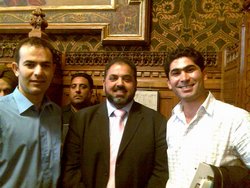 The British Ahwazi Friendship Society (BAFS) this week participated in a conference on self-determination hosted by Lord Nazir Ahmed at the British Houses of Parliament (Lord Ahmed is pictured with Ahwazi activists).
Lord Ahmad, who chairs the Parliamentarians for National Self-Determination (PNSD), Liberal Democrat President Simon Hughes MP, Plaid Cymru (Party of Wales) leader Elfyn Llwyd MP, Conservative MEP Daniel Hannon, Scottish Nationalist MP Peter Wishart and Unrepresented Nations and Peoples Organisation (UNPO) General Secretary Marino Busdachin were among the participants at the meeting which sought to explore common goals and challenges among nationalist movements ( click here for more details ).
 Self-determination is a fundamental human right under the Universal Declaration of Human Rights and is regarded as an important instrument in conflict resolution. The PNSD, which organised the meeting, is a forum for aspiring nation states to advocate the management of their own internal affairs, development and nurturing of their national resources, and direct external engagement with international bodies to promote economic, environmental and cultural co-operation for mutual benefit.
Aside from Ahwazis, the conference was attended by Sikhs, Kashmiris, Nagas, Assamese, Manipuris, Kurds, Chechens, Palestinians, Kosovans and Tamils.
Labels: activism , minorities
permalink
keywords: ahvaz ahwaz ahwazi arabistan khuzestan khuzistan khuzestani arab arabistan iran iranian human rights security oil news ahmadinejad ethnic cleansing
.......................................................................................
16 April, 2006
The Federal Democratic Movement of Azerbaijan (FDMA), a pro-federalist party representing Iran's Azeri community, sent a letter of solidarity to the Ahwazi Arabs demonstrating in Brussels on Saturday.
Ahwazi groups from around Europe gathered outside the European Parliament to draw attention to human rights abuses in Al-Ahwaz (Khuzestan), including the killing of unarmed demonstrators, the imprisonment and torture of Ahwazi children and pregnant women related to opposition activists and the government's land confiscation programme. The protest marked the first anniversary of the Ahwazi intifada against the Iranian regime.
The FDMA said it stood with "our Arab compatriots in their struggle for a just cause, in proclaiming of their denied political and cultural identity." It attacked the "systematic political, cultural and economic oppression by the successive governments in power in our country" and the "deliberate dislocation of indigenous Arabs, cultural assimilation and expulsion of them from their lands by subtle methods or direct coercion." It added that it stood "shoulder to shoulder" with Ahwazis campaigning for freedom, equality, democracy and cultural oppression and pledged its "political and moral support for a common struggle for a democratic and federative Iran, the common country and fatherland of all nationalities in Iran."
The FDMA is a member of the Congress of Nationalities for a Federal Iran (CNFI), which also includes the Democratic Solidarity Party of Al-Ahwaz (DSPA).
Links
Federal Democratic Movement of Azerbaijan
Congress of Nationalities for a Federal Iran
Democratic Solidarity Party of Al-Ahwaz
Labels: minorities
permalink
keywords: ahvaz ahwaz ahwazi arabistan khuzestan khuzistan khuzestani arab arabistan iran iranian human rights security oil news ahmadinejad ethnic cleansing
.......................................................................................
24 February, 2006
University of Cambridge academic Gabriel Glickman has called for greater recognition of cultural and ethnic diversity as a basis for democratic change in Iran.
Writing for the Henry Jackson Society think tank, the Pembroke College historian stresses the need to brak from the notion that "the nation's key political dynamic as that of a popular theocratic mainstream, opposed by a fragile minority of reformists, whose cultural base - the student movement - is under vigorous assault."
He criticises the 'realist' tendency within the British Foreign Office, which hopes that 'moderates' can emerge to lead Iran by accommodating and appeasing the Iranian regime. Such arguments, he says, "deny the reality of dissident political forces."
Glickman advocates a "re-interpretation" of Iran to recognise the social forces that lie outside the regime. He states: "The greatest of our Iranian misconceptions surrounds the country's ethnic composition. A Tehran-centred analysis exaggerates the capacity of the ruling Persian community that, in reality, probably comprises less than 50 per cent of the Iranian population." The rest of the population comprises Arabs, Azeris, Balochis, Kurds and Turkomen.
The West has chosen to ignore the ethnic cleansing, state terrorism, land confiscation and environmental destruction faced by ethnic minorities such as the Ahwazi Arabs under an Islamic Republic which has adopted the creed of Persian ultra-nationalism advanced by the Pahlavi monarchy.
"Western disregard is cruelly ironic," he writes, "when Tehran's surface rationale for mistreatment of the Ahwazis is a belief that they represent 'the stooges of foreign nations' and British imperial designs."
However, ethnic minorities have developed a "complete, alternative and increasingly coherent" blueprint for the reform of Iran. The Congress of Nationalities for a Federal Iran (CNFI), which includes parties representing minority groups, has published a manifesto that looks to establishe "a democratic, independent and non-aligned Iran", including "separation of religion and state" and "equality of men and women."
Glickman acknowledges the role the Unrepresented Nations and Peoples Organisation (UNPO) has played in "the need for the realization of democracy and human rights in Iran", against "continuing systematic social, ethnic and cultural discrimination ... The upshot is a genuine moral and intellectual challenge to the orthodoxy communicated from Tehran.
"Taking these alternative voices into account, a re-interpretation of Iran should shape a new response to the current nuclear crisis, not by propelling us into a drive for war, but by encouraging a more robust policy in the region; based unapologetically on liberal democratic virtues. Western powers can work to foster connections between minority groups, lend support to a unified vision of reform, and enhance the credibility of liberal voices at the forefront of the disaffected communities, to offset separatist claims.
"Now is the time for the West to let re-interpretation bring about re-engagement, by embracing the democratic possibility."
The Henry Jackson Society was founded to support "the pursuit of a robust foreign policy ... based on clear universal principles such as the global promotion of the rule of law, liberal democracy, civil rights, environmental responsibility and the market economy." Its patrons include Robert Kagan of the Carnegie Endowment for International Peace, former US Assistant Secretary of Defence Richard Perle, former NATO Supreme Allied Commander General Jack Sheehan and Former CIA Director James Woolsey. Among the list of signatories of its founding principles are senior politicians, academics, leading journalists and former military chiefs.
Links
"Re-interpreting Iran" , by Gabriel Glickman, 13 February 2006
"Democracy, Ethnicity and Repression in Iran: The Plight of the Ahwazi Arabs" , by Daniel Brett (Chairman, British Ahwazi Friendship Society), HJS, 27th November 2005
"Safeguarding the Ahwazi Arabs: Essential for a Stable and Democratic Middle East" , by Daniel Brett, 11th December 2005
Labels: minorities
permalink
keywords: ahvaz ahwaz ahwazi arabistan khuzestan khuzistan khuzestani arab arabistan iran iranian human rights security oil news ahmadinejad ethnic cleansing
.......................................................................................
16 February, 2006
 The administration of President Mahmoud Ahmadinejad has come under severe criticism from Amnesty International in a report entitled "New government fails to address dire human rights situation", which was published this week.
Amnesty focusses on the treatment of ethnic minorities, particularly the Ahwazi Arabs, Kurds and Azeri Turks, but notes that Balochis, Turkmen and nomads also face persecution.
Sections of the report relating to Ahwazi Arabs have been reproduced below. Click here for the full report .
Despite constitutional guarantees of equality, individuals belonging to minorities in Iran, who are believed to number about half of the population of about 70 millions, are subject to an array of discriminatory laws and practices. These include land and property confiscations, denial of state and para-statal employment under the gozinesh criteria and restrictions on social, cultural, linguistic and religious freedoms which often result in other human rights violations such as the imprisonment of prisoners of conscience, grossly unfair trials of political prisoners before Revolutionary Courts, corporal punishment and use of the death penalty, as well as restrictions on movement and denial of other civil rights.
Some of the problems currently confronting Iran's minority groups were brought to international attention by the UN Special Rapporteur on the Right to Adequate Housing, when he visited the country in July 2005. In his preliminary findings he noted that minorities were subject to discrimination in the distribution of state resources, in access to and the quality of housing, water and sanitation provided in the areas of the country where they reside, and are disproportionately affected by policies of "land grabbing".
The mainly Shi'a-Muslim Arab community in Iran constitutes between 3 per cent and 8 per cent of the total population. The Arab community lives mainly in Khuzestan province (known as Ahwaz by the Arab community) adjoining Iraq, the location of much of Iran's oil resources. Members of Iran's Arab community have a long-standing grievance against successive governments, claiming that Arabs have been overlooked in terms of the distribution of resources aimed at social development. Frustration and economic deprivation has spilled over in recent months into a cycle of violent protest and repression which seems likely to continue unless the Iranian authorities take the measures necessary to address the social, economic and other grievances that gave rise to the unrest.
Economic, social and cultural rights: The Arab population of Iran is one of the most economically and socially deprived in Iran. Even where the majority of the local population is Arab, schools are reportedly not allowed to teach through the medium of Arabic; illiteracy rates are reportedly high, especially among Ahwazi Arab women in rural areas. Arabs have also reportedly been denied state employment under the gozinesh criteria. Many villages and settlements reportedly have little or no access to clean running water, sanitation or other utilities such as electricity.
Amnesty International has received reports that the water supply in Ahwaz City is subject to frequent and irregular cuts, apparently resulting from the diversion of water from the Karoun River to cities such as Esfahan and Sanandaj. In December 2005, the situation was reportedly so dire that people were unable to shower more than once a week, and were being forced to buy drinking water from tankers in the street. Also in December 2005, members of the Majles representing Khuzestan province reportedly launched a petition to impeach the Minister of Energy over the continued diversion of water from the Karoun River to Rafsanjan and Esfahan provinces and in January 2006 reportedly threatened to resign en masse if the diversion continued. It has also been reported that, despite the province's water shortages, water from the Karkhe River, which passes through the Ahwazi Arab area of Howizeh and Boustan, is diverted for sale to Kuwait.
Furthermore, land expropriation by the Iranian authorities is reportedly so widespread that it appears to amount to a policy aimed at dispossessing Arabs of their traditional lands. This is apparently part of a strategy aimed at the forcible relocation of Arabs to other areas while facilitating the transfer of non-Arabs into Khuzestan and is linked to economic policies such as zero interest loans which are not available to local Arabs.
In October 2005, a letter came to light, dated 9 July 2005, in which the Arvand Free Trade Zone Organization outlined plans for the confiscation of 155 sq km, including Arab land and villages, to provide for the establishment of the Arvand Free Trade Zone between Abadan and the Iraqi border. All those living within this area will have their land confiscated. Under Iranian law, no challenge can be made to the confiscation, only to the amount of compensation offered, which in other schemes is reported to have been as little as one fortieth of the market value.
The UN Special Rapporteur on the Right to Adequate Housing said in an interview following his visit to Iran in July 2005:
... when you visit Ahwaz ... there are thousands of people living with open sewers, no sanitation, no regular access to water, electricity and no gas connections ... why is that? Why have certain groups not benefited? ... Again in Khuzestan, ... we drove outside the city about 20 km and we visited the areas where large development projects are coming up - sugar cane plantations and other projects along the river - and the estimate we received is that between 200,000 - 250,000 Arab people are being displaced from their villages because of these projects. And the question that comes up in my mind is, why is it that these projects are placed directly on the lands that have been homes for these people for generations? I asked the officials, I asked the people we were with. And there is other land in Khuzestan where projects could have been placed which would have minimised the displacement.
He also referred to attempts by the government to transfer non-Arabs into the area, as in the case of Shirinshah, a new town mainly populated by non-Arab inhabitants from Yazd province, and highlighted the discrepancy between the wealth generated from the oil resources of Khuzestan and the very deprived Arab neighbourhoods he saw.
Use of force: Since President Ahmadinejad's election, several people have been killed and scores injured by security forces possibly using excessive force, in the context of ongoing violent unrest in Khuzestan Province. This began in April 2005 and has included bomb explosions in Ahwaz city in October 2005 and January 2006 which killed at least 12 people and injured hundreds, and attacks on the economically important oil installations in September and October 2005. The Iranian authorities have accused the United Kingdom (UK) government of involvement in the blasts, which the UK has denied.
In mid-September 2005, Iranian security forces were reported to have used live ammunition, tear gas and beatings with batons to suppress stone-throwing demonstrators. At least two people were reported killed and many injured. The authorities were later reported to have cut off the water supplies to some villages of the al-Bughobeysh tribe, possibly in reprisal for the inhabitants having participated in the demonstrations.
On 4 November 2005, Id al-Fitr, possibly partly in protest at earlier arrests (see below), several hundred Arab Iranian demonstrators began marching towards the centre of Ahwaz city, where they met Iranian security forces. Scuffles may have broken out. Iranian security forces reportedly fired tear gas grenades at the crowd. Two Arab youths affected by the tear gas, which is said to have caused a temporary paralysis, reportedly drowned after falling into the Karoun River. Scores, if not hundreds, of demonstrators were arrested. Amnesty International wrote to the Iranian authorities urging that these deaths be investigated, and asking for clarification of the rules governing the use of force and firearms by Iranian law enforcement officials and whether in this instance there were attempts made to disperse the crowd by non-violent means and whether the crowd was warned before tear-gas was used. By early February 2006, no reply had been received.
At least three men were reported killed, and around 40 injured, on 11 and 12 January 2006 in clashes in Khuzestan between Iranian security forces and members of the Arab Ahwazi community. The clashes followed an initially peaceful demonstration on âId al-Adha, the Muslim Feast of Sacrifice. The demonstrators were reportedly demanding an end to Arab persecution, poverty and unemployment, and the release of political prisoners arrested since April 2005.
Detention: Hundreds of Arabs have been arrested since President Ahmadinejad's election and many are feared to have been tortured or ill-treated. The prisons in Khuzestan province, and particularly the capital Ahwaz, are reported to be extremely overcrowded as a result of the large numbers of arrests. One ex-detainee is said to have estimated that during his time in detention, there may have been over 3,000 prisoners held in Karoun Prison, reportedly designed to accommodate about 800 and that the cells were so crowded that detainees were forced to sleep in shifts, as there was insufficient space for them all to lie down at once. This degree of over-crowding reportedly led to extremely unsanitary conditions. Children as young as 12 are reported to have been detained with adult prisoners. Some of those detained are believed to have been sentenced to imprisonment or death after grossly unfair trials before Revolutionary Courts.
Of those reported detained since the election of President Ahmadinejad, Amnesty International has received the names of over 250. Some illustrative cases are outlined below.
In August, Hajj Salem Bawi, an Arab tribal leader and businessman, his five sons, nephew and two other members of his extended family were detained. Hajj Salem Bawi was later released, but two of his sons, Imad and Zamel, were reportedly sentenced to death in October 2005. The precise charges of which they were convicted are not known to Amnesty International. Hajj Salem Bawi reported after his release that he had met three of his sons in Amaniya prison in Ahwaz city and could see that they had been ill-treated or tortured in detention. By December 2005, none of those still held were known to have had access to lawyers or their families.
Hamid Gate'Pour, the manager of education in Area 2 of Ahwaz city, was arrested on or around 15 September 2005 in Area 2 of Ahwaz city. Mohammad Hezbawi, the editor of Hamsaye, a regional newspaper, was arrested on 18 September 2005, possibly in connection with an article he had published about the arrest of Hamid Gate'pour, and released after several days.
At least 81 people were arrested on 3 November 2005 during the week preceding the end of Ramadan, Id al-Fitr, whilst attending an Arab cultural gathering called Mahabis which traditionally takes place during the iftar (breaking of the fast). Those arrested included Zahra Nasser-Torfi, director of the Ahwaz al-Amjad cultural centre who was reportedly tortured in detention; Hamid Haydari, a poet; and six members of the same family: Mohammad Mojadam, Hamid Mojadam, Mehdi Mojadam, Rasoul Mojadam, Khaled Bani-Saleh and Hassan Naisi. On 14 November 2005 a number of those people were reportedly released on bail to await trial, including Zahra Nasser-Torfi.
Scores of people, including at least three children, were arrested on 11 January 2006 following clashes with security forces following an initially peaceful demonstration (see above), led by Sheikh Saleh al-Haydari, the Imam (prayer leader) of Da'ira mosque in Ahwaz. He was among those detained and reportedly began a hunger strike on 25 January 2006 to protest at his detention. The next day, 12 January 2006, scores more were detained in the city of Hamidiya, after a demonstration against the arrests which had taken place the previous day.
Amnesty International is concerned about the violation of economic, social and cultural rights of persons belonging to minorities in Iran. Iran is a state party to the International Covenant on Economic, Social and Cultural Rights (ICESCR), as well as to the International Convention on the Elimination of Racial Discrimination (ICERD) which require the immediate prohibition, and steps towards the elimination of discrimination against minorities, in the realisation of economic, social and cultural rights, including the rights to free choice of employment, to housing, to education, to equal participation in cultural activities and to social services. Reports of huge disparities between minority communities and majority groups in literacy, access to education, basic services such as adequate water supplies, sanitation and electricity, as well as reports of "land grabbing" which appears to target minority communities, all suggest that Iran is failing to comply with these international obligations.
The Committee on the Elimination of Racial Discrimination stated in paragraph 14 its concluding observations in 2004: "The Committee takes note with concern of the reported discrimination faced by certain minorities, including the Baha'is, who are deprived of certain rights, and that certain provisions of the State party's legislation appear to be discriminatory on both ethnic and religious grounds.
The Committee on Economic, Cultural and Social Rights has stated in relation to Article 11(1) of the ICESCR, which provides the right to adequate housing, that forced evictions from a place of habitual residence without consultation, due process or assurance of adequate alternative accommodation are prohibited. The Human Rights Committee (HRC), has stated in relation to Article 12(3) of the ICCPR: "the right to reside in a place of one's choice within the territory includes protection against all forms of forced internal displacement It also precludes preventing the entry or stay of persons in a defined part of the territory."
Amnesty International is calling on the Iranian government to take urgent, concrete measures to address the longstanding pattern of human rights violations and to ensure that all the fundamental human rights of all persons in Iran are protected irrespective of their gender, ethnicity, religious faith or other such defining characteristics. In particular, Amnesty International urges the government of President Mahmoud Ahmadinejad to take the following steps:
- End any policy of deliberate land expropriation or population transfer aimed at dispossessing minority populations from their traditional lands;
- Cease any practice of forced evictions: that is evicting people from land or housing without consultation, due process of law, and assurances of adequate alternative accommodation;
- Cease forced internal displacement linked to forced evictions and "land grabbing";
- Take immediate steps towards the elimination of de facto discrimination in the exercise of economic, social and cultural rights such as rights to education, adequate housing, water and sanitation as well as in access to utilities such as electricity adopting special measures, such as multilingual education, as necessary.
Labels: Amnesty , minorities
permalink
keywords: ahvaz ahwaz ahwazi arabistan khuzestan khuzistan khuzestani arab arabistan iran iranian human rights security oil news ahmadinejad ethnic cleansing
.......................................................................................
23 January, 2006
 Scores of Baloch people held a large demonstration against ongoing military operations in BalochistanâPakistan on Sunday opposite the official residence of the British Prime Minister Tony Blair.
The demonstration was called by the Balochistan Action Committee in association with the Balochistan Rights Movement, World Sindhi Congress and the Sindhi Baloch Forum . Balochistan straddles the Iran-Pakistan border. Balochis from both Iran and Pakistan and their British supporters were present on the demonstration to show their solidarity with those Balochis suffering state violence in Pakistan.
Spokesmen conducted interviews with Geo TV, ANI TV and other media at the demonstration. They vigorously condemned the atrocities of Pakistani Army in Balochistan. They condemned the killing of 12 innocent Baloch in custody by Frontier Constabulary as well as killing of Baloch children and women and the use of phosphorus bombs as genocidal. Demonstrators also called for an immediate end to the Kala-Bagh Dam project.
 The demonstrators called on Prime Minister Blair and other world leaders for their intervention to stop Pakistan's military from committing genocide in Balochistan and urged them to send a fact-finding mission to war-torn regions of Balochistan. They also demanded the immediate release of over 4,000 extra-judicially detained or missing Baloch, an end to all military operations in Balochistan and a recognition of Baloch rights. The demonstrators gave their unequivocal support to the people of Balochistan and the victims of military action in Balochistan and Sindh. A petition letter was handed in to 10 Downing Street by a number of demonstrators.
Iranian Balochi groups such as the Balochistan Peoples Party (BPP) have formed an alliance with the Democratic Solidarity Party of Ahwaz (DSPA) to push for minority rights and devolution of power through the Congress of Nationalities for a Federal Iran (CNFI). CNFI also includes Kurds, Azeris and Turkmen, who are working together in a spirit of mutual solidarity. Iranian and Pakistani Balochis and Iran's Ahwazi Arab population share a common struggle for recognition of minority rights, an end to persecution and economic marginalisation and devolution of power. Both the BPP and the DSPA support non-violent means to empower minorities and are urging the international community to prevent attacks on innocent civilians in both Iran and Pakistan.
Click here for more information
Labels: activism , minorities
permalink
keywords: ahvaz ahwaz ahwazi arabistan khuzestan khuzistan khuzestani arab arabistan iran iranian human rights security oil news ahmadinejad ethnic cleansing
.......................................................................................
17 January, 2006
Balochistan People's Party Spokesperson Nasser Boladai's was interviewed on this week's edition of Al-Ahwaz TV.
The interview can be downloaded from the Balochistan People's Party website in both Balochi and Farsi languages. Click here to watch the interview.
| Launch in external player |
Labels: minorities
permalink
keywords: ahvaz ahwaz ahwazi arabistan khuzestan khuzistan khuzestani arab arabistan iran iranian human rights security oil news ahmadinejad ethnic cleansing
.......................................................................................
10 January, 2006
A front representing Iran's ethnic minority parties has condemned the Iran's President Mahmoud Ahmadinejad's position on the Nazi Holocaust and the destruction of Israel.
The Congress of Nationalities for a Federal Iran (CNFI), which includes parties representing Iranian Kurds, Arabs, Baluchis, Azeri Turks and Turkmen, condemned the regime's manipulation of the Palestinian issue for its own political ends.
In the statement, the Congress argued that "the Iranian regime's internal and external policies are based on creating tension and confrontation, both inside and outside Iran. By taking an irresponsible position, President Ahmadinejad is trying to deflect public attention in Iran away from domestic economical, political and social crises. The government's foreign policy aims to position Iran as the sole defender of Palestinian people's right by allying with extremist groups to create tension in the Middle East and ultimately derail the peace process between Palestinians and Israelis. While the Palestinians and Israelis are seeking a permanent solution to their problems despite the Iranian regime's intervention, Iran's own minorities are denied the right to voice their demands.
"While we condemn the Iranian government regarding Holocaust and the destruction of Israel, we appeal to all democratic forces and human rights organisations to support the oppressed Iranian nationalities (that comprise 2/3 of the population) towards the establishment of a secular, democratic and a federal state in Iran."
The group, which includes the Democratic Solidarity Party of Ahwaz (DSPA), drew parallels between the plight of the Palestinians and Iran's ethnic minorities. They pointed out that their appeals for human rights, freedom of speech and democracy has led to "gross human rights violations by the Iranian security forces and intelligence agencies. Arrests, kidnappings, illegal detention and the extra-judicial killing of political, cultural and social activists are routine in Iran. The Iranian constitution sets in stone the systematic social, ethnic and cultural discrimination against ethnic minority groups."
The CNFI's statement was signed by the Azerbaijan Cultural Society, Balochistan National Movement - Iran, Balochistan Peoples Party, Balochistan United Front of Iran, Democratic Party of Iranian Kurdistan, Democratic Solidarity Party of Ahwaz, Komela and the Organization for Defence of the Rights of of Turkmen People.
Labels: minorities
permalink
keywords: ahvaz ahwaz ahwazi arabistan khuzestan khuzistan khuzestani arab arabistan iran iranian human rights security oil news ahmadinejad ethnic cleansing
.......................................................................................
04 January, 2006
The Islamic Majlis Centre for Research has warned that Iran could face ethnic conflict and unrest unless the government addresses the needs of Iran's ethnic minorities.
In a recently published report, the Majlis (parliament) think tank said the country faced two key challenges: poverty among non-Persian ethnic groups living in border areas and the problem of youth unemployment. It stated that various ministries had already issued their own internal studies and reports on ethnic minorities in relation to national security, but suggests that the root causes of the "surge in identity movements" must be addressed.
Ahwazi Arabs have been at the forefront of the growing ethnic minority opposition to the government, with major riots and demonstrations throughout 2005. There has also been growing unrest among Balochis and Kurds.
The immediate cause of the rioting in Ahwaz (Khuzestan) has been the government's policy of "ethnic restructuring" or "integration". This has involved the forced relocation of Arabs and the resettlement of non-Arabs from outside the province in order to reduce the Arab population from 70 per cent to 30 per cent of the province's total.
The think tank report warned that such integration policies could lead to further social upheaval, rebellions, instability, ethnic conflicts, civil war and armed conflicts.
Key to alleviating poverty among Ahwazi Arabs is the redistribution some of the revenue generated by Khuzestan's large oilfields, which together represent around 8-10 per cent of OPEC's total output. Local legislators recently failed to get parliamentary endorsement for the redistribution of 1.5% of Khuzestan's oil revenue. This is the third time such legislation has failed in the Majlis. In a report by the IRNA news agency, Abdullah Kaabi, the Majlis representative for Abadan, said: "Khuzestan has provided 100% of its oil production and revenue to Tehran for 100 years. Is allocating 1-2% of its own oil back to its inhabitants is too much?"
In an official visit to Khuzestan in July, UN Special Rapporteur for Adequate Housing Miloon Kothari spoke of the impact of land confiscation on the impoverished Ahwazi Arab population. He said: "in deprived neighbourhoods [in Khuzestan] you can actually see the towers of the oil refineries and the flares and all of that money, which is a lot, and it is going out of the province. Even a small percentage would significantly improve things in terms of development."
Nasser Bani-Assad, spokesman for the British Ahwazi Friendship Society, said: "There is growing recognition of the negative social impact of poverty, land confiscation and forced migration on ethnic minorities in Iran. The report by the Islamic Majlis Centre for Research indicates that some parts of the establishment are realising that the continued plunder of outlying provinces with predominantly non-Persian populations will result in an ethnic backlash. We are already witnessing this with unrest among Ahwazi Arabs.
"Yet, the overwhelmingly conservative, hard-line Majlis still votes out legislation to give a few rials earned from oil back to the Arabs whose land has been confiscated for the benefit oil industry. The mullahs' greed will ultimately destroy them, for failure to address the needs of non-Persian minorities - who make up more than 50 per cent of the population - will lead to instability that will shake the foundations of the Islamic Republic."
Labels: minorities
permalink
keywords: ahvaz ahwaz ahwazi arabistan khuzestan khuzistan khuzestani arab arabistan iran iranian human rights security oil news ahmadinejad ethnic cleansing
.......................................................................................
08 December, 2005
Between 28 and 30 November 2005 in Brussels (Belgium) the CNFI International Relations Committee had several meetings with European Unions authorities including the European parliament, the Council and Commission. Beside these meetings the CNFI international relations committee had also some meetings with NGOs (Non-Governmental Organizations). The following topics were discussed in the above meetings.
- The political and social situation of Oppressed Nations in Iran, and the systematic violation of human rights situation of these people in their regions by the Iranian government.
- The continuation of discriminatory and repression policy by the Iranian government against Oppressed Nations and its intensification since Mr. Ahmadi Nezhad has come to power.
- The formation of Congress of Nationalities for a federal Iran.
- It is vital to solve the Oppressed Nations political situation for democratization of Iran and for the security, stability and maintenance of peace in the region.
- The foreign policy of Islamic Republic of Iran and its nuclear program.
- The worsening situation of political prisoner in Iran and importance of pressurising the Iranian regime to release them.
- The situation of Iranian political refuges and difficulties they are facing in Afghanistan, Iraq, Pakistan and Turkey.
- The European Unions policies towards Iran.
International Relations Committee
Congress of Nationalities for a Federal Iran
(Nasser Boladai, Karim Abdian, Mero Aliaar)
www.federalcongress.org
Labels: minorities
permalink
keywords: ahvaz ahwaz ahwazi arabistan khuzestan khuzistan khuzestani arab arabistan iran iranian human rights security oil news ahmadinejad ethnic cleansing
.......................................................................................
15 November, 2005
Below is the text of a letter from the Balochistan Peoples Party (BPP) sent to the UN Secretary General Kofi Annan on Monday regarding the Situation of the Baloch people in Western Balochistan, Iran.
You're Excellency
On behalf of the Balochistan Peoples Party (BPP) I present my compliments to Your Excellency, and would hereby like to bring the following matter to your urgent attention.
BPP is a Liberal Democratic Party, struggling to achieve sovereignty for the Baloch people within a Federal Democratic Republic in Iran. More than three million Baloch living in current Iran are being treated as third class citizens, for the reason of not being from the ruling ethnically Persian and Shiiat sect of Islam. Under the previous monarchist and the current Islamic regimes of Iran, the Baloch people are deprived of cultural, social, economic, and other fundamental rights.
The BPP would like, in particular, to draw your kind attention to some of the repressive policies of the current Iranian government. The use of the Balochi language is forbidden in public places and Baloch children are deprived of using their mother tongue as the medium of instruction at schools; Baloch children are forced to being educated in the Farsi language; consequently risking the extinction of their native Balochi mother tongue. There are also indications that Baloch ethnicity and Sunni religion are informally and practically used as barriers for Baloch students to enter into higher education systems.
The Iranian government does not allow any kind of press freedom in Balochistan and successive Iranian governments have been engaged in demographic manipulations to systematically reduce the Baloch people to a minority in their own homeland. Government policy has been based on facilitating easy access to non-Baloch to purchase land at a cheap price and set up businesses. The policy of keeping the Baloch backward has resulted in the lack of job opportunities and the impoverishment of the entire population.
Furthermore, among the many repressive policies is the destruction of poor Baloch people's homes in Balochistan and their displacement into rural area. This is done in order to provide the best located land to the non-Baloch, specifically Security Forces which are brought in from other parts of Iran, to fulfil their chauvinistic policies. Not only the high-ranking authorities in Balochistan are non-Baloch, but also the high majority of ordinary governmental officers and clerks are employed from the other parts of Iran and brought into Balochistan.
Recent examples of the Iranian government's brutal and discriminatory policies towards the Baloch nation include the following events; In July 2005 the Islamic regime destroyed thousand of Baloch people's homes in a large area in Chahbhar, a port city in Balochistan, to make place for a new military base and residence area for its security forces. No compensation or alternative accommodation to the affected families was provided; In July 2005 Iranian Para-military agents attacked the township of Nosraat Abaad to arrest a man identified as Dorra Shabaksh near Dozaap (Zahidan), the provincial capital of Sistan and Balochistan. When the Para-military force failed to arrest the man they began random shooting, which resulted in the killing of innocent civilian Baloch women and children.
In August 2005 the village Yakoob Bazaar near Bahoo Klaat area of Balochistan was attacked by helicopters, killing and wounding many innocent civilians, following accusations by the regime that the villagers were helping the Baloch resistance forces fighting Iranian security forces in that area; In September 2005 a Baloch man identified as Houshang Baameri was hanged at a Saturday morning in the city of Pahrah (Iranshahr), accused of killing two Para-military security agents in the area, and later that same month the new government of Mr. Ahmadinejad appointed the Shi'a extremist, Mr. Habibulah Dahmarde, who was widely known for his anti-Baloch and extremist religious views, during his time as principal of the Balochistan University.
The Iranian regime has increased its military and security presence in all regions that are populated by oppressed nations, Ahwazi Arab, Azerbaijani Turks, Baloch, Kurds and Turkmen. In April this year in Alahwaz region, populated by Alahwazi Arabs, security forces fired indiscriminately amongst demonstrators that were protesting against regimes repressive policies; in June several Kurdish people were killed, arrested and injured as they took to the streets in many Kurdish cities after the killing of a Kurdish activist in the streets of Mahabad City. In Balochistan the regime has carried out attacks on certain villages, where security forces have fired aimlessly and killed and injured several civilians as a result. In Turkmen Sahara and Azerbaijan, Turkmen and Turkish regions, regimes security forces have also arrested many cultural activists.
Based on the above, and on behalf of the Baloch people in Iran, BPP kindly urges;
- to raise with the Tehran authorities the issue of the current critical situation of the Baloch people and other minorities in Iran who continue to see their basic human rights violated;
- to call upon the Tehran authorities to immediately investigate the extrajudicial killings of civilian Baloch and other minorities living in Iran;
- and to take immediate measures to ensure that the enforced displacement of the Baloch people is halted.
I hope Your Excellency will give due consideration to the appeal and request contained in this communication.
Yours Sincerely,
Nasser Boladai
Spokesperson, Balochistan Peoples Party
Labels: minorities
permalink
keywords: ahvaz ahwaz ahwazi arabistan khuzestan khuzistan khuzestani arab arabistan iran iranian human rights security oil news ahmadinejad ethnic cleansing
.......................................................................................
11 November, 2005
Public meeting
The forgotten Kurds of Iran: Mobilising International Solidarity
Wednesday, 30 November at 7pm
The campaign of the Kurds in Iran for their political, social and cultural rights forms part of the ongoing struggle of the Kurds in all four parts of Kurdistan for a peaceful and democratic solution to the Kurdish question which must be at the heart of a just settlement for all the peoples of the Middle East. Only justice and recognition of equal human rights can bring about reconciliation. This meeting aims to shed light on the situation facing Kurds in Iran in the current political climate, with respect to UK government policy towards the current regime and its change of view on Iran what was once hoped to have dialogue with. Also seek to consolidate support for their struggle within and outside Kurdish communities in the UK, focussing on Kurdish of Diaspora to gain support and gather attention outside the kurdish community the same time to draw up viable strategies for how communities of activism outside Iran can work in solidarity with Kurdish activists, particularly new, young and student movements in Kurdistan.
The meeting is hosted and chaired by Hywel Williams, MP
Committee Room 8 House of Commons, Westminster, SW1
Speakers include:
Dr Nazila Ghanea-Hercock Senior Lecturer International Law, University of London, Institute of Commonwealth Studies (speaking on policies of the Iranian government regarding ethnic minorities in Iran)
Rosie Kane Scottish Parliament (MSP) Hugo Charlton, International Human Right lawyer-Green Party (speaking on international law)
Dr Paul Todd co-author of "Global Intelligence" PhD research on Iran under Shah (speaking on UK policy in Iran)
UK Amnesty International (speaking on Human Rights in Iran)
Pardeep Singh Rai Panjab, Britain All-Party Parliamentary Group (speaking on Mobilising communities and solidarity)
Kameel Ahmady Kurdish, journalist/student activist (speaking on mobilising the Student Movement and use of Media)
The meeting is supported by UK Kurdish Student Organisation
For information call
Tel &
Email:
Labels: minorities
permalink
keywords: ahvaz ahwaz ahwazi arabistan khuzestan khuzistan khuzestani arab arabistan iran iranian human rights security oil news ahmadinejad ethnic cleansing
.......................................................................................
27 October, 2005
Representatives of various Iranian minorities, including Ahwazi Arabs, participated in a panel discussion chaired by Michael Ledeen at the American Enterprise Institute (AEI) on Wednesday night.
Persian supremacist groups had tried to stop the meeting entitled "The Unknown Iran: Another Case for Federalism?". Extremist nationalist activists launched petitions and complaints to the AEI claiming that the think tank, which specialises in foreign affairs, was advocating the break-up of Iran. However, the campaign achieved little support within the Iranian diaspora in the US or the rest of the world, with the petition receiving just 900 signatures - many of them anonymous.
Mr Ledeen, a senior fellow at the AEI, insisted the claims made by extremists were unfounded, stating that Iran needed to be understood as a country with a diverse ethnic make-up and where ethnic minorities would play a prominant role in the country's future when the regime falls.
In an interview with the Iranian American radio station Radio Sedaye , Mr Ledeen sought to counter criticism levelled at him by the extremists: "For some reason some people got it into their heads that we were somehow advocating breaking up the Iranian country into little pieces, which is one of the craziest ideas I've ever heard. And I'm extremely annoyed that many people did this without bothering to talk to us about what we were doing. They just imagined what it was going to do and they started attacking us. Not one, not one of the groups that has organized petitions and written letters and done website petitions and so forth, not one of them ever spoke to me before they did this. Not one of them gave us the courtesy of asking what are you doing and why are you doing it.
"And it's particularly irritating because I and my colleagues at the American Enterprise Institute have been among the very few Americans who for years and years have been fighting as hard as we can for the freedom of all Iranians. And the idea that we would lend ourselves to anything that would disrupt the unity of the Iranian people at the moment when they're fighting for their freedom is insulting and outrageous.
"So our discussion will be about the ways in which the various ethnic groups among the Iranian people have been singled out for repression and torture and murder by this regime, so our American listeners will get a chance to see how desperately the regime is trying to isolate various groups among the Iranian population and single them out, which is a way of disrupting the unity of the Iranian people in their fight for freedom."
Mr Ledeen compared Iran's cultural and religious diversity with the US and suggested that the US's experience of federalism shows that devolution of power can strengthen a country's unity and democracy.
The panel included Ahwazi Arab sociologist Dr Ali Al-Taie from Shaw University, Manda Zand Ervin of the Alliance of Iranian Women, Morteza Esfandiari of the Democratic Party of Iranian Kurdistan, Amanollah Khan Riggi of Alliance for Democracy in Iran and Rahim M. Shahbazi of the Azerbaijani Societies of North America. [ Click here for full biographies ]
The meeting was described as extremely successful by one Ahwazi member of the audience. The failure of extremist groups to generate enough support to stop the debate indicated that the Iranian diaspora as a whole was open to new ideas for a post-mullah Iran, including federalism and regional autonomy.
Nasser Ban-Assad, spokesman for the British Ahwazi Friendship Society, said: "The extremists only gained support from a marginal element within the Iranian diaspora for their call for the meeting to be cancelled. A petition of just 900 signatures, out of the millions in the Iranian diaspora, shows just how unrepresentative these voices are.
"The fact that someone as senior as Michael Ledeen, who has a long history of support for freedom and democracy in Iran, is prepared to run such a debate indicates that he is convinced the participants are not in the business of violent ethnic secessionism. This should assure all Iranians that federalism is about genuine national unity of all the ethnic nations of Iran, with equality, tolerance and social justice at its heart. We welcome any attempt to promote honest and open debate on the future of Iran, free of prejudice and intolerance."
Labels: minorities
permalink
keywords: ahvaz ahwaz ahwazi arabistan khuzestan khuzistan khuzestani arab arabistan iran iranian human rights security oil news ahmadinejad ethnic cleansing
.......................................................................................
